What Is Personalized Pricing? How It Works and What to Do
What is personalized pricing? Learn how retailers set individual prices from your data, where it shows up, and how to test for it.
15 min read
Personalized pricing means different shoppers see different prices for the same product or service, set using data about each shopper. You're comparing headphones with a friend, you're looking at the same listing at the same time, and your price is higher. That gap might be a promotion, a test, a store location, or a price built around you. Learning which one you're seeing helps you decide whether to buy, wait, or shop elsewhere.
Table of Contents
- What Personalized Pricing Means and How It Differs
- How Retailers Turn Your Data Into an Individual Price
- Where Personalized Pricing Has Been Documented
- Is Personalized Pricing Fair to Shoppers
- Privacy and Legal Limits on Individual Pricing
- Test Personalized Pricing Yourself and Act on Results
What Personalized Pricing Means and How It Differs
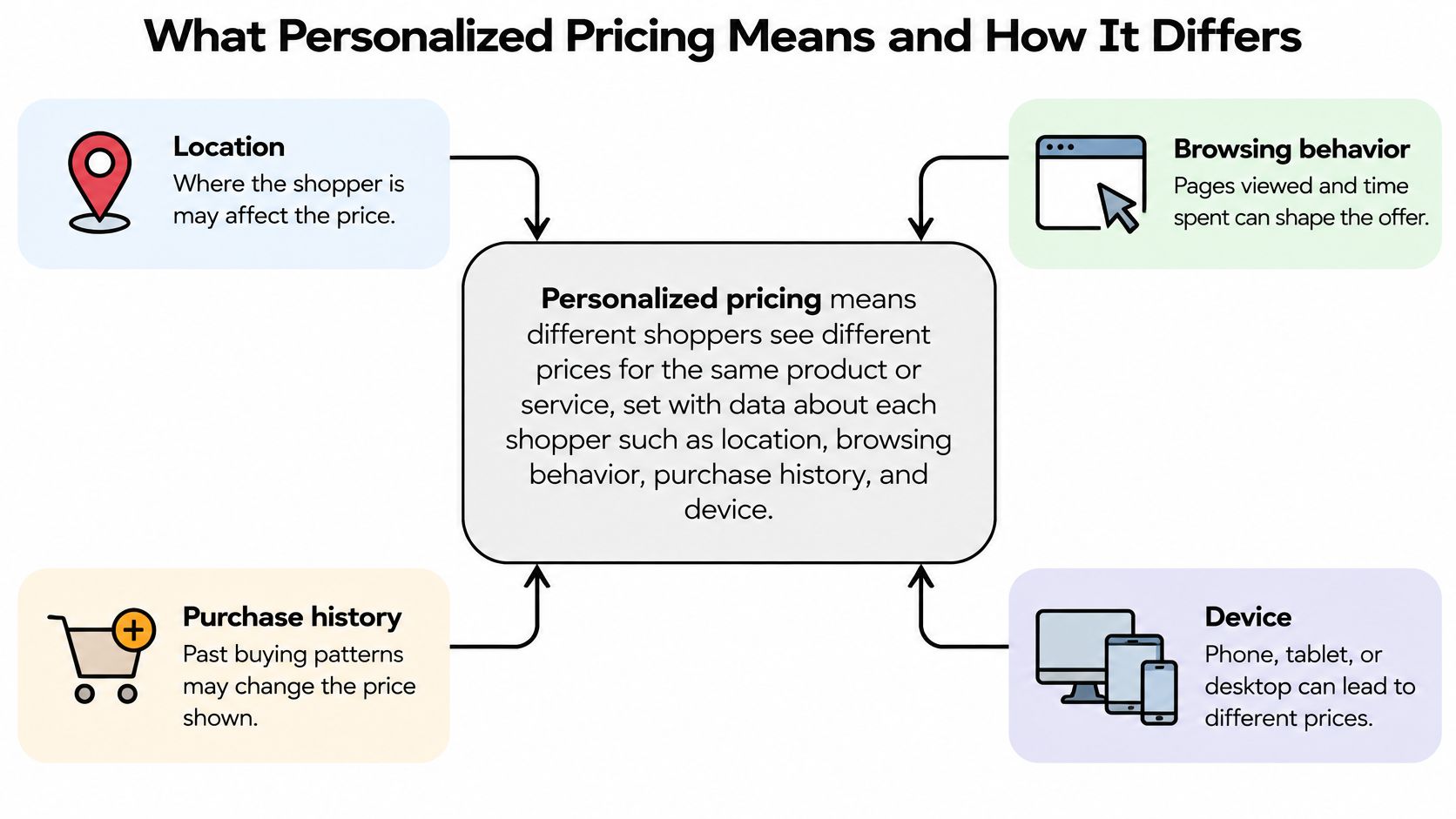
What is personalized pricing in plain terms? A seller shows different consumers different prices for the same product or service, using data such as location, browsing history, previous purchases, demographics, and inferred willingness to pay, as described in a legal analysis of personalized pricing. The price engine reacts to you as well as to demand that day.
A market trader sizes up each customer before naming a price. The shop sign across the street does the opposite, posting one number for everyone who walks past. Online, software can play the trader's role, weighing what it knows about a visitor before the page finishes loading.
The Economic Idea Behind It
Economists call the extreme version first-degree price discrimination, a concept associated with Arthur Cecil Pigou. The idea is that a seller charges each buyer that person's maximum willingness to pay and captures most or all consumer surplus, the value you keep whenever a price sits below your personal limit. For most of retail history a seller could not know each customer's limit, so firms priced to groups instead. Digital commerce changed that because cookies, account histories, device identifiers, and large-scale analytics let firms estimate individual limits at scale.
Sellers describe the same machinery from the other side of the counter, and hostAI's guide to personalized pricing explains these models for businesses that want to run them. A price that shifts after you have already bought is a separate problem, covered in this guide to Amazon price adjustments.
| Model | What sets the price | Uses personal data? | Typical example |
|---|---|---|---|
| Personalized pricing | Your data and inferred willingness to pay | Yes | Two shoppers see different prices for the same item at the same moment |
| Dynamic pricing | Time, stock and demand | Usually no | Airline fares rise as seats sell |
| Personalized discount | Loyalty status or stated preferences | Yes, for a benefit | A member-only coupon that lowers the standard price |
| Geographic pricing | Store location or region | Sometimes | The same product priced differently in two cities |
Practical rule: Ask whether the price depends on who you are, or only on the moment and place.
That single question sorts most cases. A personalized discount lowers a standard price you can still see and compare, so you can judge whether the deal is real. Personalized pricing can move the baseline itself. When sellers vary the price around what they have inferred about you, the practice is often called surveillance pricing, and if the standard price never appears, you cannot tell whether you received a bargain or a markup.
How Retailers Turn Your Data Into an Individual Price
Retailers don't need your name to price around you. They need enough signals to place you in a profile and predict what you'll do next. The pipeline usually runs in a loop, not a straight line.
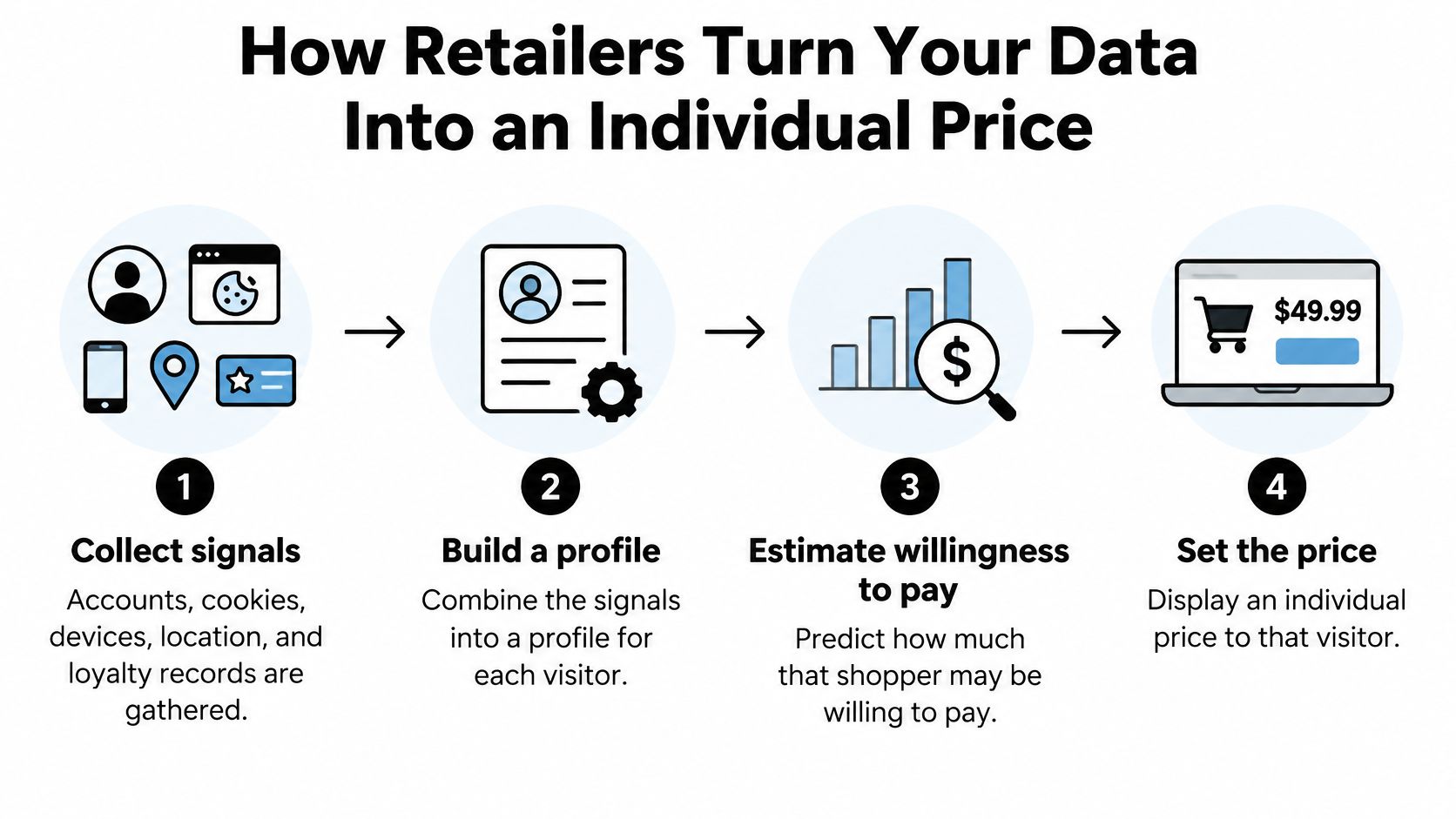
- Collect signals: Accounts, cookies, devices, location, and loyalty records reveal what you've viewed, bought, or left behind.
- Build a profile: Software combines those signals into a picture of each visitor, even across separate visits.
- Estimate willingness to pay: The system predicts whether you'll buy at a given price or need a discount to convert.
- Set the price or offer: You see an individual price, a targeted coupon, or a reordered list of products.
- Test and refresh: Retailers run A/B tests on groups and update profiles as new behavior arrives.
An A/B test matters here because it's often an experiment, not individual pricing. If a retailer randomly shows half of visitors one layout or price to learn what converts, your different price may reflect the test group you're in, not a judgment about you personally.
The short video below shows how those steps connect in practice.
Signals You May Not Notice
The Federal Trade Commission's January 2025 surveillance pricing study reported that companies may use precise location, browser history, demographics, shopping history, mouse movements, and abandoned-cart behavior to set individualized prices. Some of that data also circulates outside retailers, which is why it helps to find your data broker listings and see what's already attached to your name.
| Signal | Example | How it may be used | Usually visible to shopper? |
|---|---|---|---|
| Location | Device location or IP-based city | Shows different prices by area or nearest competitor | Rarely |
| Browsing history | Products or pages viewed repeatedly | Raises the offer for items already viewed | Rarely |
| Cookies and device identifiers | Browser cookies and device IDs | Links sessions so prices follow you across visits | No |
| Purchase and loyalty history | Past orders and member records | Estimates how much you are likely to pay | Sometimes, through loyalty terms |
| Demographics | Age or estimated income | Estimates willingness to pay | No |
| Abandoned carts | Items left unpurchased | Triggers a lower or higher offer | Sometimes |
| Cursor behavior | Mouse movements and hesitation | Gauges how strongly you want an item | No |
The practical point is simple. A price in your browser isn't proof of what another shopper sees for the same product at the same moment.
Where Personalized Pricing Has Been Documented
In 2000, a consumer found that Amazon appeared to show different prices for some DVDs, and deleting browser cookies could produce lower prices. That early case still teaches the right lesson. A shopper changed one signal, the cookie, and the price moved.
In 2012, reporting on Staples and Home Depot found prices or offers could vary by geolocation, estimated income, browsing history, and proximity to competing stores, with some reported differences reaching 166%. Read that carefully. Location-based variation may be geographic pricing rather than fully individualized pricing, even when the gap looks dramatic.
What Larger Studies Found
A European Commission study published in 2018 examined 160 websites across eight European Union member states and four markets, according to the Federal Trade Commission's surveillance pricing overview. It found prominent personalization in the ranking or presentation of offers, but no consistent and systematic personalized pricing, with observed price variations generally small.
Travel looked different. Hotel-booking websites and airlines displayed the most evidence of price personalization, and one factor was whether a consumer arrived through a price-comparison website or directly from the trader. Earlier academic research also found evidence of personalization on four general-retail websites and five travel websites among 16 sites surveyed.
A different price is a clue to investigate, not proof that a retailer priced against you personally.
So the evidence supports a narrow conclusion. Personalized pricing has been observed in online retail and travel, and ranking personalization is common. Widespread, systematic use across all shopping has historically been harder to establish, and regulators are still assessing scale, data inputs, and consumer effects.
Is Personalized Pricing Fair to Shoppers
Two shoppers add the same jacket to the same cart on the same evening, and one of them sees a lower total. Whether that feels acceptable depends entirely on why. A student discount posted for anyone to claim reads very differently from a price adjusted upward because the site decided you would probably pay it.
That gap is worth keeping straight. Personalized discounts lower a standard price in ways shoppers can see and qualify for, while surveillance-style pricing can vary the price itself based on a profile you never got to review. The first invites you in. The second happens to you. Survey evidence suggests shoppers notice the difference and judge the process, not just the amount on the tag.
| Study | Sample | Main finding |
|---|---|---|
| Gartner survey, 2025 | 303 U.S. consumers | 68% said dynamic pricing made them feel taken advantage of |
| Gartner survey, 2025 | 303 U.S. consumers | 80% trust brands with consistent pricing more; 42% would pay more for a price that will not change |
| French online pricing study, 2025 | 903 French web users | Most saw online dynamic pricing as unethical, driven by discrimination, disrespect and opacity |
| Telecom purchase journey study, 2025 | 22 participants | A price reduction offered mid-purchase still drew suspicion, with participants treating the change as evidence the first price was not genuine |
In a 2025 Gartner survey of 303 U.S. consumers, 68% said dynamic pricing made them feel taken advantage of, 80% considered brands with consistent pricing more trustworthy, and 42% would pay more if they knew a price would not change, as reported in Consumer Goods Technology's Gartner coverage. Those reactions concern dynamic pricing broadly rather than personalized pricing alone, but they show that stability itself carries real value to buyers.
When Individual Prices Could Help
The counterintuitive case deserves a fair hearing. A 2025 ACM study of negotiated individualized pricing reported that, under its fairness objective, negotiated individualized prices reduced mean net cost by as much as 66% for individuals and 69% for groups when price dispersion was high. In plain terms, a system designed to negotiate downward and limit extreme gaps could leave shoppers better off on average than everyone stuck at one high uniform price.
Averages do not settle the question. Fairness research suggests the process carries its own verdict: an individualized price can still feel wrong to shoppers even when it lowers their bill, because they cannot see the rule that produced it. A 2025 empirical study of 903 French web users found consumers generally perceived online dynamic pricing as unethical, with perceived discrimination, disrespect, and opacity driving that judgment.
Ethical modeling points the same way. Personalized pricing can look beneficial under some welfare assumptions, but worse than uniform pricing when equality and surveillance aversion receive greater weight. The verdict depends on the fairness standard you choose before you look at the result.
Before trusting any individualized-price system, check for the safeguards below. Transparent price ranges are a start, and so are the plain written terms you would expect from a retailer commitment like the Best Buy price match policy.
- Meaningful opt-outs: You can decline personalized pricing without losing basic access.
- Limits on sensitive data: Health, precise location, and proxy data stay out of pricing.
- Plain explanations: The retailer names the main factors that set your price.
- Independent testing: Someone outside the company checks for disparate effects.
Privacy and Legal Limits on Individual Pricing
In July 2024, the Federal Trade Commission ordered intermediary companies to provide information about surveillance-pricing technologies that use personal data to categorize consumers and set individualized prices. Its January 2025 study then listed data types firms may use, including precise location, browser history, demographics, shopping history, mouse movements, and abandoned-cart behavior. Regulators are mapping the ecosystem first, because the company showing you a price may not be the company that built your profile.
What the Law Does and Doesn't Do
In the European Union, privacy law including the GDPR requires a lawful basis for processing personal data, transparency about that processing, and rights of access and objection. If you're in scope, you can ask what data a company holds and object to certain uses. That doesn't automatically give you the other shopper's price, but it can reveal whether your data fed the decision.
U.S. state privacy laws differ. Some give residents rights to opt out of certain data uses, including targeted advertising or profiling in some contexts, while others don't. Check your state's current rights rather than assuming a national rule exists.
Remember this distinction: A price difference isn't automatically unlawful, and a price difference alone doesn't prove discrimination.
Coupons, loyalty benefits, student discounts, regional costs, and stock-based changes can all produce different prices lawfully. The legal concern grows when a retailer hides material facts, uses data in ways privacy law doesn't permit, or produces unjustified disparate effects on protected groups. Legal commentary describes a shift from disclosure requirements toward prohibitions on certain uses in some places, so rules are still changing. Check current law in your region before you rely on any specific right.
Test Personalized Pricing Yourself and Act on Results
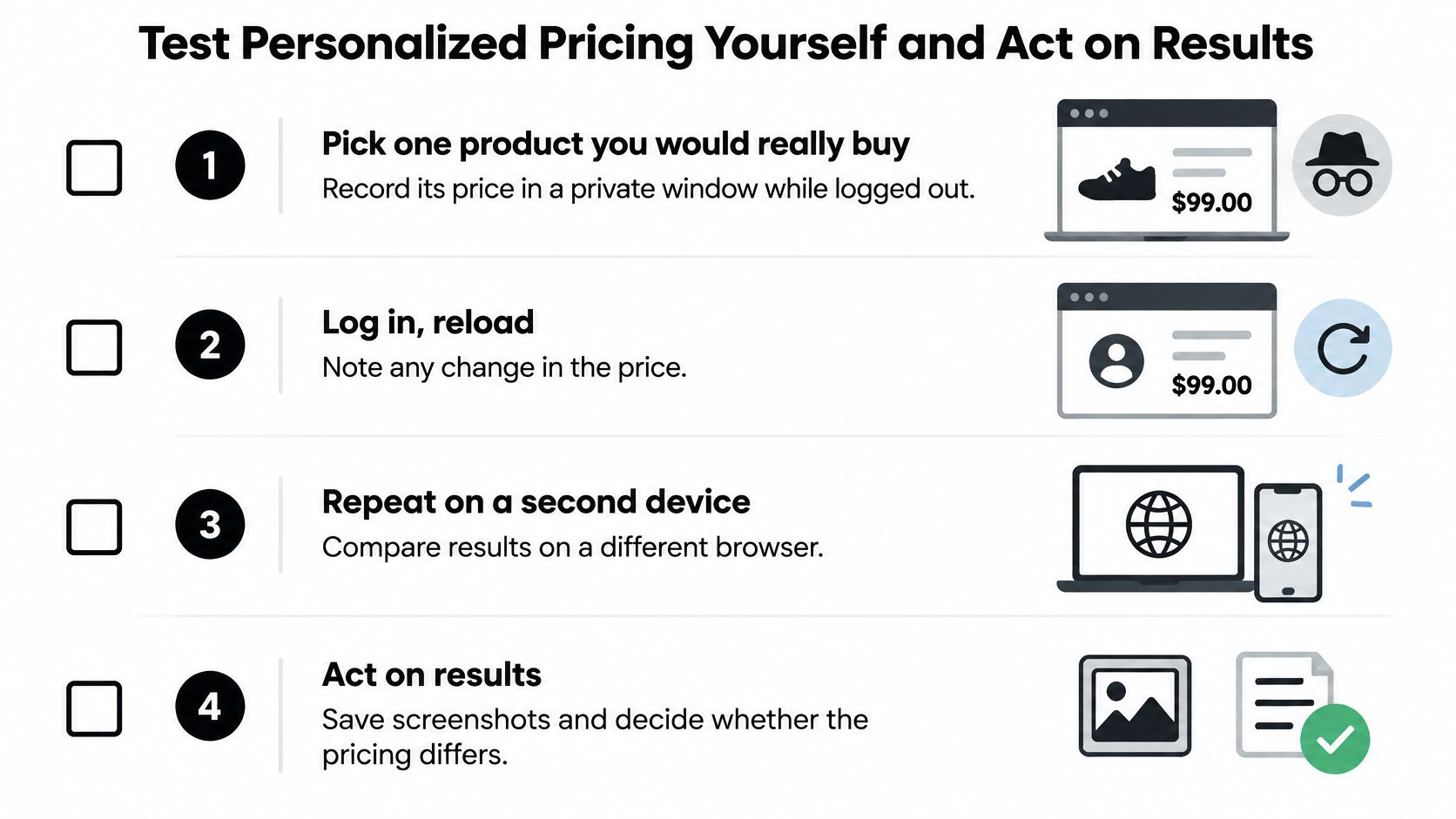
You don't need special software to run a useful audit. You need one product, a few controlled comparisons, and dated records. Change one variable at a time, or you won't know what moved the price.
Run the Nine Step Audit
- Pick one real product: Choose something you'd buy and record its price in a private window while logged out, including shipping and tax.
- Log in and reload: Note any change, because your account adds purchase and loyalty history.
- Switch device and browser: Repeat on your phone and a different browser profile to test device and cookie effects.
- Change location: Set a different delivery postcode or nearest store and compare again.
- Read loyalty terms: A member price may be a personalized discount off a standard price, which is a benefit, not a hidden markup.
- Save dated screenshots: Capture price, shipping, tax, date, and time for each version.
- Repeat over three days: Check at different times, because stock and promotions also move prices.
- Watch after purchase: If the price drops, claim the store's adjustment policy if one applies.
- Email the seller: Ask which factors set your price and whether you can opt out, and keep the reply.
Read What You Found
One difference is evidence to investigate, not proof. If the higher price only appears during busy periods for everyone, that's likely dynamic pricing. If it follows your logged-in identity across days while logged-out prices stay lower, ask for a written explanation.
Then act on the branch you're in. If it's a lower promotion, buy at that price and keep the screenshot. If the gap follows your identity, use any opt-out your law gives you, compare at another retailer, or leave the purchase. Keep receipts and screenshots, because price adjustment policies usually require proof of what you paid and when.
A price-tracking tool can log prices over time and flag drops, which saves you repeating step seven by hand. It has limits you should know. Compass+ is read-only and cannot move money, make payments, open or close accounts, or cancel a subscription with a merchant, so you still take the action yourself. Our free private audit estimates subscriptions, duplicate charges, missing refunds, fees, renewals, and bill increases worth investigating. After connecting a bank, users can see what Compass+ found for 7 days without paying.
Say you're buying a laptop. Logged out, it's one price. Logged in after weeks of research, it's higher, while your phone in a private window still shows the lower figure. That pattern is worth one email to the seller and one check at a rival store before you pay.
Run this test on one high-value item before your next checkout. This is information, not financial, tax or legal advice.
Before your next big checkout, run the audit above, then let Compass+ watch what happens after you pay, including price drops, duplicate charges, missing refunds, and renewals you'd otherwise miss. Connect your accounts, review each finding with its estimated amount and next step, and act only on the ones that make sense for you.