Price Drop Refund Guide: How to Claim What You're Owed
Learn how to detect, document, and claim a price drop refund after online purchases. Step-by-step guide with templates, timelines, and policy tips.
15 min read
You open a sale email and recognize the jacket you bought last week. Same photo, lower price. Your first instinct is to shrug, because chasing customer service sounds harder than accepting that you bought at the wrong time.
Don't dismiss it yet. A price drop refund may be available, but the sale email isn't proof that you're owed money. The useful question is whether that particular offer qualifies under the policy attached to your purchase.
Table of Contents
- Why Most Shoppers Miss the Price Drop Refund Sitting in Their Inbox
- The Claimability Framework for a Price Drop Refund
- Retailer Policy Reality Check and Recent Changes
- Building Your Evidence Bundle Before the Price Disappears
- Why Faster Detection Does Not Always Mean More Savings
- Templates and Escalation Paths That Actually Work
- Putting It Together and What to Watch Next
Why Most Shoppers Miss the Price Drop Refund Sitting in Their Inbox
The hesitation makes sense. You don't want to spend your lunch break arguing over a discount, especially when you can't tell whether the retailer will honor it. But ignoring the email before checking the rules means abandoning a potentially straightforward request.
Consider the example in Consumers' Checkbook's price-matching review: an identical item purchased for $100 drops to $85, creating a potential $15 adjustment, while most adjustment periods fall between 7 and 30 days. The difference is easy to calculate. Whether you can collect it depends on the merchant's conditions.
That word potential matters. Don't treat a sale notification as a refund confirmation, and don't assume the retailer will contact you first.
Why an obvious saving doesn't become a claim
Shoppers can get stuck at different points:
- Unclear eligibility: The retailer advertises a price-match guarantee, but you can't tell whether it applies after checkout.
- Missing context: The sale email doesn't establish that the cheaper listing has the same seller, variant, or purchase conditions.
- Expected hassle: You anticipate a long conversation, so you never assemble the documents that could make the request simple.
My recommendation is to separate the quick eligibility check from the decision to pursue the claim. First establish whether the policy covers your order. Then decide whether the likely recovery justifies the effort.
Furniture guarantees illustrate why reading the actual promise matters. If you're comparing store policies, Vinson Fine Furniture's 110% refund policy for furniture is a useful policy page to examine, not a reason to assume every furniture purchase receives the same protection. Check the covered comparison, required evidence, and deadline before relying on the headline.
Practical rule: A lower price deserves a policy check, not an automatic celebration.
Use ongoing monitoring when you have eligible purchases, rather than checking once and forgetting them. Set a reminder or use an order-monitoring tool, but don't let an alert substitute for a decision. The alert should tell you what changed; your claim needs to establish why the retailer's promise applies.
The Claimability Framework for a Price Drop Refund
Claimability means the lower price satisfies the rules governing your original transaction. That's a more demanding test than finding a cheaper product with a similar photo.
Use this flow to organize the process from detection through follow-up.
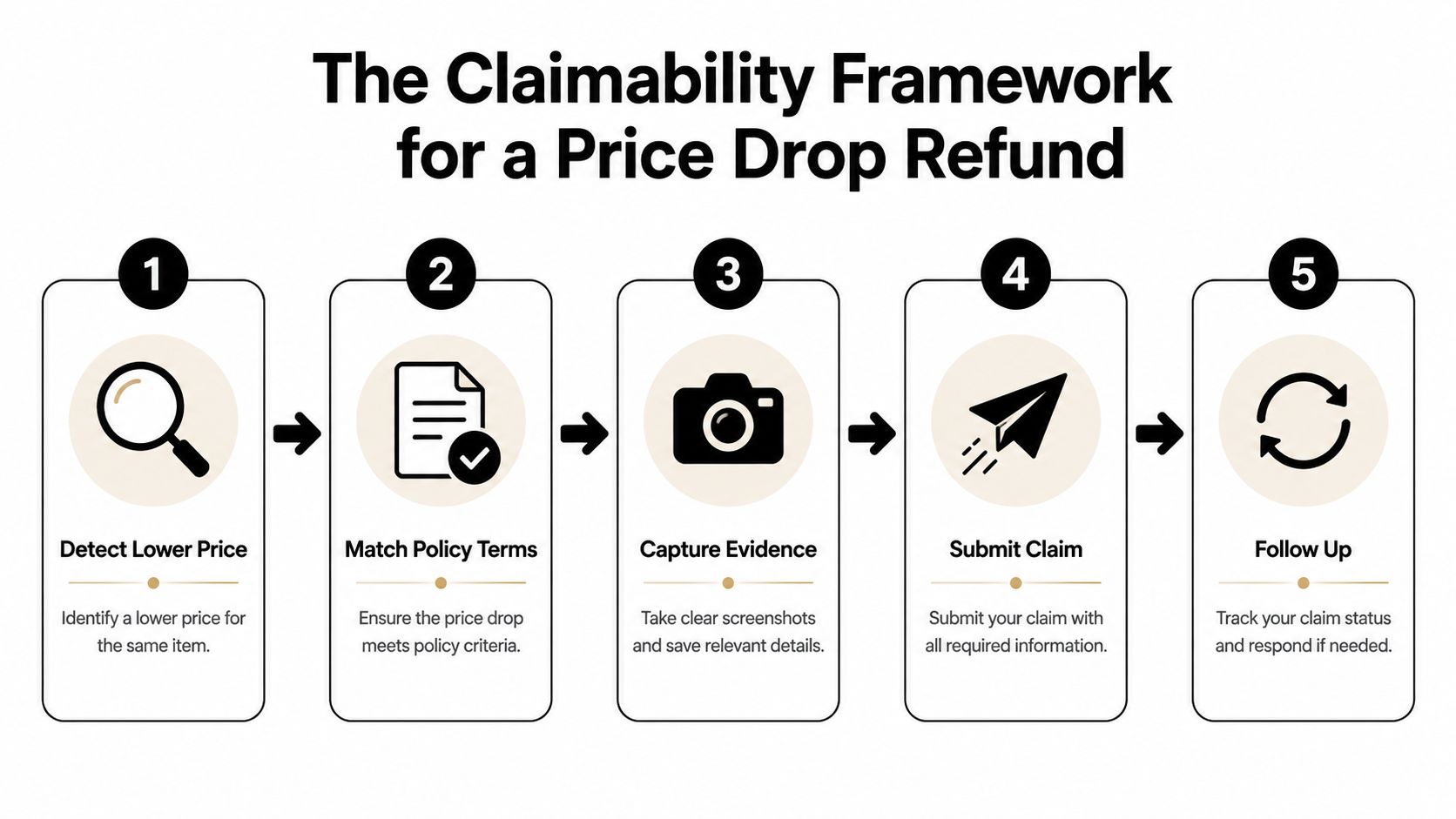
Establish the transaction before calculating the saving
Start with the original order record. Preserve the merchant, SKU or UPC, model, size, color, quantity, purchase timestamp, fulfillment channel, item price, and discounts, with tax and shipping recorded separately. Then compare the new offer against that record, not against your memory of what you bought.
LegalClarity's explanation of price-adjustment eligibility describes matching requirements, evidence, deadlines, and submission rules, and explains that these policies are discretionary rather than generally mandated by U.S. federal law. That distinction should shape your request: you're asking the merchant to apply its policy, not asserting an unconditional right to every later discount.
Use this checklist:
- Preserve the purchase. Keep the original receipt and order details before editing, returning, or replacing anything.
- Verify product identity. Compare the actual model and variant. A jacket in another size or color isn't automatically a qualifying comparison.
- Calculate the eligible difference. Use the merchant's definition of the item price. Don't automatically count shipping, tax, loyalty rewards, or bundle savings.
- Test the deadline and exclusions. Confirm which event starts the clock and whether the cheaper offer is permitted.
- Submit through the required channel. Attach the evidence and ask for confirmation of the amount and remedy.
Read the promise, not just its name
A guarantee labeled “price match” may address the price before purchase rather than an adjustment afterward. Likewise, clearance and marketplace offers may look comparable while failing the policy test.
For a furniture purchase, Lucas Furniture & Mattress lets you browse their price promise. Read it for the qualifying comparison and request procedure instead of assuming that “low price” means unrestricted post-purchase protection.
For electronics, the Best Buy price-match policy guide provides a retailer-specific starting point. Still check the merchant's applicable terms before submitting your order.
Use the accompanying video alongside your written checklist.
Your final decision should be explicit: qualifies, doesn't qualify, or needs clarification. If you can't identify the rule supporting the request, ask about that rule before describing the saving as money owed.
Retailer Policy Reality Check and Recent Changes
Don't rely on the price-protection policy you remember from an old purchase. Retailers have changed these programs, sometimes removing the comparison that would once have supported your claim.
Modern Retail's history of declining price matching records Amazon ending general post-purchase adjustments in 2016, with a television exception at that time, Walmart ending competitor matching at registers in 2017 and Savings Catcher two years later, and Target introducing its policy in 2013. Those are historical milestones, not assurances that an old exception survives today.
The more recent Consumers' Checkbook review of roughly 100 retailers reports Target ending competitor matching against Amazon and Walmart in July 2025, while retaining a 14-day adjustment for qualifying lower prices through Target's own channels. The same review identifies common exclusions involving clearance, coupons, bundles, membership-only prices, warehouse clubs, and third-party marketplace sellers.
Major Retailer Price-Adjustment Windows and Exclusions
| Retailer | Adjustment Window | Key Exclusions |
|---|---|---|
| Amazon | No broad general post-purchase window in the cited reviews | Don't assume a historic category exception remains available |
| Walmart | No broad general post-purchase window in the cited reviews | Former competitor-matching programs aren't a current claim route |
| Target | Limited window described in the review above | Competitor offers aren't covered by the narrowed policy |
| Other retailers | Merchant-specific, verify before filing | Promotional prices and marketplace sellers may be excluded |
Treat this comparison as a screening tool. The merchant's applicable policy still determines your order's eligibility.
The seller matters as much as the storefront
A product appearing on a familiar retail website doesn't settle who sold it. Check the order's seller and fulfillment details before comparing prices across listings.
The Amazon price-adjustment guide is useful for separating a potential adjustment from the assumption that every Amazon price decline creates a refund. If no policy covers the drop, don't spend an afternoon trying to revive a discontinued program.
Ask the retailer to identify the qualifying channel and remedy. A refund to your payment method, store credit, and a refusal under an exclusion are different outcomes. You should know which one you're pursuing before calculating the value of the claim.
Old goodwill practices aren't enforceable promises for a new order. Save the applicable policy and build your case around that wording.
Building Your Evidence Bundle Before the Price Disappears
“I saw it cheaper” is a weak customer-service request. “This receipt and qualifying offer establish the difference” gives the agent something concrete to review.
Build the purchase folder when you order, then add the lower-price evidence when you detect it. Don't wait until you're composing the complaint to reconstruct what the listing showed.
Use this checklist to keep the documents together.
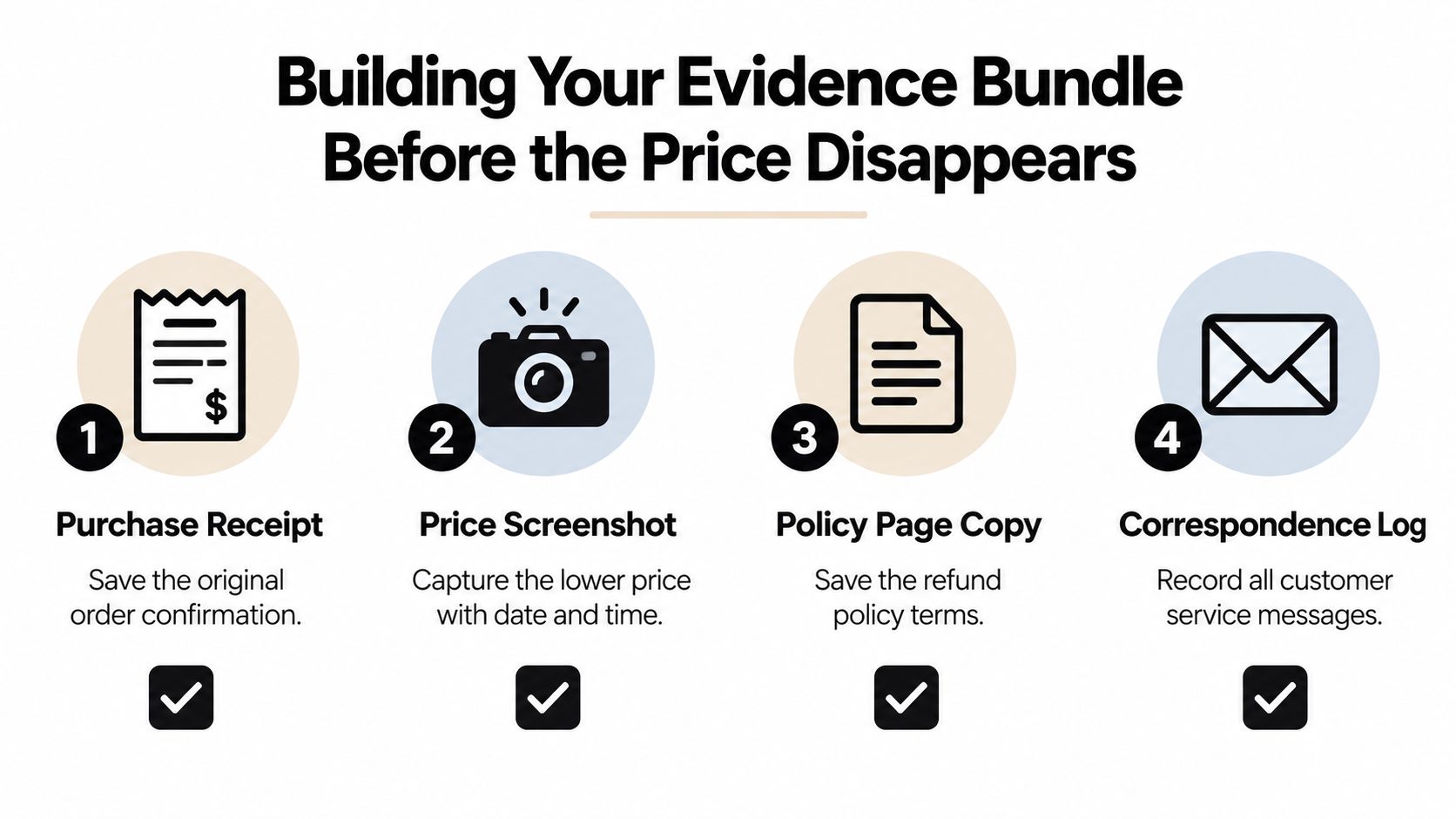
Capture enough context to resolve a dispute
Your receipt establishes the transaction. Your price capture should establish the competing offer, including its URL, seller, product details, availability, and capture time.
Keep the policy copy and correspondence alongside those records:
- Purchase documents: Save the order confirmation and receipt in their original form.
- Lower-price evidence: Capture the listing while the offer is visible, including restrictions rather than cropping them out.
- Policy wording: Preserve the relevant terms so you can point to the exact provision you're relying on.
- Conversation history: Save submitted forms, chat transcripts, emails, and case references.
- Payment record: Keep the matching card transaction available if you investigate a card-benefit claim.
A screenshot is useful documentation, but don't assume it's the only accepted proof. Check whether the merchant or benefits administrator requires a live advertisement, particular document format, or submission through its own form.
Coordinate retailer and card remedies
Chase's guide to credit-card price protection describes documentation such as proof of purchase, a card statement, and evidence of the lower advertised price, with claim periods often ranging from 30 to 90 days and exclusions that may include auctions, liquidation, and going-out-of-business sales. Confirm that your specific card includes the benefit before relying on it.
Stacking remedies means coordinating them, not collecting the same loss twice. Check the card's rules on retailer reimbursements and disclose any refund or store credit you've received.
Before accepting store credit: Ask the card-benefit administrator whether that remedy reduces or prevents a price-protection payment.
If the retailer process is still pending, ask how to preserve the card deadline without misrepresenting the unresolved claim. Submit required documents on time and update the administrator when the retailer decides.
One evidence bundle can support both routes. The eligibility decisions remain separate, and you shouldn't assume that rejection by the retailer guarantees approval by the card provider.
Why Faster Detection Does Not Always Mean More Savings
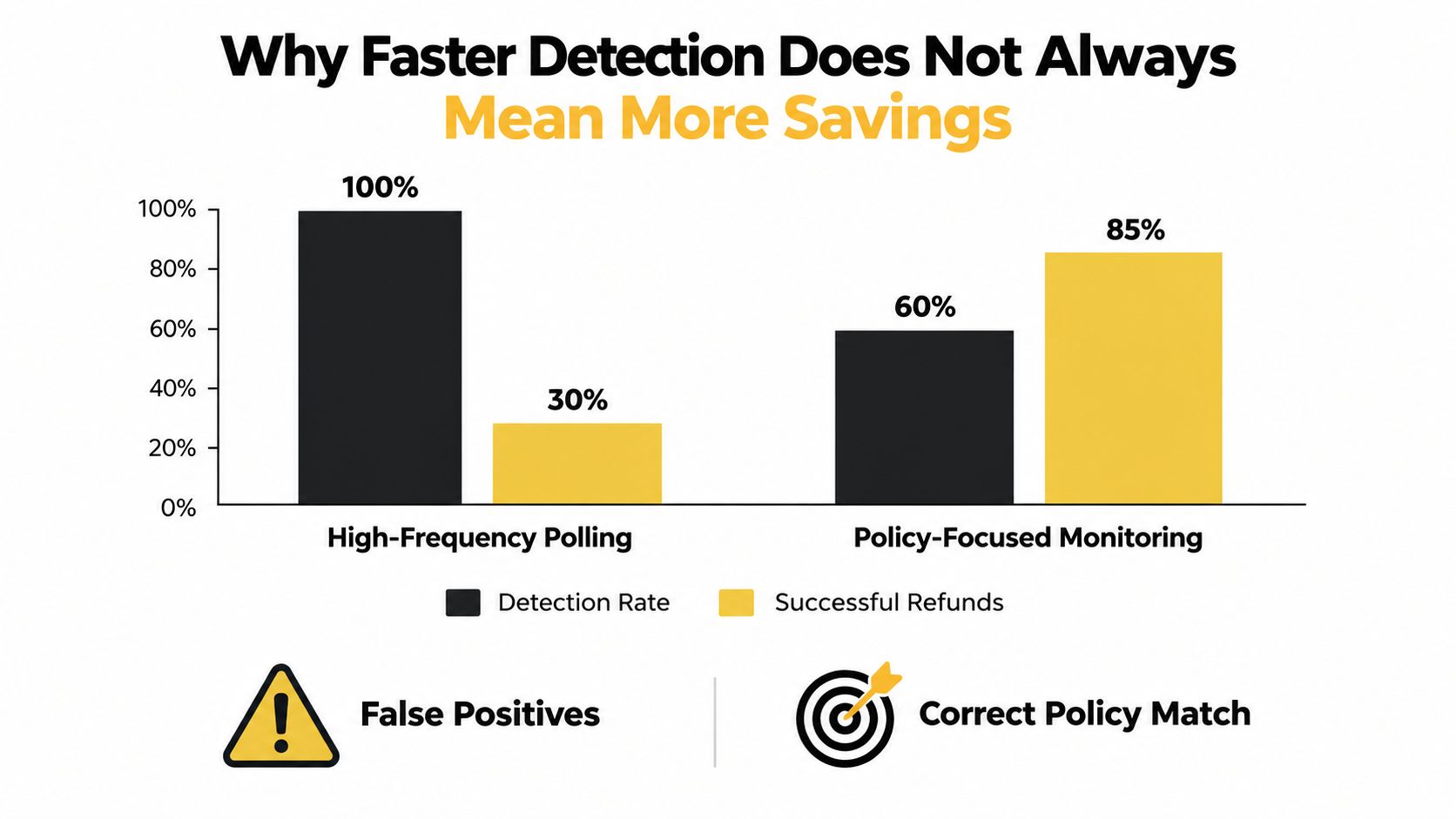
A monitoring tool that notices every dip can still send you useless alerts. If the cheaper offer fails the seller, variant, promotion, or deadline test, detecting it sooner doesn't make it refundable.
I recommend policy-focused monitoring over indiscriminate notifications. Speed matters when an eligible offer is short-lived. It doesn't compensate for comparing the wrong products.
The following visual illustrates that distinction. Its depicted rates are illustrative, not verified performance measurements, and shouldn't be used to predict refund success.
Rank by recoverable value
Use a practical decision rule:
Expected value = eligible price difference × estimated eligibility probability − your action cost.
This is a prioritization method, not a guaranteed forecast. If you don't have reliable eligibility probabilities, use plain-language labels such as confirmed, uncertain, and excluded rather than inventing precise confidence scores.
Consider your own effort too. A documented adjustment that can be submitted through the required form deserves attention. A speculative comparison requiring repeated calls may not.
Good alerts should answer concrete questions:
- What changed? Identify the product, seller, and offer conditions.
- Why might it qualify? Name the applicable policy provision.
- What remains uncertain? Flag ambiguous promotion or fulfillment details.
- What should you do? Provide the deadline, evidence needed, and submission route.
Suppress repeat alerts for the same unchanged offer. Once you've filed, another notification about that price should update the existing case rather than prompt a duplicate request.
Treat dramatic drops as a reason to inspect
Research on post-purchase discounts and product returns, using more than 84 million purchases and 37 million returns, found that discounts above 25% were associated with nonlinear increases in returns, with effects varying by category. That association doesn't establish that a large discount is a listing error or that returning the product is your best response.
My recommendation is narrower: inspect unusually large drops carefully. Check whether the listing is used, refurbished, membership-restricted, or otherwise different from your purchase before treating it as recoverable money.
Don't turn a price-adjustment request into a return-and-repurchase exercise without checking the separate costs and conditions. The advertised discount isn't your net saving if the workaround adds fees, delays, or unwanted store credit.
Templates and Escalation Paths That Actually Work
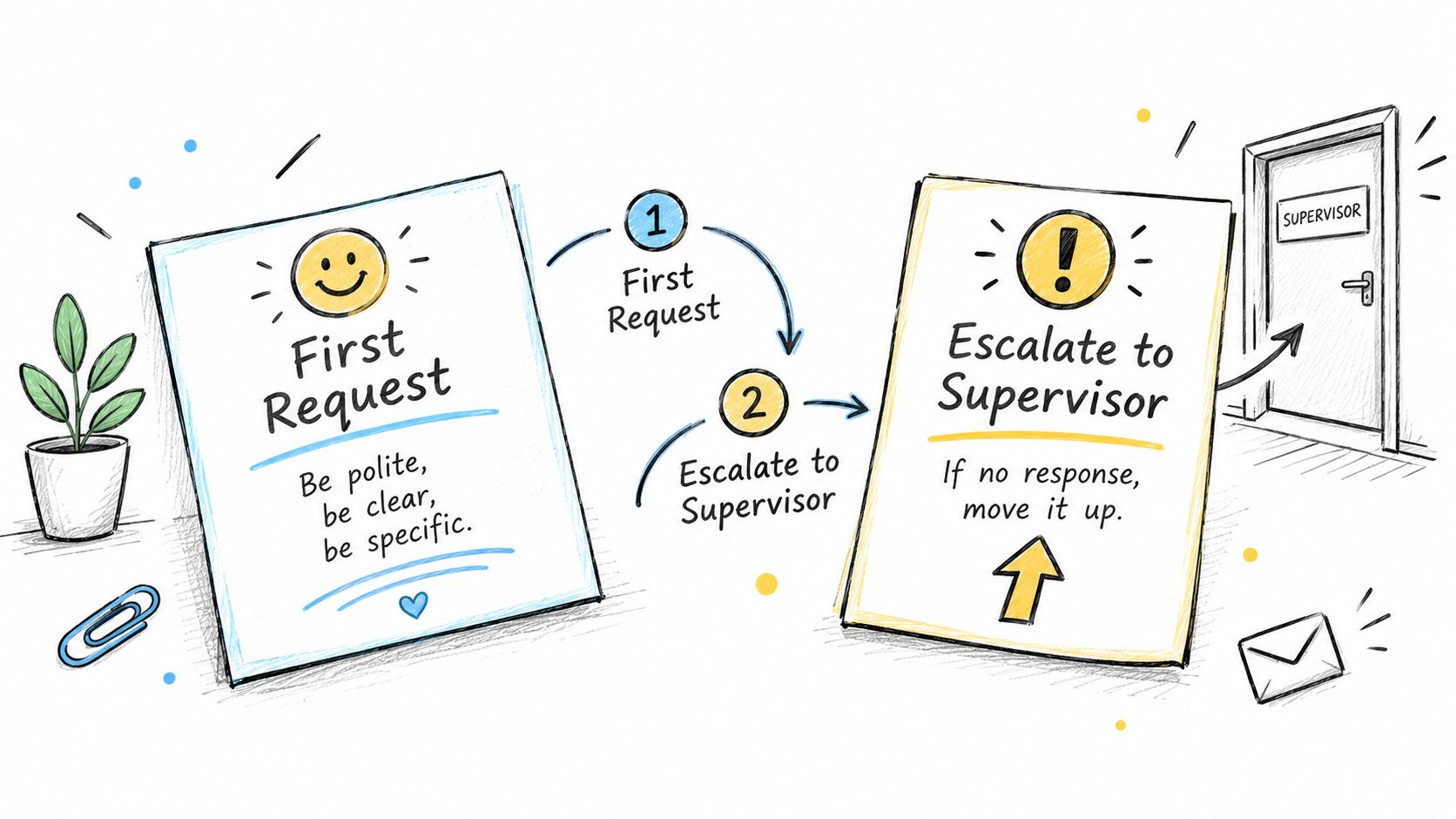
Start with a request the agent can approve without guessing what you mean. Identify the transaction, the qualifying offer, and the policy, then state the remedy you're requesting.
Use the merchant's required channel first. If several channels are permitted, I prefer written chat or email for the record; use phone support when necessary, and keep notes and a case reference.
First request
Copy and adapt this message:
Hello, I'm requesting a post-purchase price adjustment for order [order reference], purchased on [purchase date]. The identical [product and variant] is now listed at [lower price] through [qualifying seller or channel]. I've attached my receipt, the offer evidence, and the relevant policy wording. Please confirm whether this qualifies and, if approved, the adjustment amount and refund method.
Keep the tone neutral. You're requesting application of a policy, not asking the agent to defend the retailer's pricing strategy.
Escalation request
If the answer appears inconsistent with the terms, use this:
Thank you for reviewing my request. Please identify the specific policy clause supporting the denial. My evidence shows [relevant qualifying condition], and the request was submitted on [submission date]. If this requires further review, please forward it through your supervisor or formal complaint process and provide a written decision.
The escalation sequence should stay focused on the unresolved policy question.
Fix an error or accept the exclusion
Match the response to the rejection:
- Wrong product identifier: Supply the matching SKU or model evidence.
- Excluded seller: Find a permitted comparison or stop pursuing that offer.
- Different variant: Establish identity with product details; don't argue from the photo.
- Missed deadline: Check an alternative card benefit rather than insisting the merchant extend its policy.
- Ambiguous wording: Ask for review of the specific clause, not a generic reconsideration.
Escalate when the retailer misapplies its terms. Don't keep escalating a plainly excluded claim just because another agent might offer goodwill.
If you receive approval, save the amount, payment method, and expected processing information. Your job isn't finished when an agent says yes; it's finished when the promised adjustment arrives.
Putting It Together and What to Watch Next
Treat eligible purchases as records you can act on, not isolated receipts you might remember later. Save the transaction, establish the applicable policy, monitor during the qualifying period, preserve an actionable offer, and track the result.
You can manage that process manually with receipt folders and reminders or use a connected-account monitoring service. Either way, keep the distinction between an opportunity detected and a claim approved visible.
Edge cases deserve a deliberate check
Before filing, inspect the parts of the order that are easy to overlook:
- Marketplace purchases: Identify the actual seller instead of assuming the website operator's policy covers the transaction.
- Promotional purchases: Use the eligible price you paid, not a crossed-out regular price.
- Fulfillment timing: Verify the policy's stated starting event rather than guessing whether purchase, shipment, or delivery controls.
Watch for policy revisions and changes to your card benefits. The retailer history discussed earlier gives you a good reason to verify terms, but it doesn't prove what merchants will change next.
Once approved, use the guide to tracking a refund to keep the promise and payment connected. An approval message shouldn't disappear into the same inbox that hid the original opportunity.
The useful habit is simple: preserve enough information to make the decision quickly. A price drop refund is an administrative proof problem with a short shelf life. A repeatable process is more dependable than remembering to check a product page.
Compass+ monitors connected accounts for post-purchase price drops and other potential savings, pairing findings with estimated amounts and concrete next steps. Visit to join the standalone experience's waitlist and explore how monitoring can help you spot an adjustment opportunity before its deadline.