How to Ask for a Price Reduction That Actually Works
Learn how to ask for a price reduction with proven scripts, timing tips, and evidence-backed tactics. Covers pre-purchase, price-match, and post-purchase drops.
16 min read
You bought it last Tuesday, and now it's cheaper. That sting is familiar, and so is the hesitation that follows. Is it worth calling, getting bounced around chat, and begging for a small refund?
Stop thinking of it as begging. Learn how to ask for a price reduction as a triage problem. Pick the right remedy, bring the right evidence, say one short script, and you're done. That's the difference between shoppers who recover money and shoppers who just complain about the price drop.
Table of Contents
- The Moment You Notice a Better Price After Paying
- What the Research Actually Says About Asking
- Before You Pay Building the Ask That Lands
- The Policy First Decision Tree
- After You Buy The Post Purchase Workflow
- Timing Evidence and When to Move On
- Letting Compass+ Watch the Price So You Don't Have To
The Moment You Notice a Better Price After Paying
You see the same jacket, appliance, or laptop listed for less than you paid. Your first instinct is usually wrong. Shoppers either fire off an annoyed message asking for “a discount” or do nothing because they assume the posted price was final once the card went through.
Neither approach works well. A vague complaint gives the agent nothing to approve. Silence leaves money with the retailer even when a policy already allows an adjustment. What works is a specific, evidence based request made before the window closes.
Two Different Asks, Two Different Playbooks
Asking before you pay is a negotiation. You're trying to move a seller who still wants the sale. You need a competing price, a reason to say yes, and a number you can accept today.
Asking after you pay is mostly a policy claim. You're not charming anyone into a new price. You're checking whether you qualify for a post purchase price adjustment, a price match, a return and repurchase, or a goodwill credit, then filing that claim cleanly.
Confusing those two situations wastes time. People haggle with a chat agent who only has a policy button to press. Others cite a policy to a salesperson who had discretion to discount before checkout. Match the ask to the moment.
Don't start with “Can I get a discount?” Start by deciding which remedy you're actually entitled to request.
What You'll Walk Away Able To Do
You'll be able to make one precise offer at the counter without revealing your maximum budget. You'll know how to calculate the net difference after shipping, coupons, taxes, and return costs so you don't chase a drop that disappears once fees are counted.
You'll know when to stop. A tiny drop that needs a long phone call isn't a win. A larger drop inside a short adjustment window is worth acting on today, not next week.
If you've only got five minutes, jump straight to the decision tree and the post purchase workflow. That's where most readers recover money fastest, because the purchase is already made and the clock is already running.
What the Research Actually Says About Asking
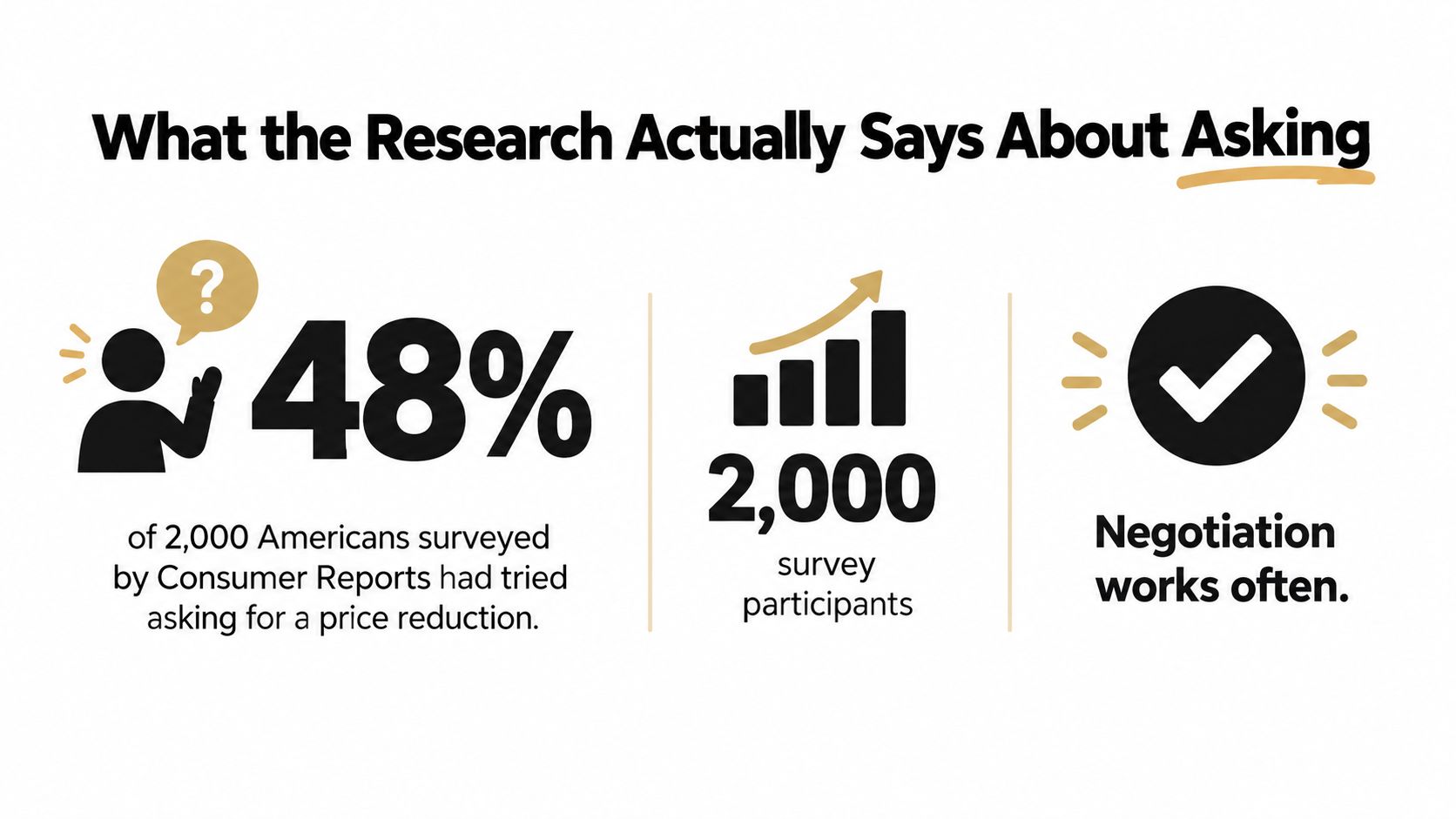
Asking works far more often than most shoppers expect. In a nationally representative Consumer Reports survey of 2,000 Americans, 48% had tried bargaining for everyday goods and services during the previous three years, and 89% of those who negotiated reported saving money. Participation had fallen from 61% in earlier research to that 48% level, which tells you the main problem isn't failure. It's not asking at all.
Earlier Consumer Reports research in that same source found success above 75% for hotels, mobile phone plans, clothing, jewelry, and appliances, while medical bill negotiations succeeded about 58% of the time. Don't treat those as guarantees. Treat them as a filter. Sellers with discretion, recurring plans, and durable goods are better targets than rigid, fixed price transactions.
Information Beats Confidence
Your advantage comes from what you know, not how firm you sound. In research on U.S. automobile negotiations in an industry worth approximately $340 billion, a consumer with basic information about the seller's reservation price and outside options captured 15% of the average dealer margin relative to an uninformed buyer.
The same source describes an electricity market field experiment where retailers offered a nonzero discount in 93% of negotiations. Calling only for a quote produced an average discount of 1.5%, or $13.24, while negotiating during the call increased it to 4.0%, or $39.83, a difference significant at the 1% level.
Read that carefully. The quote isn't the end. It's the starting point for the actual ask.
The Three Rules Worth Repeating
- Do your homework first: Check comparable retailers, current promotions, and the seller's own adjustment policy before you contact anyone.
- Name one specific number: A vague request lets the seller offer the smallest possible concession.
- Negotiate, don't just ask for a quote: Get the best stated price, then explicitly ask for a better one with your evidence attached.
Follow those rules and you're not relying on charm. You're giving the other side a documented reason to move.
Before You Pay Building the Ask That Lands
Pre purchase is where you have the most power, because you can still walk away. Don't waste it by asking, “What's your best price?” and accepting whatever comes back. Build the ask in four steps and deliver it in under a minute.
Step One and Two Establish the Price and Anchor It
1. Establish the objective market price. Check comparable retailers, recent promotions, and the seller's published adjustment or refund policy. You need a real benchmark you can show, not a guess.
2. Make one specific, evidence based offer. Research summarized in an experimental study on first offers and best price requests notes that a meta study of 16 papers reported a correlation of nearly 0.5 between the first offer and the eventual outcome. Precise first offers also anchor more strongly than round numbers.
Use this script:
“I found the same item at $X, and I can complete the purchase today at $Y. Can you match that or offer the closest adjustment?”
Don't invent the comparison price. A fake or implausibly aggressive anchor destroys trust and makes an impasse more likely. If you can't document it, don't claim it.
Step Three and Four Justify It and Give a Fallback
3. Justify your number with a low cost rationale. A documented competitor price works. So does a visible defect, delayed delivery, repeat business, or your willingness to buy immediately. You're making it easy for the seller to explain the concession internally.
For a large appliance, show the competitor listing on your phone and offer to pay today. For internet service, reference the current new subscriber promotion or a competing plan and ask for a loyalty credit or equipment change instead of threatening to cancel in your first sentence.
4. Define a fallback the seller can give. Say, "If you can't hit that price, could you waive delivery or installation, or include store credit for the difference?" That face saving option often saves a deal that a cash only demand would kill.
Two Mistakes That Kill Your Leverage
Don't reveal your maximum budget early. Once the seller knows your ceiling, you've told them exactly where to stop conceding. Let your specific offer do the talking.
Don't negotiate after you've accepted a nonrefundable term. At that point you've surrendered the walk away power that made the seller listen. Ask before you sign, before you pay, and before you agree that the sale is final. If the answer is no and the fallback isn't worth it, thank them and leave. A polite exit preserves the option to buy elsewhere at the price you documented.
The Policy First Decision Tree
After checkout, stop negotiating like you're at a market stall. Your first job is classification. Which of five remedies fits your situation?
A 2025 review of roughly 100 major retailers found post purchase adjustment windows commonly range from 7 to 30 days, with restrictions and eligible competitors varying widely. That review also notes post purchase adjustments are often easier than price matching and may be available through chat or phone. Specific retailer examples in the verified research include Target generally allowing a 14-day adjustment and Best Buy commonly allowing 15 days with exclusions.
The Five Remedies in Order
- Post purchase price adjustment: The same retailer dropped its own price inside the window. This is your cleanest claim. Ask for the difference back to the original payment method.
- Price match: A competitor sells the identical item for less. This is stricter, because model numbers, seller eligibility, and stock status all matter. Our guide to the Best Buy price match policy shows how much those exclusions can change the answer.
- Return and repurchase: No adjustment is offered, but you're inside the return window. Only do this if the net saving survives return shipping and hassle.
- Store credit or fee waiver: Cash isn't available, but credit, waived delivery, or an upgraded service is. Accept it when you'll genuinely use it.
- Discretionary goodwill request: No policy covers you. You're asking for an exception based on loyalty, a service failure, or a very recent purchase.
Post Purchase Price Reduction Options at Major US Retailers
| Retailer | Adjustment Window | Common Remedy | Channel |
|---|---|---|---|
| Target | Generally 14-day | Price adjustment | Customer service |
| Best Buy | Commonly 15 days, with exclusions | Adjustment or price match | Chat, phone, or store |
| Walmart | Generally does not refund later drops | Return based options where eligible | Store or support |
| Amazon | Return window applies | Return and repurchase | Online returns |
Don't rely on memory for any row in that table. Open the retailer's current policy, confirm the deadline from your purchase date, and screenshot the lower price with the item, seller, price, and timestamp visible.
Then calculate the net difference. Subtract shipping, membership costs, lost coupons, tax differences, and return costs. If the net number is trivial, a return and repurchase is a bad trade even if it's technically allowed.
Scripts That Match Each Remedy
For an adjustment, say, “I bought this on [date] under order [number]. It's now listed lower on your site. Please refund the difference under your price adjustment policy.” For a match, add the competitor link and confirm it's the identical model in stock.
If the agent says no, use your fallback sentence exactly:
“If a cash reduction is unavailable, would store credit or waived delivery fees be possible?”
You're not escalating yet. You're giving the agent a second button to press.
After You Buy The Post Purchase Workflow
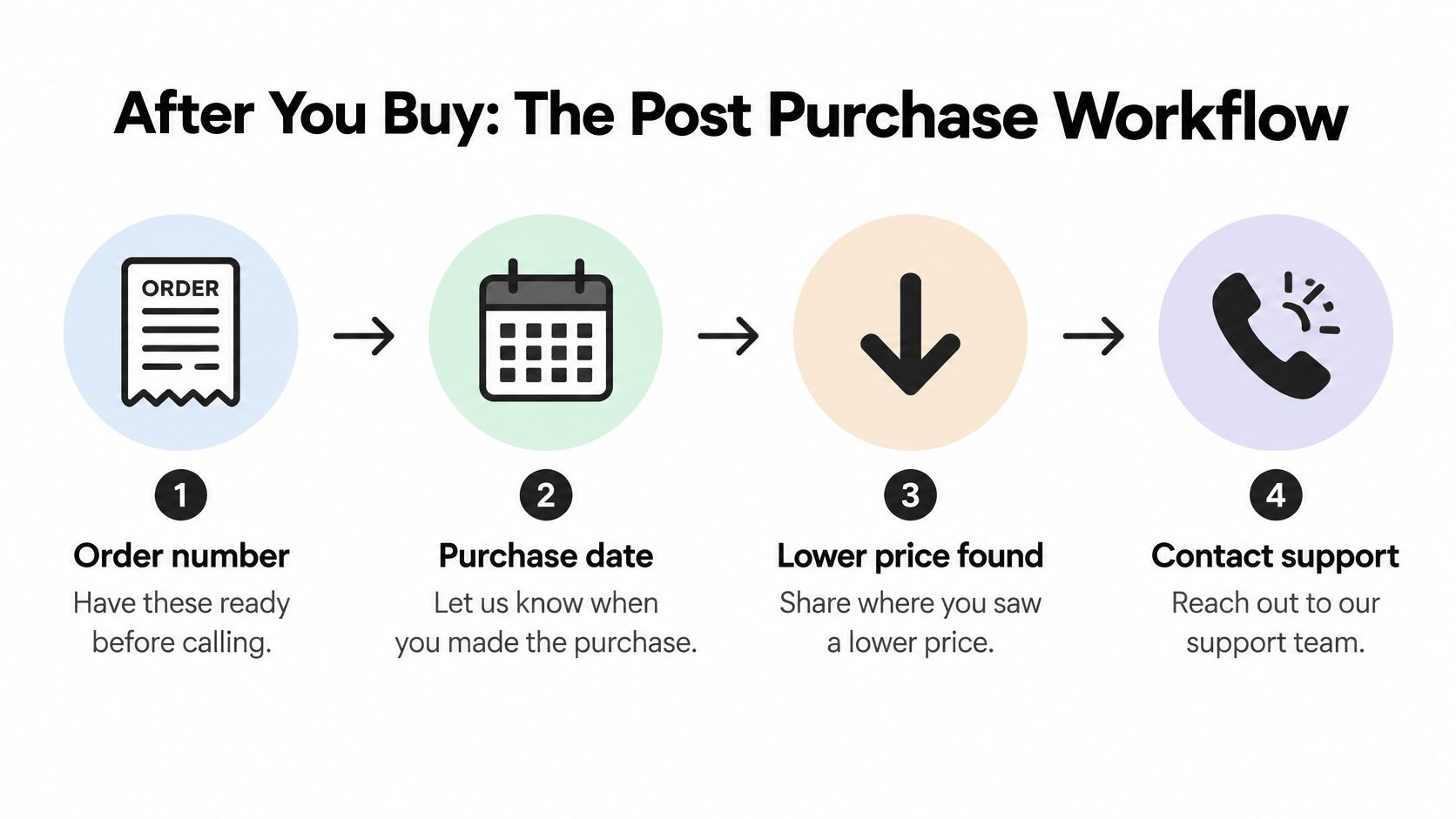
Speed matters more than eloquence here. Open the chat only after you have everything in front of you. Agents close weak claims quickly, and you don't want to hunt for an order number while the session times out.
Have These Four Things Ready
- Order number and purchase date: This proves you're inside the window without debate.
- Evidence of the lower price: A live link plus a timestamped screenshot showing item, seller, and price.
- Exact amount requested: Don't make the agent do your math. State the net difference you calculated.
- Preferred remedy and fallback: Refund to original payment method first, store credit or fee waiver second.
Chat First, Phone When Discretion Matters
Default to chat for straightforward adjustments. You get a written transcript, you can paste links, and you can save the confirmation. That's ideal for most large retailer orders, including the situations covered in our Amazon price adjustment guide, where return and repurchase is often the realistic route.
Use this chat opener and don't add a life story:
“Hi, I'm requesting a price adjustment. Order [number], purchased [date]. The current price is lower at [link]. The difference is [amount]. Please refund that amount to my original payment method, or let me know the closest credit available.”
Choose phone for furniture, service contracts, and other purchases where a person has real discretion. Keep the tone factual. Explain the benchmark, make the specific request, then stop talking and let them check.
Escalate Once, Properly
If the first agent refuses, ask one clarifying question before you escalate. “Can you tell me which part of the policy excludes this order?” Sometimes the issue is a wrong model number or an expired listing you can fix.
If the exclusion doesn't make sense, say, “I understand you may not be able to approve this. Could a supervisor review it as a goodwill exception?” That's firm without being abusive. Agents remember tone when they decide how hard to push internally.
Don't forget non price remedies. A missed delivery guarantee can support a delivery credit. A service plan problem can support a fee waiver. Ask for the remedy tied to what went wrong, get the resolution and any expiration terms in writing, and save them with your receipt.
Timing Evidence and When to Move On
Most claims don't fail because the script was wrong. They fail because the shopper noticed the drop after the deadline, or noticed it in time and meant to call later. This is a monitoring problem, not a courage problem.
In McKinsey's 2025 survey across 18 markets, more than half of respondents said they look for deals on every purchase, and 49% of U.S. respondents planned to delay purchases over the following three months. People hunt hard before buying. Far fewer protect the price after buying.
Rank Claims by Expected Value
Use a simple filter before you spend time on any claim:
Price difference × probability the merchant says yes − time and friction of asking
A small drop on an inexpensive cable that requires a long phone call fails that test. Let it go. A large drop on a laptop, appliance, or piece of furniture inside the adjustment window passes easily. Act the same day.
That ranking also tells you how to escalate. Send one concise request first. Escalate only when the expected value still justifies another contact. Two polite attempts on a worthwhile claim beat five frustrated messages on a trivial one.
Evidence That Survives a Dispute
- Screenshot the lower price: Capture the item name, seller, price, and a visible timestamp in one image.
- Save the live link: Listings change, so the screenshot is your backup if the price moves again.
- Keep order confirmations together: Store receipts, chat transcripts, and refund confirmations in one folder you can find.
That last habit matters beyond price drops. When a promised refund doesn't arrive, our guide on how to track a refund walks through matching the merchant's promise against what hit your account.
Set a calendar reminder for the last day of the retailer's adjustment window when you buy anything expensive. Check once near the start and once before it closes. If there's no drop, delete the reminder and move on. Don't turn every purchase into a surveillance project. Triage, claim what's worthwhile, and release the rest.
Letting Compass+ Watch the Price So You Don't Have To
The manual system above works if you remember every window, check every retailer, and catch every missed credit. Most busy people don't. That's not a discipline failure. It's an attention problem, and automation handles attention better than willpower does.
The screenshot below shows the savings feed approach, where findings arrive with an amount and a next step instead of leaving you to audit statements yourself.
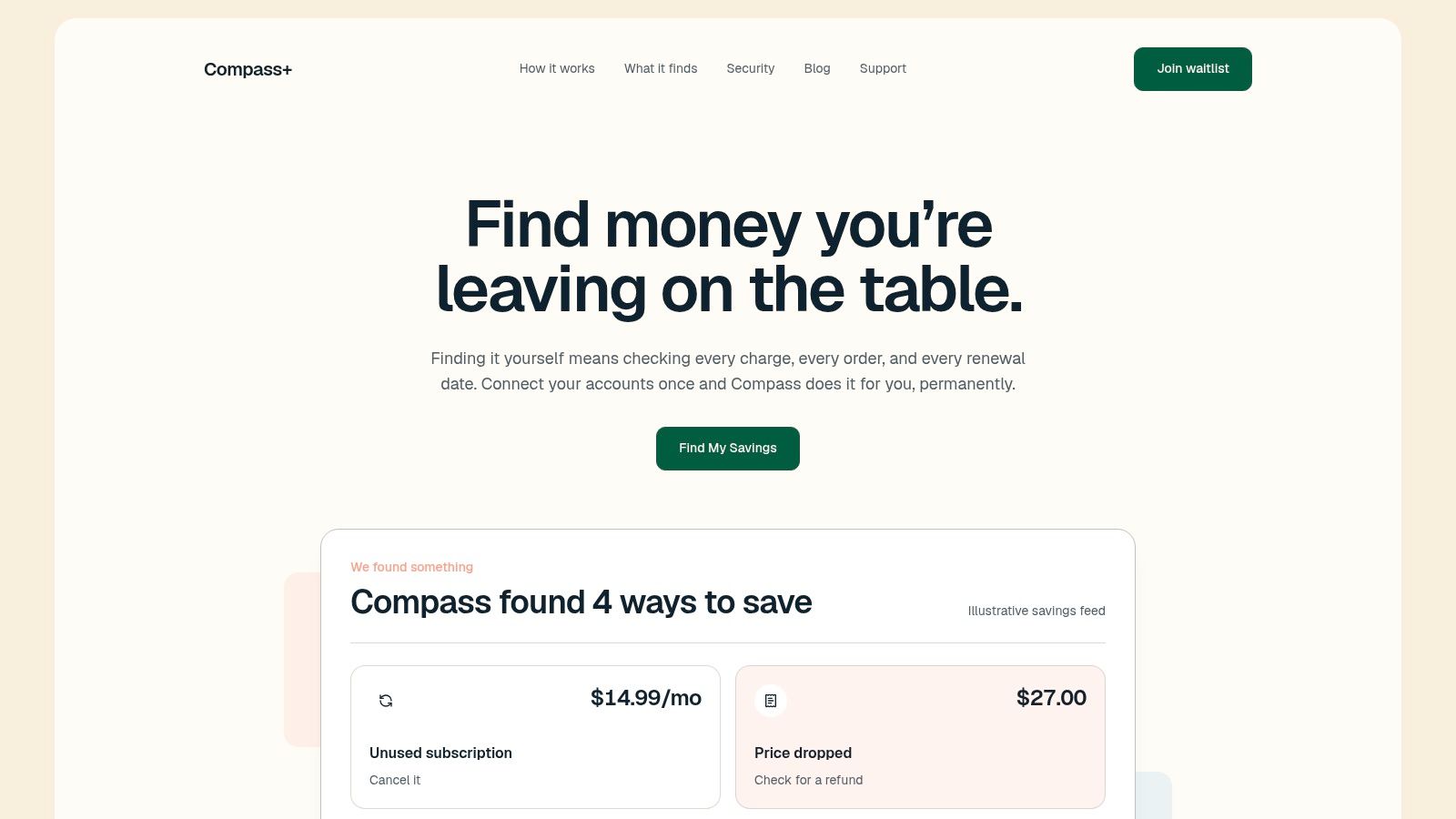
Compass+ is a money saving agent that monitors linked financial, email, calendar, and shopping accounts to surface opportunities to reduce expenses or recover funds. It identifies refunds owed, post purchase price drops, late delivery credits, duplicate or increased charges, and low use subscriptions, then pairs each finding with a concrete next step and an estimated amount.
How the Monitoring Actually Works
Bank and card transactions connect through read only Plaid access, which can view balances and transactions but can't move money, and banking passwords aren't stored. Email access is narrow, limited to receipts, renewals, and refund confirmations rather than general correspondence.
Calendar checks watch renewal dates and return windows before they pass. Shopping order tracking watches for price drops after checkout and deliveries that miss stated guarantees. Each connection is opt in and individually revocable, so you control the scope.
Instead of checking ten retailers, you get a contextual notification explaining what happened, why it matters, and what to do next. That includes the post purchase price reduction request described earlier, surfaced while the window is still open.
The same monitoring mindset helps outside retail. Travelers who watch fares proactively, for example through business class fare alerts, catch drops they'd otherwise miss. Retail purchases deserve that same passive watchfulness.
Watch the walkthrough below to see how findings are presented before you decide whether monitoring fits your routine.
Compass+ is currently available by waitlist as a standalone experience and embedded inside Gerald. If you already follow the decision tree manually, keep doing it for big purchases. Let automation catch the ones you'd forget.
Join the waitlist at Compass+ to have post purchase price drops, late delivery credits, duplicate charges, and low use subscriptions surfaced with an estimated amount and a concrete next step. You'll spend your time approving worthwhile claims, not hunting through receipts and retailer policies hoping you didn't miss a deadline.