Unclaimed Money Ohio How to Find and Claim It Fast
Find unclaimed money Ohio is holding for you. Search the state portal, file correctly, and track your claim with this practical step-by-step guide.
13 min read

You move out of an Ohio apartment, change jobs, close an old bank account, and forget about a final utility deposit or refund. Years later, you search your name and find a property listed by the state. The money is real, but recovering it isn't always as simple as clicking a button. Your name, address history, ownership relationship, and supporting documents all need to line up.
The rules also changed in 2025 and 2026. Older advice often says Ohio funds can be claimed forever, but that expectation is no longer safe. The practical approach is to search the official database, identify the deadline attached to older property, prepare documents that prove your connection, and track the claim until payment.
Table of Contents
- What Unclaimed Money Means in Ohio
- How Long You Have to Claim Before Ohio Keeps It
- Finding Your Money on the Official Ohio Portal
- Documents You Need to Prove Ownership
- Submitting Your Claim and Tracking It to Payment
- Keep More Money From Slipping Away Again
What Unclaimed Money Means in Ohio
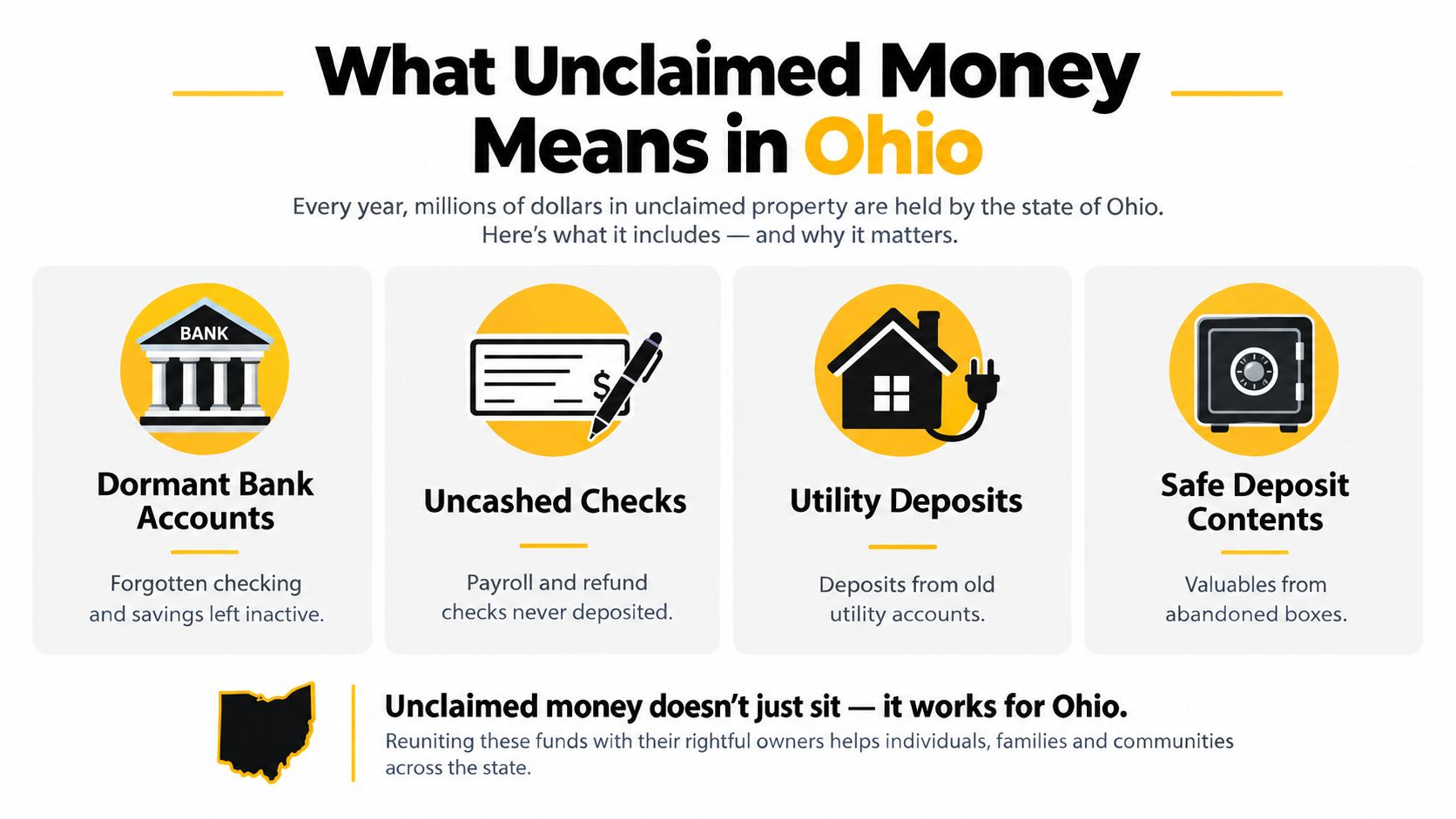
A forgotten payroll check, inactive bank account, utility deposit, or refund sent to an old address can become unclaimed money in Ohio. The balance may still belong to you, even after the original business transfers it to the state. The state database can show the property, but approval depends on matching your identity, address history, ownership relationship, and supporting records.
Businesses generally report qualifying property after a period of inactivity, often three to five years depending on the property type and reporting process. Ohio lists old bank accounts, utility deposits, refunds, checks, and other dormant assets among the sources described in the Ohio Division of Unclaimed Funds media information.
Why the balance is so large
Ohio currently holds about $4.8 billion in unclaimed funds. That total combines many small forgotten balances with larger dormant accounts and property connected to individuals, estates, businesses, and organizations. It does not predict the value of any one search result.
The program also returns money through paid claims. Ohio reported 26,420 claims paid and $149 million returned in 2025. Another state report recorded 67,879 claims and $149.6 million returned, with the difference attributed to reporting periods or methodologies. The state claims webinar materials report an average payout of roughly $2,204 per paid claim for one period, calculated from the reported totals.
Practical rule: Treat an Ohio unclaimed-funds search as asset recovery, not a lottery search. Small balances can still justify the paperwork, while larger properties deserve prompt attention because current deadlines apply.
Search again after a move, name change, job change, account closure, or responsibility for a deceased relative's affairs. Use former names, older addresses, and business or estate details where they apply. This guide to finding money you're owed or wasting can help identify other overlooked funds. Ohio's deadline change makes monitoring useful too, because newly reported property can require action before it becomes unclaimed again.
How Long You Have to Claim Before Ohio Keeps It
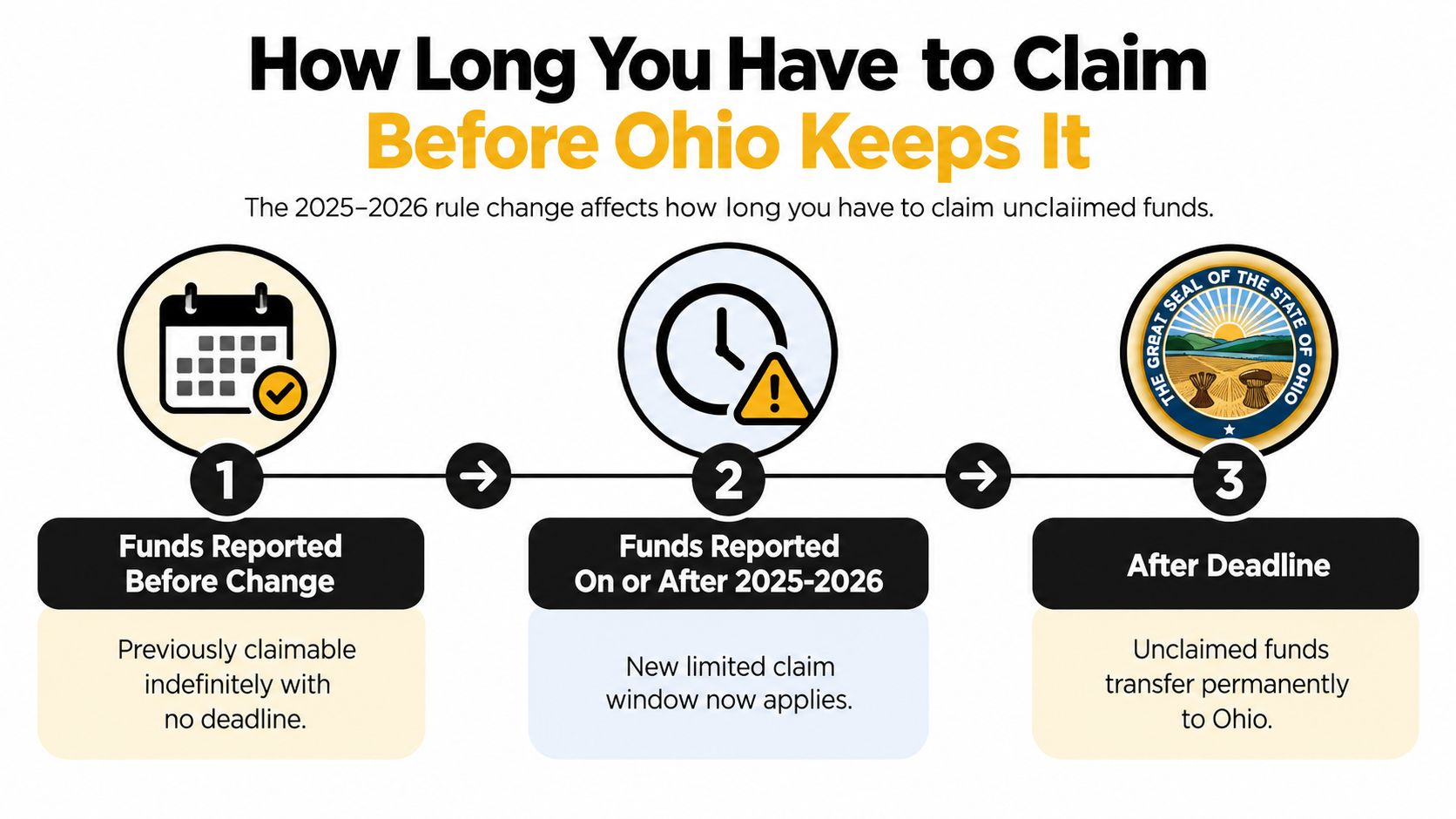
The old advice to claim Ohio property whenever you are ready no longer gives owners a safe plan. Under the newer rules, funds reported on or before January 1, 2016, are scheduled to remain claimable until January 1, 2036, while newer funds follow a rolling 10-year claim window, according to recent Ohio deadline reporting.
The property's reporting date matters as much as the date you find it. A listing can remain visible in the portal while its deadline approaches, so check the record's reporting information and applicable claim window before spending time on supporting documents.
Prioritize older property first
Use this review order when several results match your name:
- Reported on or before January 1, 2016: Put the property first and work toward the scheduled January 1, 2036 deadline.
- Reported after that date: Check the record for its applicable rolling window. Do not assume the property can be claimed indefinitely.
- Estate or business property: Begin gathering authority documents early. Executor, administrator, ownership, or business records may require more preparation than an individual claim.
- Multiple matching properties: Review every record separately. Their reporting histories and deadlines may differ.
The practical risk is delay. Recent reporting placed Ohio's unclaimed-property pool at roughly $4.8 billion to $5.4 billion and said 884,912 claims worth $746.5 million were filed in fiscal 2026. Those figures show how many owners are using the revised system, but they do not tell you how long a particular property remains available. Use the Division's current instructions for the record in front of you rather than relying on a general deadline summary.
What happens after the window closes
Property that passes its applicable deadline may transfer permanently to Ohio under the rule described in the reporting above. Administrative developments or legal challenges can affect how requirements are applied, so owners of high-value, estate, or disputed property should confirm current Division instructions and consider qualified legal advice.
Check the listing now, save its property details, and record the applicable deadline before building your document packet. This order avoids a common failure point: preparing paperwork without first confirming that the claim is still within its permitted window.
Finding Your Money on the Official Ohio Portal
A former apartment, employer, bank, or utility account can leave a record under an address you no longer use. Start with the official Ohio unclaimed-funds claim search, rather than a paid finder service. Direct filing keeps your search, documents, and claim under your control.
Search broadly, then narrow carefully
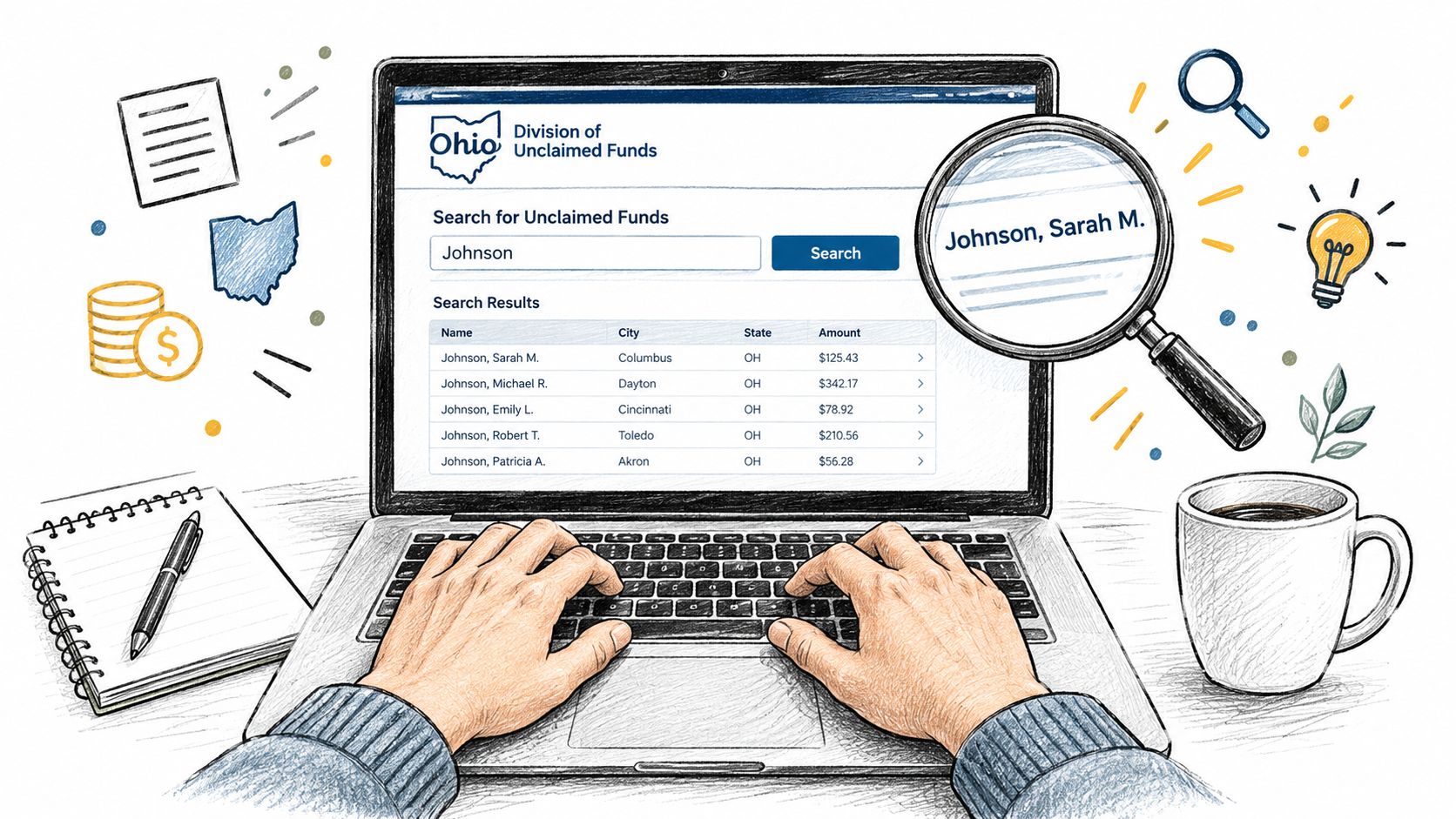
Enter your current legal name, then test a maiden name, former surname, middle-name variation, common misspelling, or relevant business name. Review the fields shown for each result, including the reported owner, holder, property type, reported date, and address. Those details help distinguish your property from someone with a similar name.
Search prior Ohio addresses where available. An old address tied to a lease, employer, bank, or utility account can provide the missing connection, especially when the listing uses a former surname or abbreviated name.
Choose the correct owner or relationship before starting a claim. Open each plausible property separately and compare its identifying details with your records. A similar name alone does not establish ownership, and selecting the wrong relationship can create a document mismatch later.
Ohio's largest population centers contain a significant share of the statewide balance. Cuyahoga County holds about $477 million, Franklin County about $343 million, and Hamilton County about $267 million, according to county-level reporting on Ohio's unclaimed funds. If you have lived in Cleveland, Columbus, Cincinnati, or nearby communities, include those older locations instead of searching only your current address.
The useful output is the property record itself. Save the listing details, note the holder and property type, and record the reported date before generating the claim. That information gives your supporting documents a clear target and helps expose a mismatch before submission.
The video below offers another visual look at the search process. Use it as a supplement, while treating the current state portal and claim instructions as the controlling guidance.
Review the claimant selection one final time. A clean form cannot compensate for weak ownership evidence, but an accurate property match makes the later document review easier.
Documents You Need to Prove Ownership
Most avoidable problems occur after the search. The property record may use an old surname, former address, abbreviated business name, or a deceased owner's name. Ohio's claiming guide instructs claimants to generate the claim, gather required proof, and submit by mail or upload. Your packet should explain the connection between the claimant and the reported property.
Build the packet around the mismatch
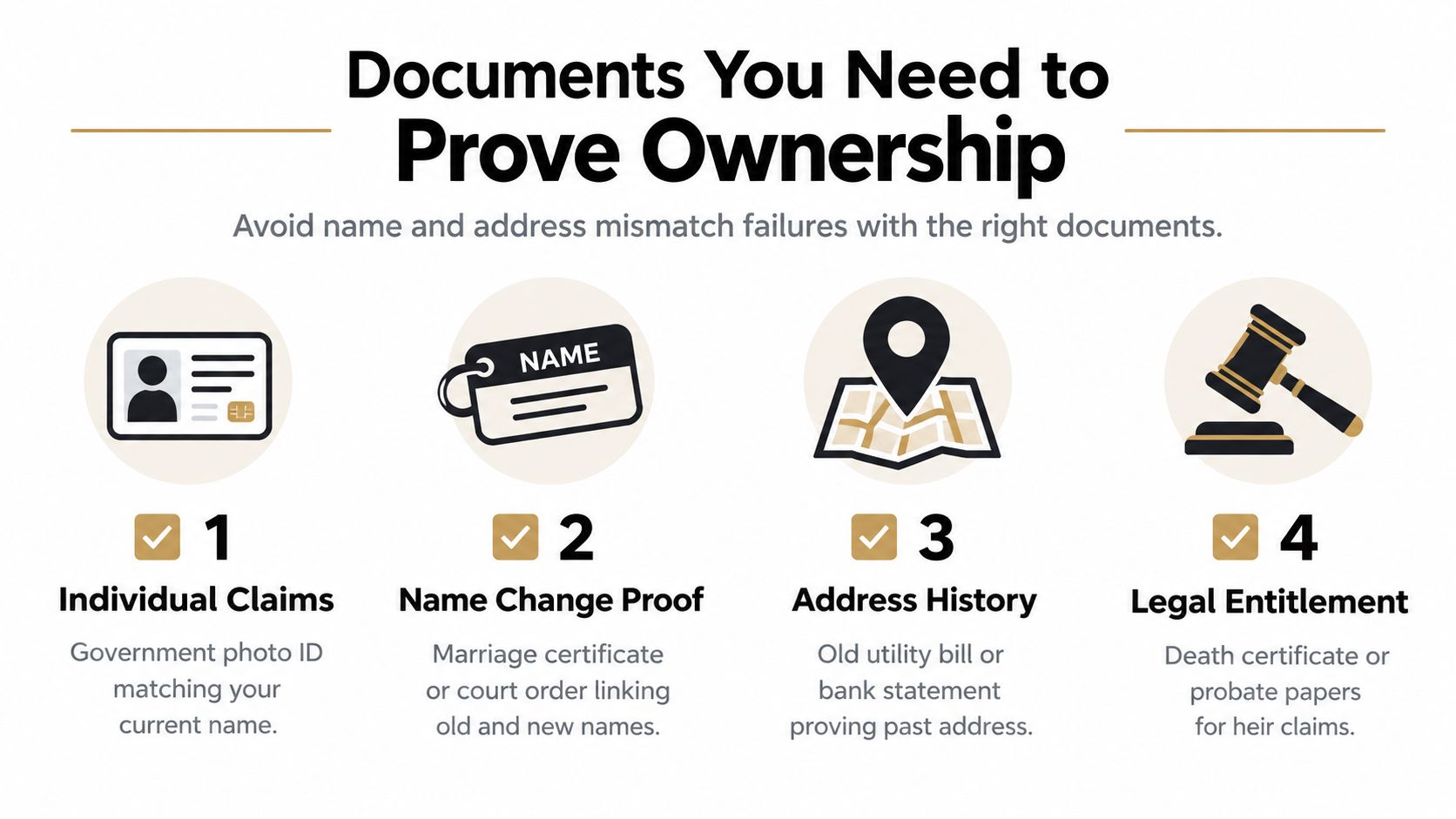
For an individual claim, begin with a government photo ID showing your current name. Then add evidence connecting that current identity to the name or address on the property record.
A practical packet may include:
- Current identity: A legible government photo ID that matches the claimant information.
- Former name: A marriage certificate, divorce record, or court order linking the reported name to the current name.
- Address connection: An old utility bill, bank statement, lease, tax record, or similar document showing the prior address associated with the property.
- Ownership evidence: Records that connect you to the account, check, deposit, refund, or other property when the portal requests more than identity and address proof.
Don't send unrelated paperwork just because it contains your name. The reviewer needs a coherent chain, not a thick file. If the property uses an old address, your strongest supporting document is usually one that shows both your identity and that address, or that links the address to another document in your packet.
More complicated ownership situations
A deceased-relative claim requires proof of the owner's death and proof that you have authority or legal entitlement to receive the property. Depending on the estate, that may involve a death certificate, probate documents, letters of authority, a small-estate filing, or other records requested by Ohio. Don't assume a family relationship alone establishes entitlement.
Business and organization claims need the entity's legal identity and the claimant's authority to act for it. Gather formation or registration records, documentation showing the reported business name, and evidence that you represent the entity. For a multi-owner property, each owner relationship must be accurate, and the state may request documentation for more than one person.
Document test: Someone unfamiliar with your history should be able to read the claim form and supporting papers and understand why the property belongs to you, the estate, or the organization.
Scan or photograph documents clearly before uploading. Keep the original packet and a copy of everything submitted, including the claim confirmation and any correspondence. That record makes follow-up much easier if Ohio asks for clarification.
Submitting Your Claim and Tracking It to Payment
After generating the claim and assembling your proof, choose between online submission and mail. Uploading is usually easier when scans are readable, complete, and arranged in the order requested. Mail works well for claimants who prefer paper records or have documents that are easier to organize physically. Keep a full copy of the packet, and retain mailing or delivery evidence when you send paperwork.
Use the official Ohio portal to check claim status 24/7. Sign in with the information connected to your filing, then respond promptly if the Division of Unclaimed Funds requests more proof. A clean name and address match may move differently from an estate, business, or multi-owner claim. The portal's status updates and document requests are more useful than comparing your timeline with someone else's.
| Claim Situation | Key Documents | How to Track |
|---|---|---|
| Individual owner | Photo ID, address connection, and any name-change proof | Check the portal regularly and answer document requests |
| Former name or address | Name-change record and historical address evidence | Confirm that the submitted records connect old and current information |
| Deceased relative or estate | Death certificate plus probate or estate-authority records | Track under the estate claim details and contact support if authority is unclear |
| Business or organization | Entity records and proof of representative authority | Keep the legal name consistent across the claim and supporting documents |
| Multiple owners | Ownership and identity documents for the relevant parties | Review the claim status for every required owner response |
Ohio businesses also deal with a separate holder-reporting process, including filing periods and remittance requirements. Commercial accounts, customer credits, payroll checks, and refunds can later appear under a business or organization name. Keep who owns the property separate from who may file for it. A representative may have authority to submit the claim without personally owning the funds.
Create one folder for the search result, claim form, uploaded files, mailing evidence, confirmation number, and status screenshots. The same recordkeeping approach applies to company-issued refunds. This guide to how to track a refund covers the practical steps, preserve the reference number, record each action date, and follow up if the file stops moving.
Contact Ohio support if the status page does not explain a relationship, an estate document is unclear, or a requested record cannot be obtained. Do not submit a second claim for the same property unless the Division tells you to. Duplicate filings can make the record harder to reconcile and may delay clarification. Save every response so you can show exactly what Ohio requested and what you provided.
Keep More Money From Slipping Away Again
Recovering an Ohio property solves one problem, but ordinary account changes can create another. Update your address with banks, employers, insurers, and utility providers when you move. Close accounts deliberately, confirm final balances, deposit checks promptly, and keep records for refunds that a company promises to issue.
A recurring personal review also helps. Search the Ohio portal when your name, address, business status, or family responsibilities change, and check other states separately if you've lived or worked elsewhere. Keep a list of open claims and deadlines instead of relying on memory.
Continuous monitoring adds a different layer. It can surface promised refunds, missed delivery credits, post-purchase price adjustments, duplicate charges, increased bills, and low-use subscriptions while the account activity is still recent. Compass+ can connect financial, email, calendar, and shopping accounts in a read-only monitoring setup, then present a finding with an estimated amount and a suggested action such as requesting a refund or canceling a subscription. Its money leak finder is designed for those ongoing checks, not as a replacement for Ohio's official unclaimed-funds claim process.
Action plan: Search the Ohio portal, record the property deadline, prepare proof that matches the reported name and address, submit through the official workflow, and monitor the claim until it closes.
The most important habit is consistency. A one-time search can recover property already transferred to Ohio, while address hygiene and ongoing account monitoring can help prevent future refunds, credits, and balances from becoming harder to retrieve.
Compass+ monitors linked financial, email, calendar, and shopping accounts for refunds, credits, price drops, duplicate charges, and recurring fees that deserve attention. Visit Compass+ to join the waitlist or explore a more continuous way to find money before it slips out of reach.