Six Steps to Financial Planning That Actually Work
Master six steps to financial planning with a practical guide to goals, budgeting, debt, savings, investing, and review. Includes tools to automate the work.
16 min read

Most advice about the six steps to financial planning gets the order right and the operating model wrong. It treats a financial plan like a document you create, file away, and revisit when the calendar reminds you. That's how missed refunds, duplicate charges, quiet bill increases, and forgotten renewals become permanent parts of your spending.
A useful plan is a continuous loop. You define an objective, inspect real evidence, choose an action, execute it, and check whether the result still matches your life. The Financial Planning Standards Board describes this cycle through engagement, information gathering, analysis, recommendations, implementation, and review, with review acting as the mechanism that keeps the plan current when circumstances change (financial planning practice standards).
That execution gap matters because financial resilience remains uneven. The Federal Reserve reported that 55% of U.S. adults in 2024 had enough savings to cover three months of expenses, while 45% did not (Federal Reserve household savings data). A plan that identifies a savings target but fails to recover an owed refund or stop an unwanted renewal isn't finished. It has merely produced paperwork.
Table of Contents
- Why Most Financial Plans Fall Apart
- Step 1 Define Your Goals With Numbers and Deadlines
- Step 2 Build a Budget From Real Transactions
- Step 3 Pick a Debt Payoff Strategy and Stick With It
- Step 4 Build a Tiered Emergency Cushion
- Step 5 Start Investing Without Overthinking It
- Step 6 Review the Plan on a Real Cadence
Why Most Financial Plans Fall Apart
Most financial plans fail in the space between deciding and doing. A household can set a savings target, choose a debt priority, and still lose ground when a subscription renews, a merchant delays a refund, a bill increases, or a return deadline passes.
Treat the six-step model as a closed loop, not a checklist. Establish the relationship and scope, collect facts, analyze the current position, develop recommendations, implement them, and review the outcome. The review feeds new information into the next decision, as outlined in the Financial Planning Standards Board practice standards.
Practical rule: If your plan does not name the next action, the owner, and the deadline, implementation has not started.
The execution gap is expensive
Annual reviews miss changes that happen between meetings. The Federal Reserve reported that 59% of U.S. adults experienced at least one major unexpected expense in the prior year, including vehicle repairs, home repairs, and medical costs (Federal Reserve economic well-being data). Those shocks arrive alongside ordinary cash-flow leaks, so a household can fall behind without making one reckless decision.
Recurring charges deserve a deliberate audit. A C+R Research survey cited by Government Computer News found that nearly one-third of respondents underestimated monthly subscription spending by $100 to $199, while nearly one-quarter underestimated it by $200 or more (subscription spending research). Keep useful services. Cancel what no longer earns its place, and identify charges that should be refunded.
Review bank transactions, receipts, free-trial conversion dates, annual renewals, refund promises, and return deadlines. Use this guide to finding all your subscriptions to consolidate scattered records into one working list. Then automate alerts, cancellation reminders, and transfers where possible, so execution continues between formal reviews.
Monitoring belongs inside the plan
Recent household conditions make occasional reviews too slow. Entering 2026, 88% of U.S. respondents reported some financial stress, and 77% said they experienced a financial setback during 2025, according to the Federal Reserve's report on economic hardships (Federal Reserve hardship findings). Changing bills, income, and obligations require a process that can detect problems before the next annual appointment.
Each step should produce an action and a check. Goals set the destination, transactions expose what is happening, debt and cash reserves absorb shocks, investing supports long-term growth, and review keeps the system aligned with real life.
Step 1 Define Your Goals With Numbers and Deadlines
A goal such as “save more” is not a financial goal. It's a wish. A usable goal has a purpose, an amount, and a date, so you can decide what to fund first and measure whether your monthly actions are sufficient.
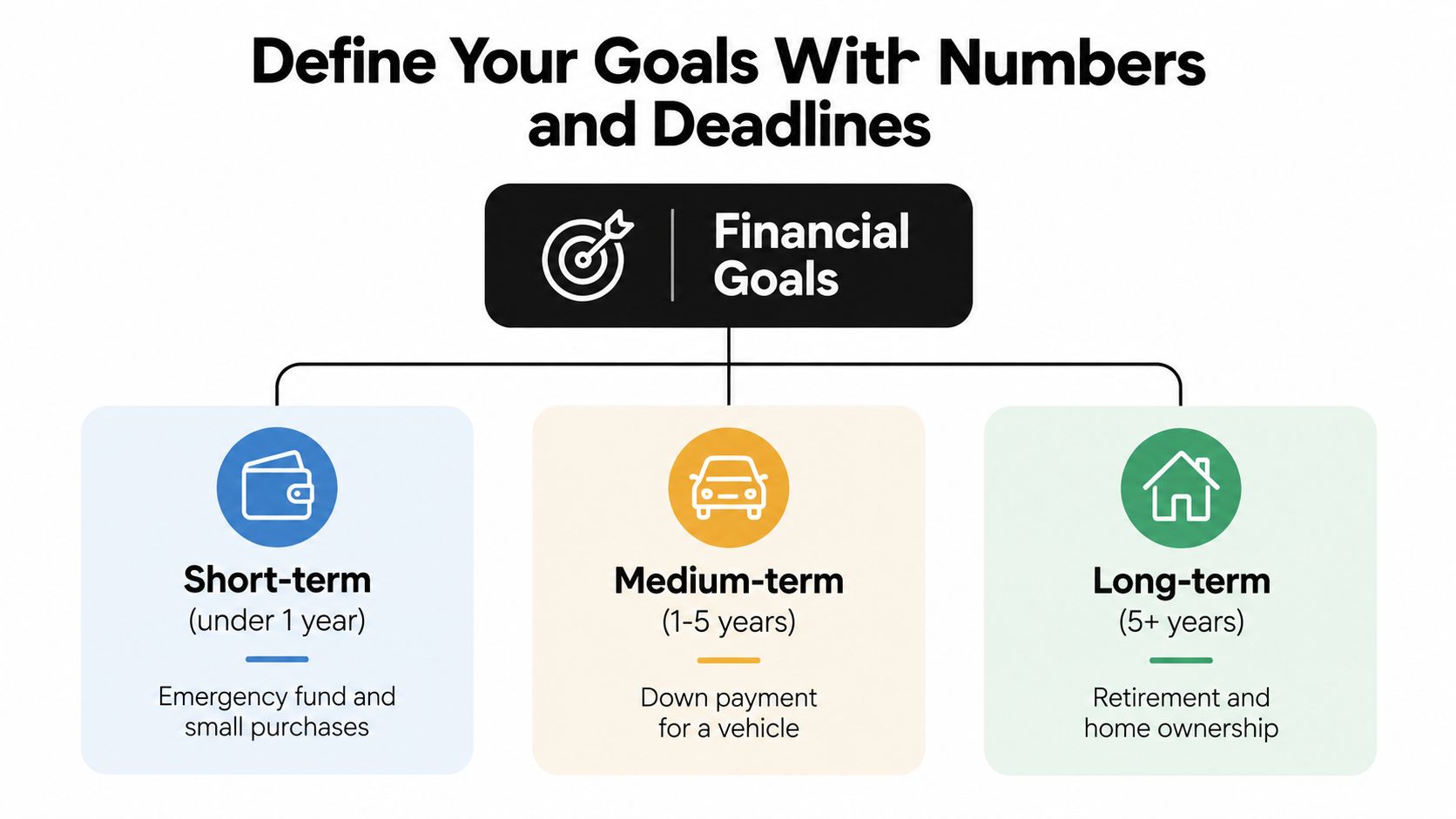
Start with three time horizons:
- Short term: Goals under one year, such as building an emergency cushion or paying an upcoming annual bill.
- Medium term: Goals from one to five years, such as a vehicle down payment or a planned move.
- Long term: Goals beyond five years, such as retirement or home ownership.
Turn wishes into funding targets
Write each goal in a sentence that a spreadsheet or savings account can understand. “Build a $1,500 emergency cushion in six months” gives you a target and a deadline. “Save a $6,000 used-car down payment in two years” tells you which money must stay accessible and when you'll need it. A retirement goal needs more assumptions, but the same principle applies. Define the desired lifestyle, expected income sources, and the date at which work becomes optional.
Separate planned expenses from emergencies. Annual insurance, vehicle maintenance, professional fees, and predictable gifts aren't emergencies just because they don't arrive monthly. Give them their own sinking-fund targets so they don't compete with genuine shocks.
Prioritize without pretending everything matters equally
Use this order:
- Protect essentials. Keep housing, food, utilities, insurance, minimum debt payments, and basic liquidity funded.
- Fund planned obligations. Cover known annual bills, necessary repairs, and near-term purchases.
- Advance aspirational goals. Direct remaining capacity toward travel, upgrades, early retirement, or other optional objectives.
If two goals compete, compare the consequence of delay. A looming insurance payment usually outranks a discretionary purchase. A high-interest balance may outrank a long-term investment contribution after any available workplace match has been considered. The answer depends on your actual rates, deadlines, and cash flow, not on a slogan.
Create a one-page goal sheet with the goal, total target, current balance, deadline, monthly contribution, account location, and next review date. Update it when the goal changes. Without that written reference point, later reviews become arguments with your memory.
Step 2 Build a Budget From Real Transactions
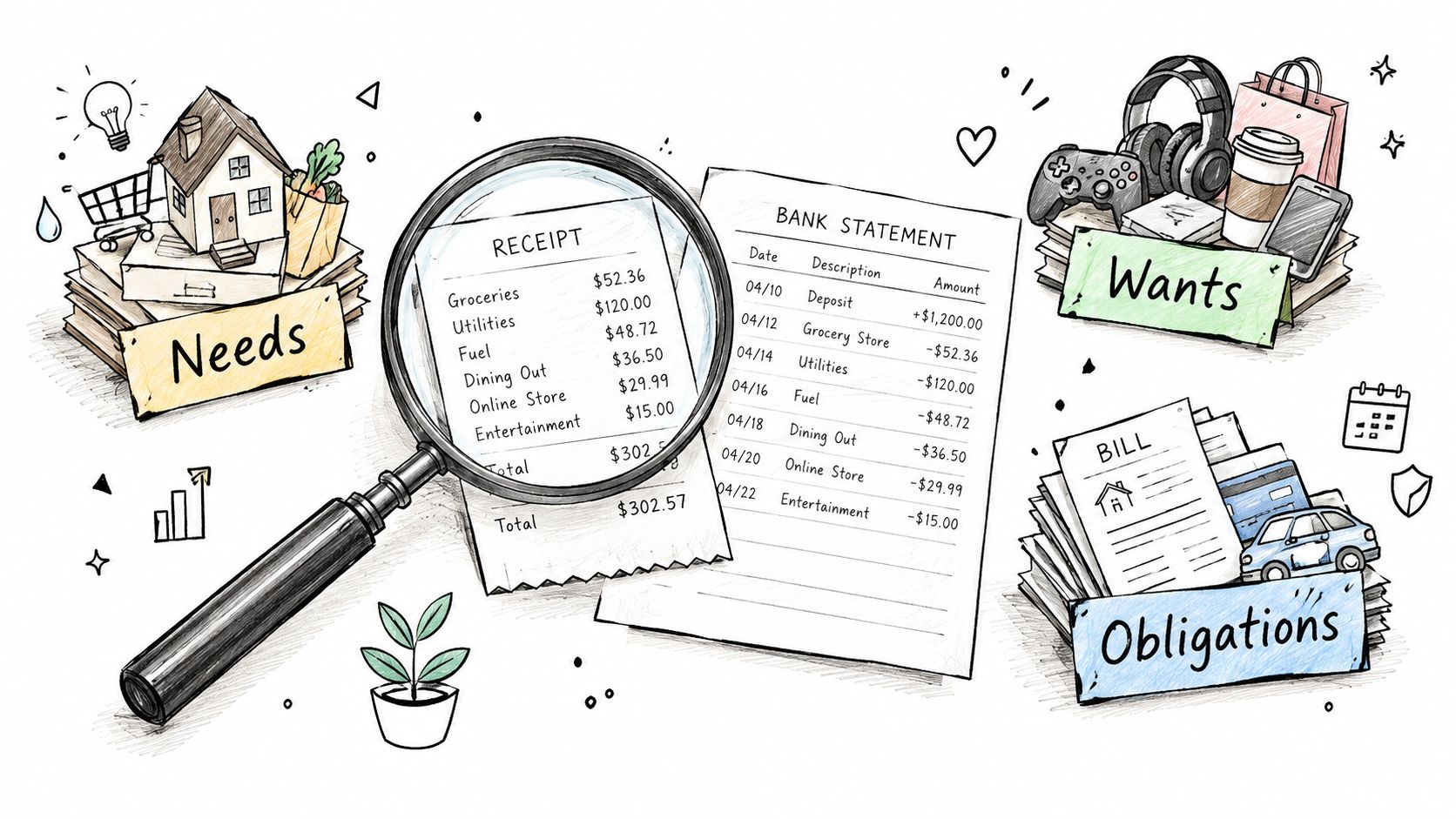
A budget built from memory is fiction with neat formatting. Start with bank and card transactions, then verify the categories against receipts, contracts, and account statements. Your first job isn't to judge the spending. It's to identify what really happened.
Build the spending map
Sort transactions into four useful groups:
- Core needs: Housing, utilities, groceries, transportation, insurance, and required payments.
- Flexible choices: Dining, entertainment, clothing, travel, and convenience spending.
- Automatic obligations: Subscriptions, memberships, software, service plans, and recurring donations.
- Recoverable or questionable items: Duplicate charges, promised refunds, price adjustments, fees, and charges that don't match the receipt.
The fourth group is where ordinary budgeting becomes active money management. Cutting discretionary spending has a limit. Recovering money already owed or stopping a charge you no longer want can improve cash flow without asking you to eliminate every enjoyable purchase.
Review each recurring item for amount, frequency, use, renewal date, and cancellation terms. Then check receipts and emails for credits that were promised but never posted. Look at delivery guarantees and return windows before they expire. The point is not to build a perfect category tree. The point is to produce a short action list with evidence.
For a deeper explanation of why statements can expose spending problems that budgets conceal, use this resource on scary bank statements and spending control as a practical companion.
Reconcile before the next pay cycle
A monthly recurring-charge reconciliation should answer five questions:
- Did the charge match the expected amount?
- Did the merchant charge more than once?
- Did a free trial convert?
- Was a promised refund or credit received?
- Is an annual renewal approaching?
Record the evidence, estimated value, deadline, next action, and completion status. A finding without a deadline becomes another item you intend to handle later. The Money Leak Finder can help organize this kind of review around recurring charges and missed savings opportunities.
The accompanying video can serve as a visual prompt while you reconstruct your categories from actual activity:
Finish with a one-page operating budget. Show expected income, fixed obligations, flexible spending limits, debt payments, goal contributions, and a separate savings-opportunity list. That last column matters. Your budget should not merely explain where money went. It should identify what you can recover, cancel, challenge, or renegotiate next.
Step 3 Pick a Debt Payoff Strategy and Stick With It
Debt payoff plans often stall because people keep comparing methods instead of choosing one. The two main approaches are straightforward. The avalanche method directs extra money to the balance with the highest interest rate, while the snowball method targets the smallest balance first.
The avalanche approach is mathematically stronger because it attacks the costliest debt first. The snowball approach can be behaviorally stronger because an early payoff creates visible progress. Neither method works if you keep moving the extra payment around or adding new balances.
Choose based on your behavior
Use avalanche when your cash flow is stable, your rates are clear, and you don't need an early win to stay engaged. Use snowball when several small balances create confusion, motivation is fragile, or closing an account will make the plan easier to follow.
| Criterion | Avalanche | Snowball |
|---|---|---|
| First target | Highest interest rate | Smallest balance |
| Main advantage | Reduces interest cost efficiently | Creates quick visible progress |
| Main risk | Progress may feel slow | May cost more interest |
| Best fit | Stable cash flow and strong follow-through | Need for simplicity and momentum |
Pay the minimum on every account, then direct all extra debt money to the selected target. When that balance disappears, roll its former payment into the next target. Write a payoff date for each balance using the current payment plan, and update it whenever the rate or payment changes.
A teaser rate deserves a separate line in your calendar. Record when the introductory period ends, what rate applies afterward, and whether a transfer fee or deferred interest condition changes the decision. If the rate is variable, build your plan around a payment you can sustain if the cost rises.
For a broader comparison of approaches and a payoff strategy that saves time, use the method that fits your actual follow-through rather than the one that sounds most impressive.
Ask for a better rate
Call the issuer with a specific request:
“I've paid on time and want to keep the account. Can you review my interest rate or offer a lower-rate option?”
Ask about hardship programs, product changes, promotional offers, and fee reversals. Don't accept a lower rate that comes with a new annual cost or a shorter promotional window unless you understand the trade-off.
Pause extra payments if a genuine emergency threatens housing, utilities, food, insurance, or minimum payments. A debt plan should make the household sturdier, not force you to borrow again after the next repair.
Step 4 Build a Tiered Emergency Cushion
The familiar advice to save three to six months of expenses is incomplete. A household with limited liquidity needs a sequence of targets, not a distant number that feels impossible. The Federal Reserve found that 18% of adults could cover less than $100 using savings alone, while another 12% could cover only $100 to $499 (Federal Reserve emergency savings findings).
Start with a tier that matches your current reality:
- Starter buffer: A $500 reserve for predictable shocks such as a minor repair, urgent travel, or an insurance cost.
- One-month reserve: One month of essential expenses, especially useful for renters or single-income households.
- Full cushion: Three to six months of expenses once high-priority debt is under control and income is stable.
Pick the right tier
Your target should reflect job stability, dependents, insurance deductibles, housing costs, and access to other support. A household with variable income needs more protection than one with predictable pay and low fixed obligations. A high deductible or one-income household also changes the amount that a small repair can disrupt.
Don't use invested money as your first line of defense. Keep the emergency cushion accessible in a separate savings account, where market volatility won't decide whether you can pay an urgent bill.
Fund the first milestone creatively
The starter buffer can come from recovered money rather than a dramatic lifestyle overhaul. Check for duplicate charges, unclaimed refunds, price-drop adjustments, and late-delivery credits. Route those recoveries directly into the reserve instead of allowing them to disappear into ordinary spending.
Set an automatic transfer after each payday, then add windfalls and recovered credits when they arrive. The amount should be sustainable enough to continue through a difficult month. A smaller automatic contribution that happens consistently beats an ambitious transfer that repeatedly gets reversed.
The Compass+ savings experience is one way to organize opportunities such as refunds, duplicate charges, bill increases, and renewal risks while you build the cushion. Treat every detected opportunity as a task with a deadline, not as money you already possess.
Review the tier whenever income, household size, insurance, debt, or housing changes. The reserve is not a trophy. It is a shock absorber that keeps one bad week from becoming a new balance.
Step 5 Start Investing Without Overthinking It
Investing becomes difficult when beginners try to solve every decision at once. Reduce it to three choices: how much to contribute, which account to use, and what investment to buy. A plan that runs automatically is more useful than an elaborate allocation you never fund.
Start with the account that offers the clearest advantage. An employer-sponsored retirement plan may include matching contributions, so check the plan rules and contribute enough to receive any available match if your cash flow can support it. A traditional IRA generally provides tax treatment that differs from a Roth IRA, while a taxable brokerage account offers flexibility but lacks the same retirement tax structure. Account eligibility and tax consequences vary, so verify the current rules before acting.
Use a simple investment default
For a beginner with a long time horizon, a low-cost total-market index fund can provide broad exposure without requiring individual stock selection. The point isn't that one fund suits everyone. The point is to avoid turning a starter plan into a research project about companies you can't evaluate.
Separate short-term reserves from long-term investments. Emergency money may be needed when markets are down, so it shouldn't depend on a favorable selling price. Money for retirement or another distant objective can tolerate more fluctuation because the withdrawal date is farther away.
Choose a monthly contribution that fits after essentials, minimum payments, and the emergency tier are funded. Automate it through payroll or the investment account. Increase it when income rises or a debt payment ends, but don't set an amount that forces you to interrupt the plan every few months.
Your minimum viable investment plan has four lines:
- Amount: A contribution you can maintain.
- Account: An employer plan, IRA, or taxable brokerage account chosen for the purpose.
- Investment: A diversified, low-cost option you understand.
- Schedule: An automatic contribution date.
Review the allocation when your goals or time horizon changes. Don't react to every market headline. A long-term plan needs a reason to change, not a new opinion every morning.
Step 6 Review the Plan on a Real Cadence
The review step is the engine of the six-step process. A plan stays useful only when someone compares the intended result with current evidence and assigns the next correction. Research from the CFP Board's longitudinal study found that 44% of clients working with CFP professionals reported reviewing their plan more often than annually, compared with approximately 23% among other advised clients (CFP Board planning study).
Set a quarterly baseline review. Check:
- Goals: Current balances, deadlines, and required monthly contributions.
- Cash flow: Budget variance, upcoming obligations, and recurring-charge changes.
- Debt: Balances, rates, minimums, and projected payoff dates.
- Liquidity: Progress toward the current emergency-cushion tier.
- Investing: Contribution status, account choices, and allocation drift.
- Execution: Open refunds, credits, cancellations, renewals, and disputed charges.
Re-plan when a trigger appears
Don't wait for the next quarter after a major change. Review the plan when income changes, a dependent arrives, a major purchase occurs, a debt rate resets, an insurance policy renews, or tax legislation changes. These events can alter affordability, priorities, and the right balance between debt repayment, cash reserves, and investing.
Continuous monitoring handles the smaller events that annual reviews miss. A post-purchase price drop, a duplicate transaction, a missed delivery credit, or a renewal deadline can matter precisely because it happens between formal reviews. The useful output isn't a vague alert. It's an explanation of what happened, why it matters, the estimated value, the deadline, and the next action.

Automate the execution layer
Automation shouldn't move money or make irreversible decisions without your approval. It should reduce the inspection burden and surface evidence while there is still time to act. That means connecting transactions to receipts, renewal dates, delivery information, and refund confirmations, then asking you to confirm a cancellation, claim a credit, or challenge a charge.
This is why the six steps to financial planning work best as a loop. Goals set direction, analysis creates judgment, implementation creates movement, and monitoring catches the events that would otherwise undo progress. Review the dashboard, act on the time-sensitive findings, and update the written plan when the underlying facts change.
Compass+ monitors connected financial, email, calendar, and shopping accounts to surface refunds owed, duplicate charges, price drops, late-delivery credits, bill increases, and upcoming renewals with a specific next action. Visit Compass+ to join the waitlist and put the execution layer of your financial plan on a more consistent footing.