How to Claim a Refund the Right Way in 2026
Learn how to claim a refund from merchants, banks, and platforms in 2026 with step-by-step instructions, message templates, evidence checklists, and escalation
16 min read
You paid for a service that never arrived, chased support for two weeks, and finally received the message everyone dreads: “Your refund has been approved.” Then you checked your card. Nothing. No credit, no reference number, no useful answer.
That isn't a refund. It's a promise that still needs to be reconciled against your account. Learning how to claim a refund properly means choosing the right recovery path, preserving evidence before it disappears, respecting legal deadlines, and confirming that the money has landed.
Table of Contents
- When a Refund Stalls and What to Do First
- Building Your Refund Evidence File Before You Contact Anyone
- Writing the Merchant Request That Actually Gets a Yes
- Choosing Between a Merchant Refund, Chargeback, or Platform Case
- Following the Official Refund Windows and Dispute Deadlines
- Verifying the Refund Actually Landed in Your Account
- Using Automated Monitoring to Catch Refunds You Would Otherwise Miss
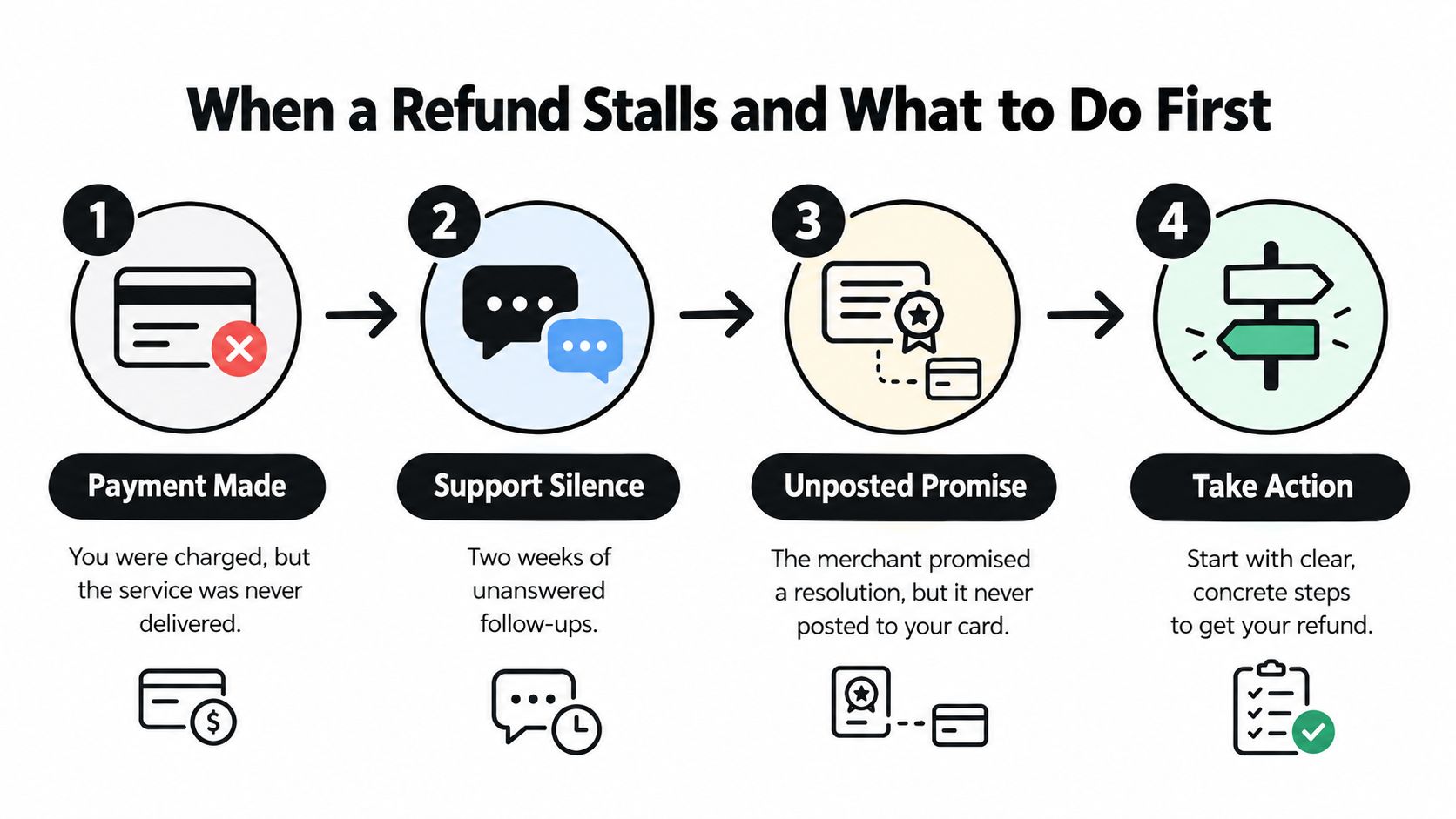
When a Refund Stalls and What to Do First
A stalled refund usually means the merchant's process broke somewhere between approval and settlement. The support agent may have marked the case complete while the payment team never submitted the credit. A platform may have issued a decision without sending the money. Your bank may be waiting for a transaction that the merchant can't prove was ever processed.
Treat the problem as a three-path decision, not an endless customer-service conversation:
- Ask the merchant to complete or trace the refund.
- File a card, bank, or platform dispute when the merchant fails to resolve it.
- Escalate to an enforcement body, ombudsman, or court when the conduct affects eligibility, deadlines, or a wider group of consumers.
Start by opening a claim file. Pull the original receipt, payment record, delivery details, and every message about the refund. Write down the date the merchant approved it, the employee or department that made the promise, the channel used, and the exact amount they said would be returned.
Make the first decision quickly
If the merchant has provided a refund reference, a settlement date, and the original payment method, give that trace a chance to clear while monitoring the account. If the merchant only says “we're looking into it,” send a written demand with a firm response deadline. If the merchant is unreachable, the charge is unauthorized, or a legal dispute window is approaching, escalate instead of waiting for another vague promise.
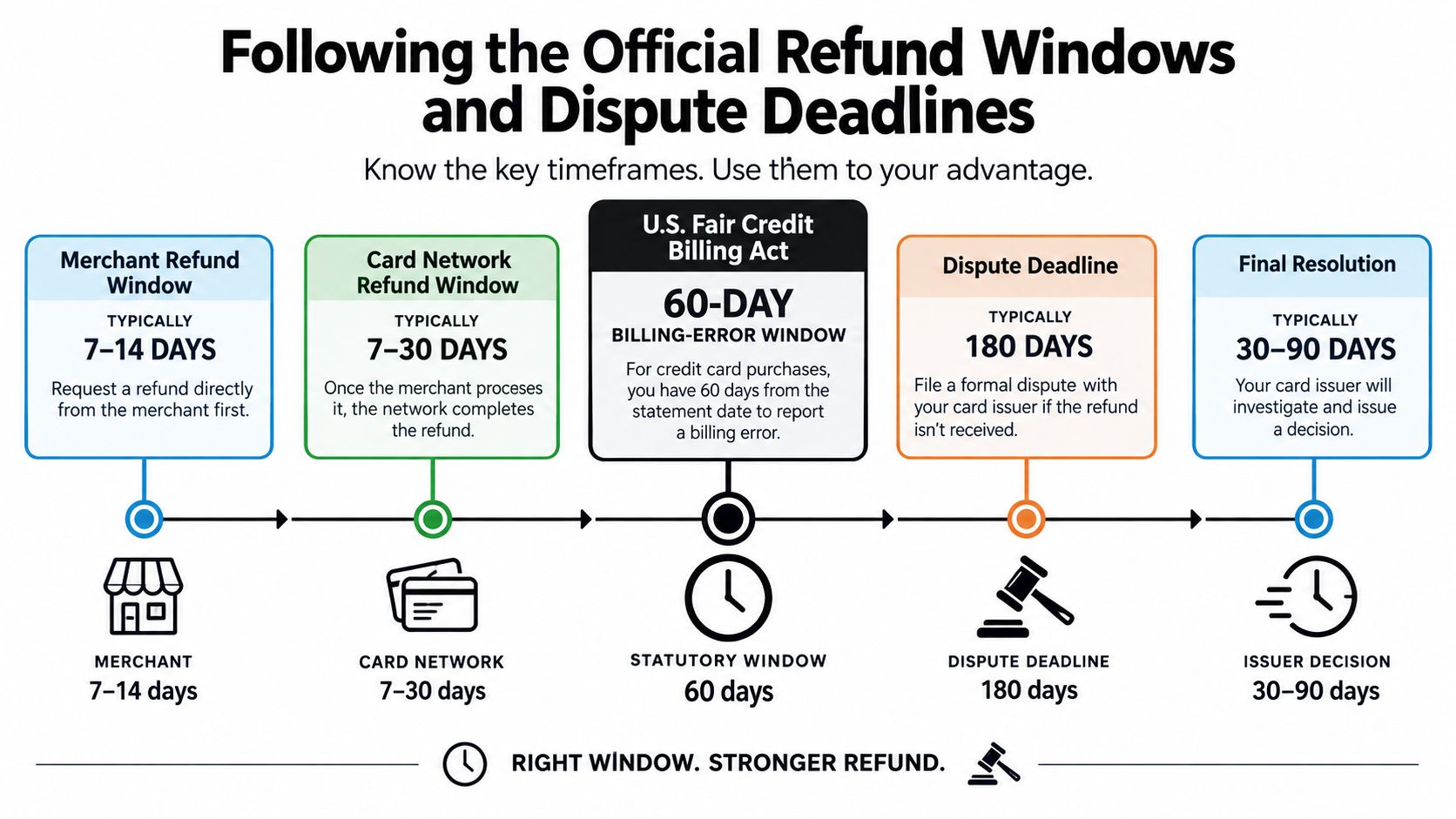
The clock matters. For U.S. credit-card billing errors, the written notice deadline is measured from the statement showing the charge, not from the day support stopped replying. UK and EU distance-sale rules also use defined cancellation windows for many purchases, subject to exceptions. Read the applicable window before you spend another week in chat.
Practical rule: Silence is not a resolution. It is a reason to preserve evidence and move the claim to the next path.
Building Your Refund Evidence File Before You Contact Anyone
Build the file before you contact support. Your strongest evidence is the material you control, not the merchant's internal notes.
Create one folder for the transaction and save:
- Order proof: Keep the dated confirmation, invoice, order number, transaction ID, and payment method's last four digits.
- Product or service records: Save the listing, contract, promised delivery date, cancellation terms, and any description that conflicts with what you received.
- Communication history: Export emails, chats, and portal messages. Capture the page showing a refund was approved, including the date and reference number.
- Performance evidence: Add delivery tracking, photographs of damage, service logs, appointment records, or proof that the promised service never occurred.
- Policy evidence: Save the relevant return, cancellation, price-adjustment, subscription, or service-level policy as a PDF. Policies change after a dispute starts.
- Call notes: Record the date, agent's name, case number, department, promise made, and next action. A phone call can help, but your written record makes it usable later.
PDFs are easier to submit and review than a pile of cropped screenshots. Use screenshots when they capture a disappearing portal or a visual defect, but keep them in chronological order and label each file with the date and what it proves.
Write a one-page claim summary
Put a plain-English summary at the front:
- Order and transaction reference
- Purchase date and amount
- Payment method
- What went wrong
- What you already requested
- The exact remedy you want
- The deadline you're giving the recipient
Write “The item was never delivered” rather than “The transaction was unsatisfactory.” Write “Please credit the original card for the full purchase amount” rather than “Please resolve this.”
Store the folder in two separate places, such as local storage and a secure cloud drive. If the merchant closes your account, deletes a chat, or stops answering, you'll still have the evidence needed for a card issuer, payment platform, regulator, or court. This same file becomes the backbone of every later escalation.
Writing the Merchant Request That Actually Gets a Yes
Your first message should make the merchant's decision easy. Use a subject line that identifies the transaction and the remedy:
Order [number], [short problem], refund requested
Open with the order reference, describe the failure in one sentence, attach the relevant evidence, and state the amount and payment method you want credited. Give a clear response deadline that's reasonable for the problem, then name the next step if the merchant doesn't act.
Use language like this:
Hello,
I'm writing about order [number], purchased on [date]. [The item wasn't delivered / the item arrived damaged / the service wasn't as described / I was charged twice].
I've attached [tracking, photographs, cancellation confirmation, or account records]. Please refund [amount] to the original payment method and send the refund reference and expected posting date. If this isn't resolved by [date], I'll submit the evidence to my card issuer or the relevant platform.
Regards,
[Name]
Adapt the first sentence to the actual problem:
- Item not received: “Tracking doesn't show delivery, and I haven't received the order.”
- Damaged item: “The item arrived damaged, as shown in the attached photographs.”
- Service not as described: “The delivered service materially differs from the description and confirmation.”
- Duplicate charge: “The same order was charged twice. Please reverse the duplicate transaction.”
- Canceled subscription still billed: “I canceled on [date], but the account was billed afterward. Please reverse that charge and confirm future billing is stopped.”
- Price drop: “The same product is now listed at a lower price under your adjustment policy. Please apply the difference.”
- Approved refund missing: “You confirmed a refund on [date], but no matching credit has appeared. Please provide the refund date, amount, destination, and transaction trace number.”
A real resolution includes a refund reference, exact amount, destination, and expected posting date. “Sorry, we're looking into it” is not a resolution. It gives you no verifiable event to match against your statement.
Merchant-first contact can be the fastest and cleanest route, especially for a minor pricing error or a straightforward return. The trade-off is that waiting can consume the deadline for a formal dispute. Skip repeated merchant outreach when the charge is unauthorized, the merchant is unreachable, or the applicable card deadline is close.
Choosing Between a Merchant Refund, Chargeback, or Platform Case
Choose the remedy based on the failure, not your frustration. A direct refund is usually best when the merchant accepts the mistake and can credit the original payment method. A card dispute fits a documented non-delivery, billing error, or refused remedy. A platform case makes sense when the purchase was governed by PayPal, Amazon, Airbnb, Etsy, or an app store's buyer-protection process.
Use an ACH or bank-reversal route only when your bank confirms that route applies to the transaction. Don't label a recognized purchase as fraud just because the merchant handled it badly. Unauthorized means you didn't authorize the transaction. A disappointing purchase, missed cancellation, or unresolved service complaint is a different category.
For marketplace sellers, platform procedures can have their own evidence rules and deadlines. If the seller disputes the case, a guide on how to respond to Seller Central chargebacks can help marketplace operators understand the evidence they may submit. For your own records, separate duplicate billing from unauthorized activity. The distinction is explained in this guide to a duplicate charge on a bank statement.
| Situation | Best path | Trigger condition | Time window | Risk |
|---|---|---|---|---|
| Merchant accepts a return or billing mistake | Direct merchant refund | Written confirmation includes amount and refund destination | Follow the merchant's stated posting date | Delay if you stop monitoring |
| Recognized card purchase, merchant refuses or fails to resolve | Credit-card billing dispute | You have the charge, evidence, and written merchant attempt | The issuer's statutory notice deadline applies | Evidence may be rejected if vague or late |
| Unauthorized transaction | Bank or card fraud process | You didn't authorize the charge | Contact the provider immediately | Mislabeling a recognized purchase can weaken credibility |
| Marketplace transaction | Platform case | Platform protection covers the order or seller failure | Follow the platform's case deadline | Platform rules may differ from statutory rights |
| Wider misconduct or settlement | Official enforcement claim | An agency identifies eligible consumers | Follow the official notice and administrator instructions | Payment can be missed if contact details are outdated |
A chargeback is a last resort, not a reflex. The merchant can answer with shipping proof, usage records, or a refund record, and the issuer can reverse a temporary credit. File only after you know the remedy category and can prove the story in a clean timeline.
Following the Official Refund Windows and Dispute Deadlines
Deadlines are pressure. They also punish casual waiting.
For a U.S. credit-card billing-error claim, contact the merchant first when practical, then send the card issuer a written billing-error notice to the designated dispute address. Use the address printed for billing errors on the statement, not the ordinary payment address. The notice must arrive within 60 calendar days after the statement containing the charge was sent, according to the Consumer Financial Protection Bureau's credit-card dispute guidance.
Identify the account, disputed amount, transaction date, and reason. Attach the receipt, cancellation record, delivery evidence, merchant correspondence, and proof of any promised refund. A phone call or online chat may speed up an answer, but it doesn't replace the written notice needed to preserve the formal billing-error process. The issuer generally acknowledges the notice within 30 days and completes its investigation within two billing cycles, as described by the CFPB.
During the investigation, you may withhold the disputed amount, but keep paying undisputed balances. If the issuer rejects the claim, request the written reasoning and retain the complete file for further escalation.
UK and EU distance purchases
For many UK distance purchases, the official UK returns and refunds guidance provides a 14-calendar-day cancellation period after receipt of the goods. After notifying the seller, the consumer normally has another 14 days to return them. The seller generally refunds within 14 days of receiving the goods or earlier proof of dispatch, including the cheapest standard delivery cost. Return postage may remain the consumer's responsibility unless the seller agreed otherwise or failed to disclose it.
EU rules work similarly for many online purchases. The Your Europe consumer-rights guidance says the withdrawal period is generally 14 days, starting when goods are received or, for services, when the contract is concluded. A dated written notice should identify the order, items, withdrawal decision, and preferred refund method. For late delivery, the normal EU rule is delivery within 30 days unless another deadline was agreed, followed by an additional reasonable deadline before termination in many cases.
These rules have exceptions. Personalized goods, perishables, certain opened sealed goods, and some digital services can fall outside the ordinary cancellation right.
A practical cross-border timeline
Suppose you bought a defective item for $400 using a UK card from a German retailer. Keep the purchase record, report the defect in writing, and identify whether you're invoking withdrawal, a goods remedy, or a billing error. If the item was bought online and the withdrawal right applies, count the UK or EU notification period from the relevant receipt or contract date, send the notice before it expires, and retain return tracking.
At the same time, check the statement date for the card transaction. If the U.S. card issuer's billing-error rules apply, send the written notice within the issuer's 60-day period even if the merchant conversation is still active. Don't assume a cross-border return pauses the card deadline.
Formal enforcement can also deliver money through a settlement rather than directly from the merchant. The FTC's refund-program data records that its 2020 enforcement actions produced $483 million in payments for 1.7 million people in the United States and 64 other countries. Monitor official notices, verify eligibility, and follow the administrator's payment instructions.
Verifying the Refund Actually Landed in Your Account
An approval email is not money. Reconciliation starts after the merchant says the refund is complete.
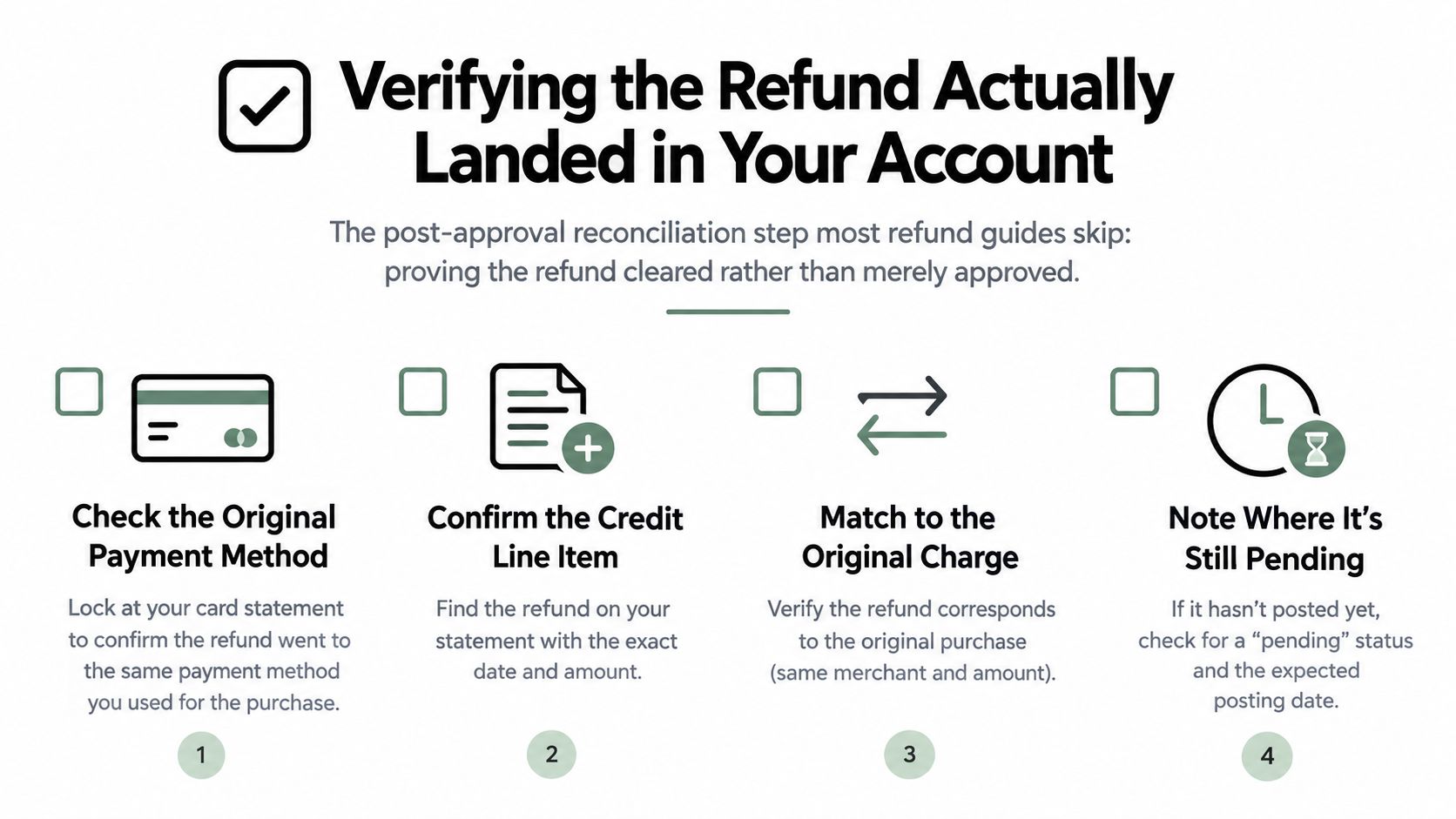
Check the original payment method, not just the merchant account. Review the card statement, PayPal balance, bank ledger, or wallet used for the purchase. Search for the merchant's legal name, payment processor, and the refund amount. A credit may appear under a processor name rather than the store name, and it may be pending before it becomes available.
Ask the merchant for four precise details:
- The date the refund was submitted
- The amount sent
- The destination account or original payment method
- The transaction trace or reference number
Match that trace to the original authorization. Compare the approved amount with the actual credit. Merchants sometimes refund the product but not shipping, issue a partial credit, or convert a return into store credit. Cross-border payments can also create a difference through currency conversion or intermediary-bank deductions. A foreign-transaction fee may not reverse cleanly even when the purchase itself is refunded.
Build a reconciliation record
Create a simple line item with the original charge, approved refund, actual credit, date posted, and remaining difference. If the merchant says the refund was sent but can't provide a trace, record that failure. If the trace exists but the credit doesn't, send it to the payment provider with the original receipt and approval message.
A practical refund-tracking workflow helps keep the approval record, expected credit, and actual statement entry together. Use the merchant's stated posting window as the follow-up point, then escalate if the credit remains absent.
The escalation must describe the right problem. You're no longer disputing the original purchase if the merchant confirmed a refund. You're reporting non-delivery of an agreed credit, supported by the approval record, trace request, and missing statement entry. Ask the card issuer or payment provider which dispute category fits. Don't submit a second claim that falsely describes the original purchase as unauthorized.
Using Automated Monitoring to Catch Refunds You Would Otherwise Miss
Manual checking fails because refunds hide across inboxes, statements, order portals, and calendar deadlines. An automated monitor should connect those signals and surface a concrete action, not merely announce that a transaction exists.
Look for four useful triggers:
- Confirmed but missing refund: An email or chat contains a refund confirmation, while the linked card or bank account shows no matching credit. The tool should prompt a trace-number request or a payment-provider escalation.
- Post-purchase price drop: A tracked order is followed by a lower product price. The tool should draft a price-adjustment request using the order number, original price, current price, and the merchant's policy.
- Late delivery or service failure: A promised delivery timestamp passes, or a service-level commitment is breached. The tool should identify the applicable credit process and prepare the supporting order record.
- Subscription billed after cancellation: A cancellation message predates a later recurring charge. The tool should separate the tasks, stop future billing, and seek a refund for the charge already posted.
A useful signal can be as specific as a refund email containing a confirmation and future posting language, a statement credit that doesn't match the approved amount, or a renewal charge after a cancellation date. The output should be a draft request, evidence list, deadline reminder, or dispute recommendation.
For readers assessing the difference between a merchant credit, reversal, and other recovery outcomes, this explanation of what the refund entails provides useful terminology. The point is not to automate every dispute. It is to prevent an approved credit, price adjustment, or cancellation window from disappearing in the noise.
Keep the safety net practical
A monitoring tool should use read-only account access where possible, show the source record behind each alert, and let you revoke individual connections. It shouldn't replace your judgment on whether a charge is unauthorized or whether a statutory exception applies.
You can also review a dedicated money leak finder when you want to locate missed credits, duplicate charges, recurring billing, and other transactions that deserve a closer look.
Your complete workflow is straightforward:
- Build the evidence file before support can delete or alter records.
- Ask the merchant clearly for the exact amount and original payment method.
- Choose the correct path instead of calling every failed purchase fraud.
- Calendar the deadline for the card, bank, platform, or legal process.
- Reconcile the approval against the statement until the credit appears.
- Use monitoring to catch promised refunds and missed opportunities after the manual claim ends.
Compass+ monitors linked financial, email, calendar, and shopping accounts to surface promised refunds, price drops, late-delivery credits, duplicate charges, and subscription issues with a concrete next step. If you want a background safety net for money you may be owed, visit Compass+ and join the waitlist.