Does Amazon Guarantee Delivery? What to Know
Does Amazon guarantee delivery? Learn how Prime, A-to-z, and shipping-fee refunds work, when you're owed a credit, and the exact steps to claim it.
17 min read
You watched the tracking page all day. The delivery window passed, the package still isn't at your door, and Amazon's app now gives you a vague update instead of an answer. The obvious question is, does Amazon guarantee delivery, or are you expected to accept the delay?
Amazon doesn't guarantee every order. Its policies create a conditional claims system with different remedies for guaranteed orders, Amazon-fulfilled purchases, and third-party marketplace transactions. The wording at checkout matters more than your Prime membership, the original estimate, or how late the package eventually becomes.
The practical rule is simple. Identify the promise Amazon made, match the order to the correct protection, and make the claim through the right route. If you treat every late package as automatically refundable, you'll often ask for the wrong remedy and leave money unrecovered.
Table of Contents
- The Short Answer Most Articles Get Wrong
- Estimated Delivery vs. Guaranteed Delivery
- What Makes a Delivery Date Actually Guaranteed
- Prime, A-to-z, and Marketplace Orders Compared
- Step-by-Step Path to Claiming a Late-Delivery Credit
- Common Misconceptions That Cost Shoppers Money
- Two Real-World Scenarios and How They Play Out
- Your Quick Reference for the Next Late Package
The Short Answer Most Articles Get Wrong
If the delivery date passes and your package is still missing, the answer depends on the promise shown at checkout. Amazon guarantees delivery only when the order has an eligible guaranteed delivery date and meets the conditions attached to that promise. If Amazon misses that date without attempting delivery, its official Delivery Guarantees policy says shipping fees tied to the order may be refunded.
That does not make every late package refundable. An estimated delivery date is a forecast. A guaranteed date is a specific checkout commitment connected to an eligible shipping method, address, inventory position, and order window. If the order shows only an estimate, customer service can deny a shipping-credit request even when the parcel is clearly late.
The claim starts with the checkout promise, not the tracking delay.
Third-party seller orders use a different protection. For qualifying marketplace purchases, Amazon's A-to-z Guarantee can cover an order that never arrives or an item with another covered problem. Amazon Pay's A-to-z terms state that protection can cover up to $2,500 of the purchase price, including shipping charges, subject to the policy's conditions. Sellers generally receive 48 hours to respond to a delivery complaint before the buyer can escalate through a claim (Amazon Pay's A-to-z Guarantee terms).
That is not an automatic late-delivery credit. The A-to-z route has separate eligibility rules and timing requirements. An Amazon-sold order, a marketplace order fulfilled by a third-party seller, and an order showing only an estimate can face the same delay while qualifying for different remedies.
Use the order record as your evidence. Save the checkout promise, check who fulfilled the order, and submit the claim through the route that matches those facts. “Guaranteed” is enforceable only when the order record proves that guarantee applied.
Estimated Delivery vs. Guaranteed Delivery
Amazon uses two different kinds of delivery language, and shoppers routinely treat them as interchangeable.
An estimated delivery date is Amazon's prediction. It may appear as a range, such as an estimated arrival across several days, or as a date that Amazon still labels estimated. That language tells you what Amazon expects, but it doesn't by itself create the shipping-fee remedy attached to a guaranteed delivery commitment.
A guaranteed delivery date is more precise. At checkout, Amazon may display language such as “Get it by” followed by a specific date, often alongside an “order within” countdown. The final checkout page is decisive because Amazon says the guarantee depends on placing the order within that window, keeping the shipping option available, and completing the purchase through an eligible route (Amazon's customer delivery guarantee conditions).
How to check the wording before paying
Look in three places:
- Product page: Find whether Amazon labels the arrival as guaranteed or estimated.
- Cart: Check whether the delivery line gives a specific promised date or an estimated range.
- Final checkout: Confirm that the date and shipping method remain available immediately before payment.
Don't rely on a product page you viewed earlier. Amazon notes that inventory and delivery capacity can change before checkout finishes, which can remove the previously displayed delivery day. The date that matters is the one attached to the completed order.
Why the distinction changes your remedy
If Amazon misses an eligible guaranteed date, the stated remedy is typically a refund of shipping fees associated with that order. If the order has only an estimate, you may still have a delivery complaint or an A-to-z route for a qualifying marketplace problem, but you shouldn't assume the guaranteed-shipping credit applies.
The fastest habit is to screenshot the final promise before buying expensive or time-sensitive items. That record gives you the exact wording Amazon used, rather than relying on a later memory of what the listing appeared to say.
What Makes a Delivery Date Actually Guaranteed
A delivery promise becomes enforceable only after the order clears several conditions. Amazon's terms make clear that the guarantee is conditional, and the final checkout screen can change the result shown earlier while you browse.
The checkout conditions that matter
| Condition | What to verify at checkout | What breaks the guarantee |
|---|---|---|
| Order timing | The order is placed while the displayed “order within” window is still active. | The countdown expires before payment is completed. |
| Eligible route | The item and shipping method qualify for the displayed guarantee. | The selected method or fulfillment path isn't eligible. |
| Address coverage | The destination accepts the promised service. | The address falls outside the applicable delivery coverage. |
| Available capacity | The promised day remains visible in the final checkout. | Inventory or delivery-capacity changes remove the date. |
| Successful order completion | Payment is accepted and the order is confirmed with the promise attached. | The card charge fails or the order doesn't complete as shown. |
Amazon's customer terms also identify events outside its control, such as strikes or severe weather, as exclusions. That means a delivery date can appear guaranteed at checkout and still fall outside the remedy when an excluded disruption causes the delay.
The shipping method matters as much as the item. A product can qualify for fast delivery under one option but lose the promise when you select another method, change the address, or combine it with an item that can't share the same fulfillment window.
Treat the order record as your evidence
Open the order details after purchase and compare the confirmed date with the delivery result. Keep the order number, promised date, shipping method, and tracking history together. Customer service can see the order record, but a clean timeline makes it harder for the conversation to drift toward a generic estimated date.
Practical rule: Never argue only that “the package is late.” State the exact guaranteed date, the shipping method shown at checkout, and the remedy Amazon's policy attaches to that missed promise.
For seller-fulfilled products, Amazon also uses operational performance rules. In the U.S., seller-fulfilled products must maintain at least a 90% on-time delivery rate without promise extensions, while Amazon says promise extensions may be added when performance falls below 95% in some contexts (Amazon seller-fulfilled delivery guidance). Those seller metrics help explain why Amazon may adjust a promise before checkout rather than expose the customer to a commitment it expects a seller or carrier to miss.
Prime, A-to-z, and Marketplace Orders Compared
A Prime badge does not decide the remedy. The order's fulfillment model and checkout promise do. Match those details to the applicable claim route before contacting support.
An Amazon-fulfilled order with a guaranteed date usually points to a shipping-fee remedy if Amazon misses that commitment. It does not automatically turn into a refund of the product price. The delivery guarantee generally concerns the shipping charge for the promised service.
Marketplace orders work differently. A third-party seller order may qualify for the A-to-z Guarantee when the package is not delivered on time or another covered problem occurs. That protection requires an eligible claim and review. It is not an automatic credit for every late arrival.
| Order type | Guarantee or protection | Trigger condition | Filing deadline or timing | Likely outcome |
|---|---|---|---|---|
| Amazon-fulfilled order with a guaranteed date | Amazon's delivery guarantee | No delivery attempt by the stated guaranteed date | Use the order's policy and customer-service route promptly | Shipping-fee refund tied to the order |
| Seller-fulfilled marketplace order | A-to-z Guarantee, if eligible | The package remains undelivered under the policy's timing rules, or another covered issue applies | Buyer generally waits until 3 days after the latest estimated delivery date before filing when the order still has not arrived | A claim review, potentially including the purchase price and shipping charges within the policy limit |
| Order with an estimate only | No guaranteed-date shipping promise | The estimate passes without delivery | Use the available seller, return, or A-to-z process if the order qualifies | No automatic guaranteed-delivery shipping credit |
| Mixed or otherwise ineligible order | The protection shown on the final order record | The final checkout no longer carries the eligible promise | Check the actual order details, not the earlier product page | Remedy depends on the surviving policy and fulfillment route |
The table's practical lesson is simple: identify the party responsible for fulfillment, then confirm whether checkout displayed a guaranteed date. An estimated date can support a late-order complaint, but it does not create the same shipping-credit claim as a missed guarantee.
For Amazon-fulfilled orders, start with the delivery guarantee route. For eligible marketplace orders, use the seller contact and A-to-z process instead of treating Prime status as blanket protection. If the final order record shows no qualifying promise, ask for the remedy attached to that order type, not the remedy advertised for a different shipping option.
The A-to-z terms also impose eligibility requirements and a policy limit. A claim can cover qualifying purchase and shipping amounts within that framework, but approval depends on the facts and the supporting order record. Keep the guaranteed or estimated date, fulfillment label, seller identity, and tracking history aligned with the route you choose.
Step-by-Step Path to Claiming a Late-Delivery Credit
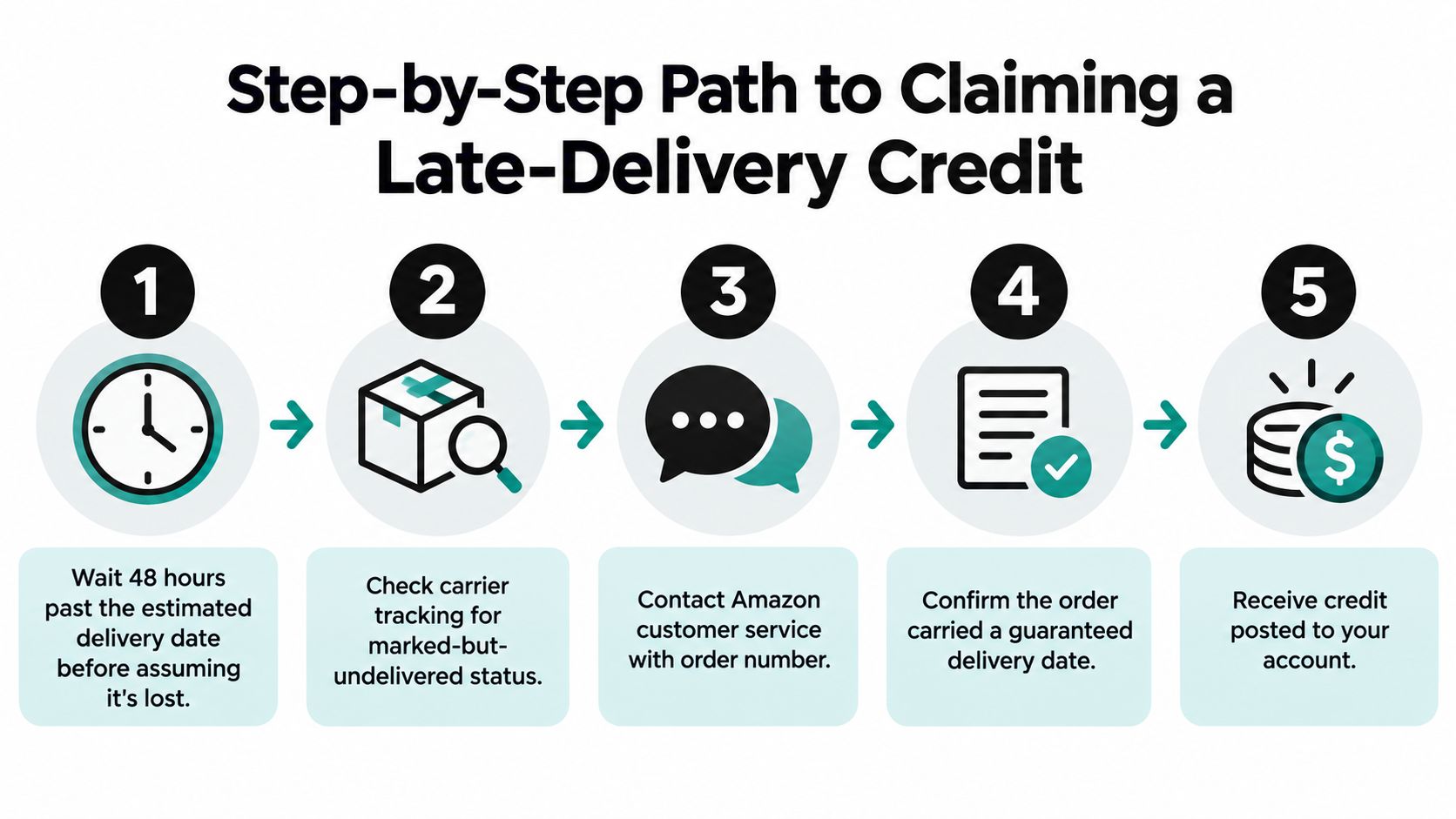
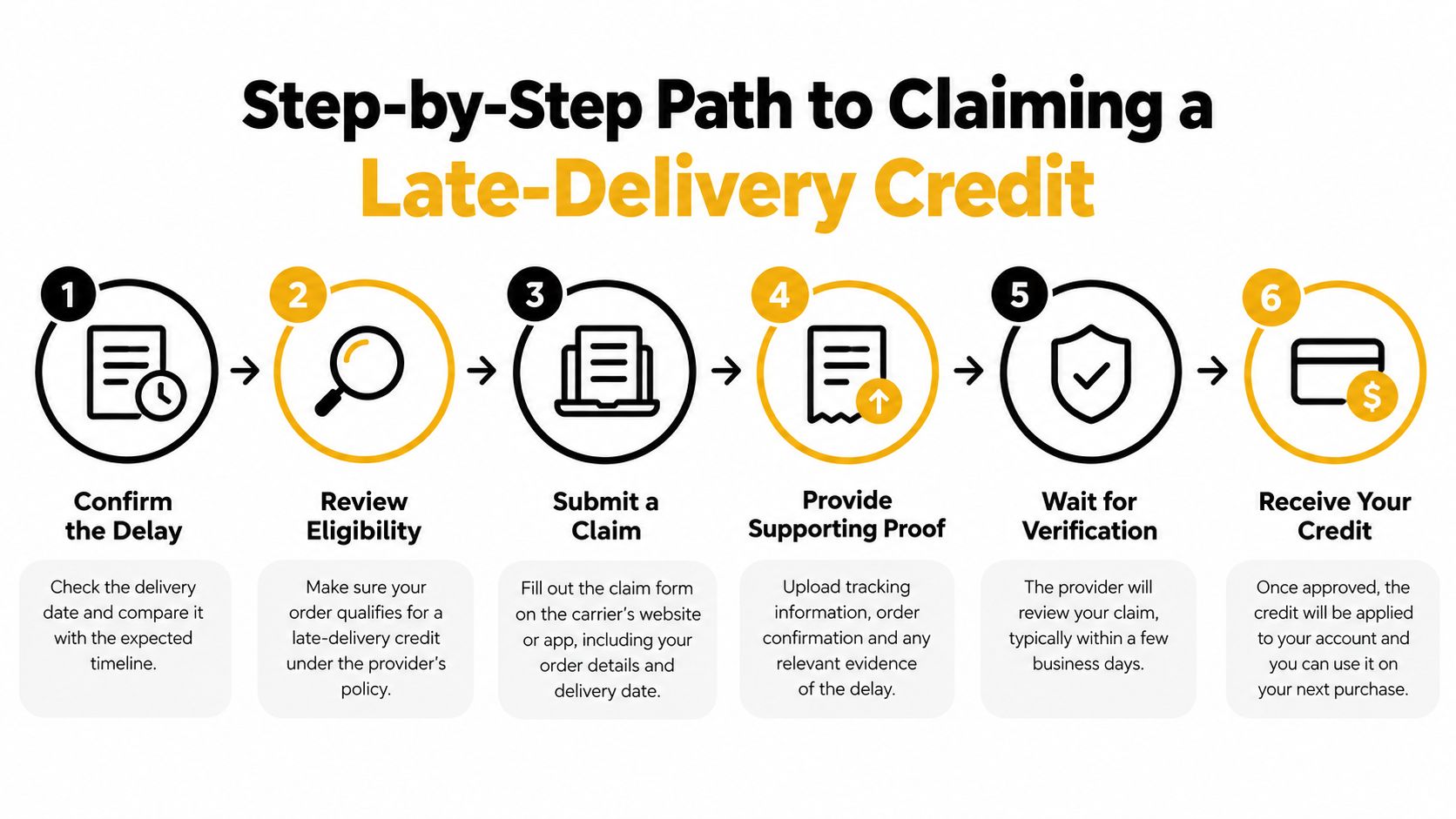
Start by recording the facts, not by venting in chat. Save the promised or estimated date, the tracking status, the seller name, the fulfillment label, and the shipping charge. The right sequence depends on whether Amazon or a marketplace seller handled the order.
Use this claim sequence
Check the final order promise. Open Your Orders and inspect the delivery line. Confirm whether Amazon recorded a guaranteed date or only an estimate.
Review tracking. Look for a delivery scan, an attempted delivery, or a status that says delivered while the parcel is missing. Don't treat a stale scan as proof that Amazon met the promise.
Choose the correct first contact. For a marketplace purchase, contact the seller through Your Orders and describe the missing or late delivery. Amazon's A-to-z process expects the seller to have an opportunity to respond.
Wait for the applicable milestone. For an undelivered marketplace order, Amazon's policy generally requires waiting until three days after the latest estimated delivery date before filing. If the seller receives a delivery complaint, the policy gives the seller 48 hours to respond.
Escalate through the matching route. Use Amazon's customer-service or order-issue flow for an Amazon-fulfilled guaranteed order. For an eligible third-party order that remains unresolved, file through A-to-z rather than repeatedly reopening a general chat.
State the remedy clearly. Ask for the shipping-fee refund when Amazon missed a guaranteed date. Ask for an A-to-z review when the marketplace order meets that policy's delivery conditions.
Seller-fulfilled and Amazon-fulfilled delays often have different causes, so this explanation of MFN vs FBA delay causes can help you interpret the tracking history before choosing an escalation path.
Keep the written record tight
Use Your Orders, Problem with order, select the reason, then choose the refund type where those options appear. If Amazon's interface doesn't show the expected option, use customer service and quote the exact order details instead of describing the issue as a general late package.
For a separate guide to the mechanics of following a refund after submission, see how to track a refund. Check the account activity and the original payment method after Amazon confirms the remedy. A promise that a credit was issued isn't the same as verifying that it posted.
Common Misconceptions That Cost Shoppers Money
The most expensive mistake is assuming Prime equals a blanket delivery guarantee. Prime may provide access to delivery options, but the order still needs an eligible promise at checkout. Amazon's terms also exclude certain disruptions outside its control, including severe weather and strikes, so membership doesn't override the policy conditions.
Five beliefs to discard
“Every late Prime package gets an automatic refund.” Incorrect. The shipping-fee remedy depends on a guaranteed date being attached to the eligible order. An estimated date that slips doesn't automatically become a guaranteed claim.
“A late parcel qualifies for the full item price.” Usually not under the delivery-fee remedy. The stated Amazon delivery guarantee focuses on shipping fees associated with the order. A-to-z protection is a separate policy with broader potential coverage for qualifying marketplace problems, but it still requires eligibility.
“Amazon will notice and issue the credit first.” Don't wait for that. A missed promise may be visible in the account, but you should verify the order record and initiate the request yourself.
“A-to-z applies to every marketplace delay.” It doesn't. The order must fall within the program, and the buyer must follow the timing and seller-contact requirements. Amazon can deny a claim that skips those steps.
“The product page is enough proof.” It isn't always. Amazon says inventory or delivery capacity can change before checkout, so the final confirmed order record carries more weight than an earlier browsing screen.
A late package is a fact. A refundable late delivery is a fact plus the right policy, the right timestamp, and the right claim route.
Customer-service phone calls aren't automatically superior either. A concise written request through the order page gives you a record and keeps the discussion tied to the order number, date, and shipping charge. If you want a broader way to identify overlooked refunds and other recoverable spending, find money you're owed or wasting offers a useful checklist for reviewing those opportunities.
Two Real-World Scenarios and How They Play Out
Consider an Amazon-fulfilled order for a laptop. At checkout, the order displays a specific guaranteed delivery date and an eligible shipping method. The parcel arrives after that date.
The buyer should open the order details, confirm that the guaranteed date survived checkout, and request the shipping-fee remedy through the order-issue flow. The buyer shouldn't demand the entire laptop price merely because the delivery was late. The relevant promise concerns the delivery service, while a product-price refund would require a different basis, such as a return or another covered problem.
Now compare a kitchen gadget sold by a third-party marketplace seller. The order shows only an estimated delivery range, and the parcel arrives after the latest estimated date. The delay is frustrating, but the buyer can't convert an estimate into a guaranteed-date shipping claim after the fact.
What changes the result
The first buyer has a documented guaranteed promise connected to the order. The second buyer has a marketplace transaction with an estimate, so the next question is whether the A-to-z Guarantee covers the non-delivery or another qualifying issue. The buyer should contact the seller through Amazon, preserve the tracking record, and use A-to-z only if the policy's timing and eligibility rules are satisfied.
| Question | Guaranteed Amazon-fulfilled order | Estimated marketplace order |
|---|---|---|
| What must be proved? | The final order carried the guaranteed date and eligible route | The order qualifies for marketplace protection and meets its timing rules |
| What should the buyer request? | The applicable shipping-fee remedy | Seller resolution first, then A-to-z review if eligible |
| What shouldn't the buyer assume? | That the full item price is refundable | That a late estimate creates a guaranteed shipping credit |
The order type, not the general reputation of Amazon, controls the outcome. Two parcels can arrive equally late while producing entirely different rights.
Your Quick Reference for the Next Late Package
Save this checklist before a delivery problem starts. It keeps the claim tied to the order record, not to frustration or assumptions about Amazon's general practices.
Identify the order
- Amazon fulfillment: Confirm who shipped the item and whether the completed order shows a guaranteed delivery date.
- Marketplace seller: Record the seller, shipping status, latest estimated date, and any seller-provided tracking.
- Mixed cart: Review each item separately. Items in one checkout can have different fulfillment routes and delivery terms.
- Subscription order: Use the promise shown for the current shipment. An earlier delivery history does not replace the current order record.
Match the delay to the remedy
- Guaranteed date missed: Request the shipping-fee remedy tied to that promise.
- Marketplace item not delivered: Contact the seller first, follow the applicable timing rules, and use A-to-z if the order qualifies.
- Estimate missed: Treat the delay as an estimated-date problem, then check the available seller, return, or marketplace protection.
- Condition problem: File an item-condition request separately from a late-delivery request. Combining them can obscure which rule applies.
Keep the timeline
Save the final promised date, latest estimated date, tracking events, seller messages, and shipping charge. For an undelivered third-party order, Amazon's delivery policy uses 3 days after the latest estimated delivery date as a filing milestone in the circumstances described above. Seller complaints have a 48-hour response window.
Review the exclusions before filing. Address coverage, shipping method, order timing, payment completion, and outside events can affect whether a promise applies. Use the Money Leak Finder to flag delivery losses, missed refunds, price adjustments, or duplicate charges that deserve a closer review.
Before you submit anything, confirm three facts on the order record: the promised date, the fulfillment model, and the shipping charge. Those details point you to the correct claim route and show what remedy to request.
Compass+ monitors connected shopping and financial information for missed late-delivery credits, unclaimed refunds, duplicate charges, and post-purchase price drops. Visit Compass+ to join the waitlist or see how its savings assistant identifies a practical recovery step.