Where Did the Money Go: How to Trace Each Charge
Where did the money go? Trace unexplained charges with bank records and receipts, recover refunds, and stop repeat payments before the next billing cycle.
15 min read
You open your bank app expecting the balance to look healthier. Instead, there's a merchant you don't recognize, a familiar bill that looks higher, and a charge from something you thought you'd cancelled. You scroll through the statement asking, where did the money go?
Don't start by blaming your budget. Start by finding the record that explains each charge, then decide whether to accept it, stop it, or recover it. A spending category tells you where money went; a receipt, cancellation confirmation, or refund reference tells you whether it should have gone there at all.
Table of Contents
- Sort Every Unexplained Charge by Its Likely Cause
- Records That Prove Where a Charge Came From
- How to Trace a Charge Step by Step
- Recover the Money or Stop the Charge Fast
- What to Do When a Merchant Says the Case Is Closed
- Confirm Which Charges to Chase First
Sort Every Unexplained Charge by Its Likely Cause
| Pattern | Most Likely Cause | Where to Confirm | Evidence to Save |
|---|---|---|---|
| Same merchant, same amount every month | Active subscription or membership | Bank statement, merchant account page, renewal email | Cancellation confirmation and its date |
| Two identical charges on one day | Duplicate billing or double submission | Pending versus posted transactions in the bank app | Both transaction IDs and the order number |
| Charge slightly above last month | Silent price increase on an existing plan | Prior statements and plan terms emails | Old and new amounts side by side |
| Unfamiliar merchant name | Renamed merchant, marketplace seller or trial conversion | Card app merchant details and order history search by amount | Order confirmation or receipt |
| Charge after you cancelled | Cancellation not processed or charged to another account | Cancellation confirmation and bank posting dates | Screenshot showing date and reference number |
| Expected refund never appeared | Refund pending, partial, or sent to an old card | Merchant refund confirmation and card statement | Refund ID and the promised amount |
| Charge for a late or repriced order | Missed delivery guarantee or post-purchase price drop | Delivery tracking and the order page | Tracking record and the price shown at checkout |
Treat these as starting hypotheses, not verdicts. A repeating charge might be a service you want. An unfamiliar descriptor might belong to a legitimate purchase made through a payment processor.
For apparent duplicates, expand both entries before contacting the merchant. A pending authorization alongside a completed charge isn't necessarily duplicate billing. If both entries have posted, use the duplicate-charge checking guide to organize the transaction details before requesting a correction.
Separate familiar spending from wanted spending
Recognition isn't the same as consent to keep paying. In a 2025 CNET survey conducted with YouGov, U.S. adults who paid for subscriptions reported spending $17 per month on subscriptions they didn't use, while Gen Z respondents reported approximately $23 per month.
These charges are easy to leave alone because nothing looks obviously wrong. The merchant name is familiar, the payment succeeds, and you don't have to make another purchase decision. Check actual use before marking the charge as expected.
An increased bill needs a different test: compare the same plan, billing period, and included services. A delivery or price-adjustment claim needs the merchant's applicable promise, not just evidence that an order arrived late or later became cheaper.
If you discuss household spending with an adviser, keep the decisions alongside the records. VoxNote's financial advisor call summaries can be a useful reference for those discussions, but they don't replace transaction evidence.
Before opening another app or calling a merchant, match the charge to a row. That keeps your search narrow and your evidence organized.
Records That Prove Where a Charge Came From
No single record proves the whole story. Your bank shows that money moved. The merchant's receipt explains what it was meant to buy. The strongest match connects those records without asking either to prove something it can't.
| Record | What it proves | What it cannot prove |
|---|---|---|
| Bank or card transaction | Amount, date and merchant descriptor | What was actually bought |
| Email receipt or order confirmation | Promised price, items and order ID | Whether the item arrived |
| Renewal notice or plan terms email | Plan name, renewal date and renewal price | Whether you still use the service |
| Delivery record | Recorded delivery status and timing | Whether the price charged was correct |
| Calendar entry | Trial end date and return window you recorded | Whether a cancellation was processed |
| Subscription list | Memberships you have recorded | Whether unrecorded app-store subscriptions exist |
| Cancellation confirmation | Date and reference number of the cancellation | Whether the merchant stopped billing |
Choose the record that answers the question
If the amount is wrong, open the receipt and compare the total with the posted payment. Check tax, shipping, discounts, and whether the merchant split the order into separate shipments. Don't compare the bank debit with the product's advertised price alone.
If delivery is disputed, save the tracking history rather than only the current status. A delivered label doesn't establish that the parcel reached the correct address. Preserve delivery photographs and merchant messages where available.
For subscriptions, check Apple or Google subscription settings separately from the merchant's website. A list you've maintained yourself is an index, not a complete inventory. Household members may also have separate accounts using the same payment card.
Evidence rule: Save the record that establishes the promise and the record that shows what actually happened.
Checking by hand works well for an isolated purchase. A spreadsheet with columns for merchant, order reference, bank entry, evidence location, and next action is usually enough. Automatic connections become more useful when the difficulty is keeping up with scattered records, rather than understanding a particular transaction.
At Compass+, our financial, email, calendar, and shopping connections are opt-in and individually revocable. Our current bank connection is read-only: it can view balances and transactions, can't move money, and we don't store banking passwords. Disconnecting a bank doesn't delete transactions already imported; those remain until you delete the account. Decide which records you're comfortable connecting and which you'll check manually.
How to Trace a Charge Step by Step
Build a short case file for each unexplained entry. Use a spreadsheet or a note with attachments, not a collection of screenshots whose purpose you'll have to reconstruct later.
Follow the transaction, not your memory
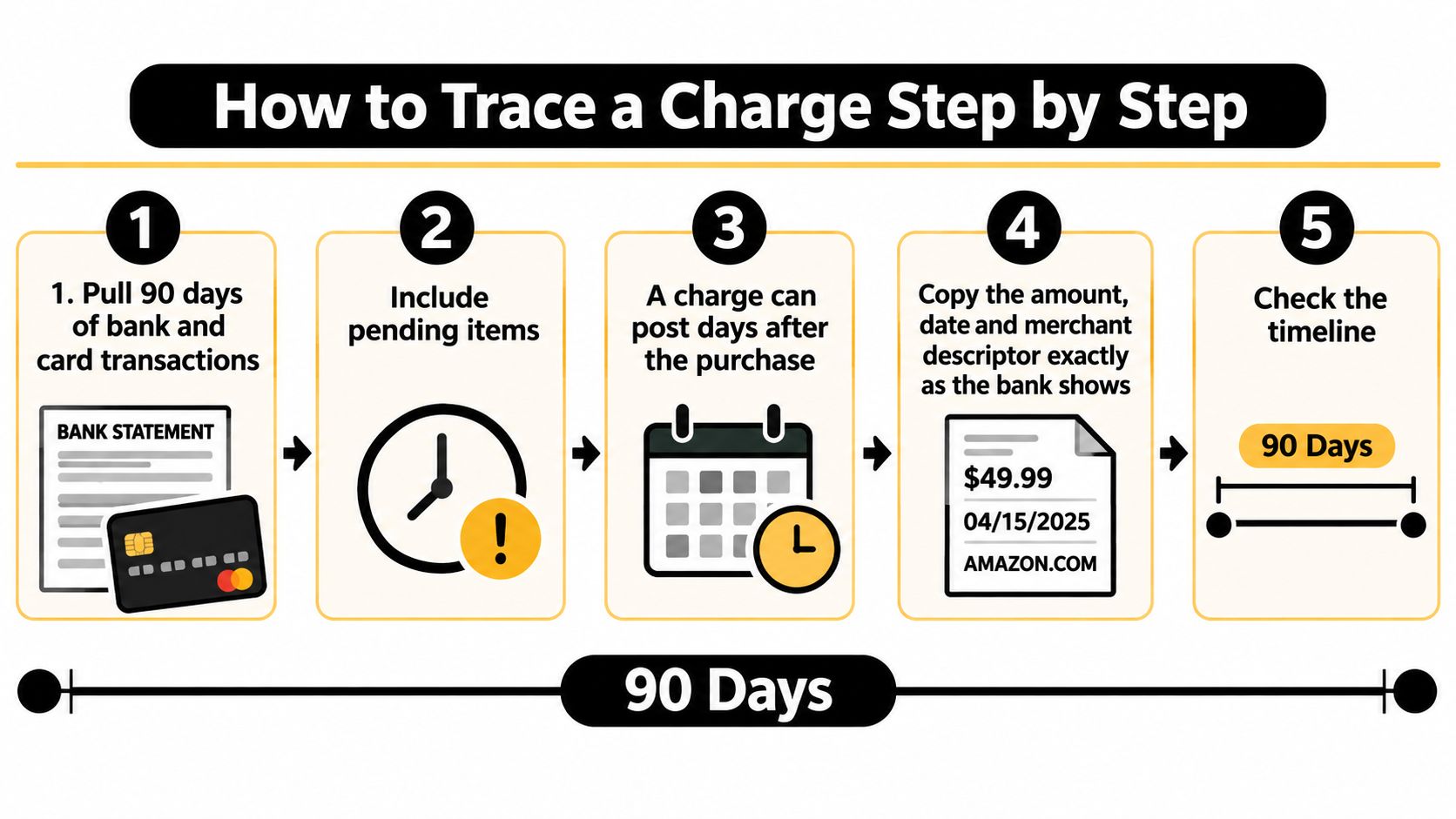
Pull a useful stretch of bank and card history. Include the period around the purchase and earlier statements that could reveal a repeating payment. Keep pending items visible but separate, because an authorization can later post with a different amount or description.
Copy the amount, transaction date, posting date, and merchant descriptor exactly as displayed. Don't replace an unfamiliar descriptor with the brand you think it means; that can hide the clue you need to find the payment processor or parent company.
Search your inbox using different identifiers. Try the exact amount, descriptor fragments, order references, and terms such as renewal, receipt, or refund. Search archived messages and the email address used at checkout, not just your primary inbox.
Open the merchant's account or order history and compare the candidate purchase. Check the payment method, order total, purchase date, and any split shipments; a matching amount alone isn't enough to establish a match.
Assign a charge pattern and test it. For a repeating payment, look for a renewal notice; for a missing credit, find the refund confirmation. If the recurring-payment trail is incomplete, use this guide to find all your subscriptions rather than guessing from merchant names.
Compare the proposed explanation with the bank entry before taking action. Check anything you intend to act on against your bank, and record whether the debit is pending, posted, reversed, or offset by a credit.
Handle entries without a useful merchant name
Cash withdrawals, person-to-person transfers, and payments to individuals need another route. Search the bank's memo field and payee name, then open the payment app's history using the date and amount. For cash, look for your own spending notes or a withdrawal receipt; the ATM entry can't tell you what you bought afterward.
Don't force an explanation because the timing seems plausible. Say a transfer appears near a dinner reservation: that doesn't prove it was your share of the meal. A payment note or message from the recipient gives you a stronger connection.
Finish with a verdict:
- Expected: The record matches a purchase or commitment you recognize and accept.
- Unwanted: You recognize the payment but want to stop future billing or pursue an available remedy.
- Still unclear: The evidence doesn't establish the purpose or authorization.
An unwanted charge isn't automatically unauthorized, and an unclear charge isn't automatically fraud. If you suspect someone used your account without permission, contact your bank promptly rather than waiting to complete an inbox search.
Recover the Money or Stop the Charge Fast
| Issue | Typical Window | First Action |
|---|---|---|
| Unauthorized debit card or bank transfer | Report immediately; ask the bank which reporting deadline and protections apply | Report to the bank in writing and ask whether provisional credit is available |
| Billing error on a credit card | The applicable billing-error deadline confirmed by your issuer | Submit a written dispute through the issuer's designated process |
| Goods not received or not as described | The card network and issuer's applicable dispute window | Ask the merchant in writing first, then open a card dispute within the issuer's window |
| Promised refund not posted | The merchant's stated processing time on its confirmation | Follow up with the refund ID, then escalate after the stated time passes |
| Subscription billing after cancellation | Act before another renewal and within the applicable dispute deadline | Confirm cancellation in writing, then challenge charges inconsistent with its effective date |
Record the deadline your issuer gives you. Don't assume that a merchant investigation pauses the time available to dispute a payment. Ask where to send supporting documents and retain proof of submission.
Take the recovery action that fits
Request the refund in writing. Include the order ID, charge date, amount, reason, and remedy you want. A specific request is easier to assess than a general complaint about poor service.
If the merchant refuses or misses its stated response time, contact your card issuer or bank before the applicable window closes. Describe the issue accurately: duplicate payment, goods not received, incorrect amount, or another supported category.
Stop ongoing billing through the correct account. Keep the cancellation's effective date and terms, then challenge later charges that conflict with them. A posting date alone doesn't establish when the merchant initiated the charge.
For an unauthorized debit, report it promptly and follow up in writing. Ask the bank about provisional credit and account-security measures; don't assume either a refund or temporary credit is guaranteed.
A promised payment still needs follow-through. Across 25 refund programs closed in 2024, the FTC's refund report says the agency returned more than $148 million, yet only 59% of eligible consumers had cashed or otherwise collected their payments when it reported.
A refund confirmation proves a promise. A completed credit proves that you received the money.
Keep a pending recovery open until you can match the credit to the original payment. Check partial refunds and the original payment account, including a replaced card's associated account. Use a refund-tracking checklist to distinguish an overdue promise from a credit that already arrived.
What to Do When a Merchant Says the Case Is Closed
A merchant may say its system shows an active membership, that it can't find your cancellation, or that it has already issued the refund. A closed support case is the merchant's position, not independent proof that the billing was correct.
Ask for a written decision identifying the relevant policy and the records the merchant relied on. Then answer the specific objection rather than sending the same complaint again.
Replace repeated complaints with an evidence chain
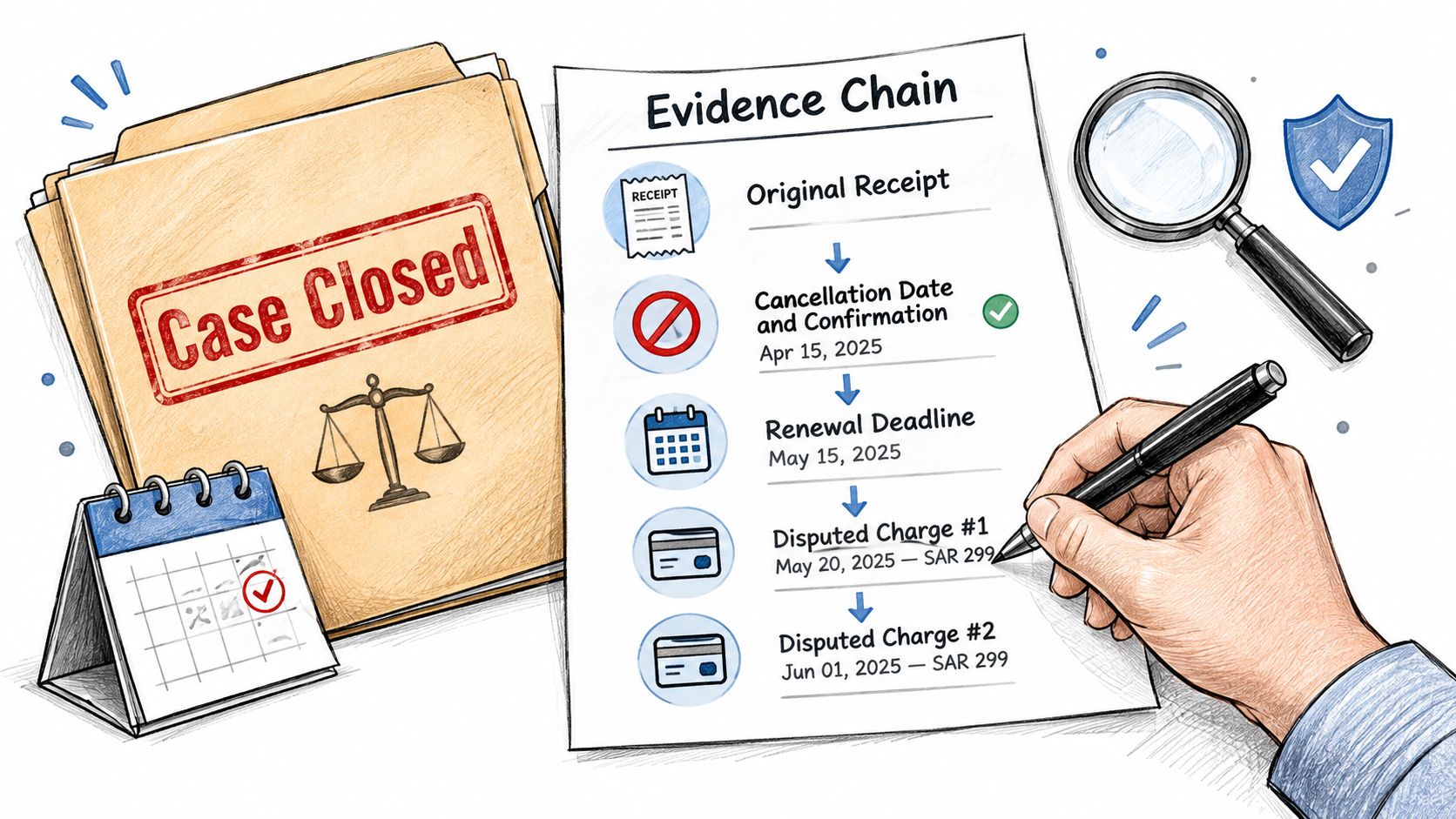
Build a concise chronology connecting the original receipt, renewal deadline, cancellation request and confirmation, disputed payment, merchant response, and any refund posting. Distinguish the date you requested cancellation from the date the merchant said it would take effect.
If the merchant says you never cancelled, provide the confirmation and account identifier. If it says you used a different account, compare the login email and payment details. If it says the refund was issued, request its reference and destination so your bank can investigate.
These aren't merely hypothetical obstacles. In April 2025, the FTC alleged that Uber One enrolled some consumers without consent, charged some before free trials ended, and required as many as 23 screens and 32 actions to cancel. Those were allegations, not a finding about your particular charge.
Take your chronology to the issuer if the merchant's explanation doesn't resolve the discrepancy. If you want help organizing the submission, AmaJova offers help with transaction disputes; keep your own copies and confirm the issuer's deadline independently.
Preserve:
- Dated screenshots: Include the account identity and full confirmation.
- Reference numbers: Keep order, cancellation, refund, and support identifiers together.
- Complete messages: Save the full correspondence, not cropped excerpts that omit conditions.
Confirm Which Charges to Chase First
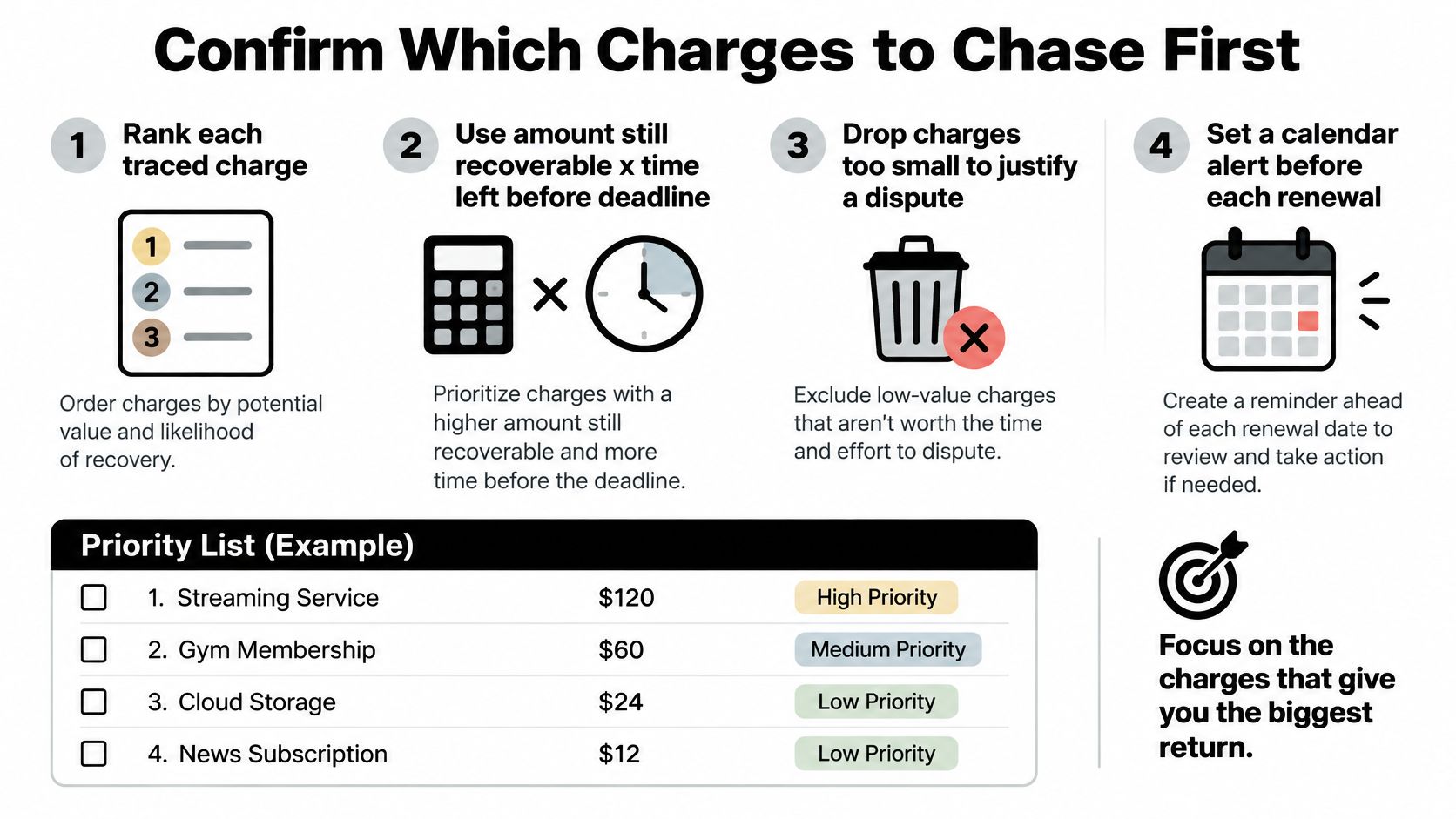
Prioritize credible recoverable value, urgency, and effort. A large, well-supported claim deserves attention, but a smaller claim with an imminent deadline may need action first. Don't multiply the recoverable amount by time remaining: that would favor cases whose deadlines are farther away.
Start with the amount you can recover, not the entire historical spend. Then identify the earliest action deadline and the evidence you already hold. Separate money recoverable now from future spending you can prevent by cancelling or downgrading.
Put reminders before the decision deadline
In a randomized field experiment described by HEC Paris, consumers who preferred to cancel had an estimated 81–85% monthly probability of failing to cancel. That's a finding from a particular subscription experiment, not a prediction about every household, but it supports a practical recommendation: schedule the decision before renewal.
Use the cancellation cutoff in the plan terms, not merely the next payment date. Leave yourself time to regain account access, identify the correct billing platform, and save confirmation. An alert after the debit posts is useful for detection, but too late for prevention.
Avoid these mistakes:
- Treating recurrence as waste: Keep services you use and value. Downgrading may fit better than cancelling.
- Overlooking annual renewals: Search renewal emails and longer account histories, not only recent monthly payments.
- Mistaking installments for memberships: Ending access to a service doesn't necessarily extinguish a purchase obligation.
- Spending too much effort on weak claims: An inexpensive written request may be worthwhile when a prolonged dispute isn't.
Practical priority: Act first where the evidence is strong and waiting could remove your options.
Give each open item an owner and follow-up date
For your weekly review, select a short list of charges you can realistically resolve. Write the first deadline beside each, send a separate written request for each issue, and set a follow-up tied to the merchant's promised response or your issuer's deadline.
If expenses are shared, name the person responsible for cancelling or submitting the claim. Otherwise, each household member may assume someone else has handled it. Mark the item complete only when the action is confirmed, not when someone agrees to do it.
Judge your routine by money recovered, unwanted billing stopped, and unresolved cases reduced. A long subscription list or a busy notification feed isn't the result you're after. Each charge should leave you with a defensible verdict and a next action you can take.
Compass+ monitors connected accounts for subscriptions, missing refunds, duplicate or increased charges, and other opportunities, pairing each finding with an estimated amount and a concrete next step. Visit Compass+ to explore the approach and join the waitlist for the standalone experience, then verify any finding against your bank before acting.