Unclaimed Money Owed to Me and How to Claim It
Find unclaimed money owed to me in state databases, FTC refunds, and merchant credits, then verify the claim and skip anyone who charges a fee.
16 min read
State unclaimed-property programs returned about $4.49 billion to owners in fiscal year 2024, and the same NAUPA annual report release shows why that headline is a poor guide to what you'll find: the average claim paid through MissingMoney.com was $2,080, while the median was $100. Half the claims were worth $100 or less, and a handful of large ones dragged the average upward.
That comparison reframes the whole search. Many people who look find something modest. Plenty find nothing at all.
The phrase unclaimed money owed to me also covers money that will never appear in a state database. Federal enforcement refunds, merchant credits, late-delivery promises and price adjustments all sit outside the state system, and several of them expire on a store's deadline rather than a statute's.
The work comes down to three questions. Who holds the money, what makes it yours, and how do you prove it before a deadline or an impersonator gets there first.
Table of Contents
- Where Unclaimed Money Sits and Why Some Expires
- Documents That Prove the Money Is Yours
- How to Search and File a Real Claim
- Real Payouts and Fee Scam Checks
- Tracking Merchant Credits Before They Expire
- Check Official Records Then Watch Everyday Credits
Where Unclaimed Money Sits and Why Some Expires
Money owed to you may be held by a state office, a federal agency, or the business that owes it. The holder determines where to search, what proof to gather, and how long you have to act. A state database covers only property reported to the state; it will not show every refund or credit waiting elsewhere.
State unclaimed-property offices hold dormant bank balances, uncashed checks, insurance proceeds, utility deposits and securities. Federal agencies may issue refunds from enforcement cases. Landlords, utilities, insurers, stores and former employers can also owe money directly, under their own rules and deadlines.
The amounts often begin with routine transactions: an overpayment, a returned deposit, an uncashed paycheck or an abandoned account. State notices show how broad the category can be. For example, state treasury unclaimed-property notices report additional unclaimed property available to claim in Tennessee.
| Source | Who holds it | Published scale or typical claim | Where to look first |
|---|---|---|---|
| Forgotten bank accounts, uncashed checks, insurance, utility deposits, securities | State unclaimed-property office | About $4.49 billion returned by NAUPA programs in FY2024; average claim $2,080, median $100 | Official state site or MissingMoney.com, every state lived or worked in |
| FTC law-enforcement refunds | FTC, by check or electronic payment | $337.3 million sent in 2024; average $127.58 in closed programs; 59% of eligible consumers had cashed payments | The FTC case page, not a texted link |
| Uncashed paychecks and employer payments | Employer, then a state if reported as dormant | Counted inside the dormant-asset total; no separate national average | Former employer's payroll or HR desk, then states where you worked |
| Rental and utility deposits | Landlord or utility, then a state if unclaimed | Small per claim; most resolve with the landlord before any state filing | Lease or final bill, then the state database |
| Healthcare or other overpayments | Provider, insurer, or later a state | No single published median; read the explanation of benefits line by line | Statement and EOB, then a state search |
| Merchant refunds, price adjustments, late-delivery credits | The store, usually on a deadline | Not counted in the $4.49 billion state total | Receipt, order email, and card statement |
| Abandoned gift certificates where state law requires reporting | State, after the holder reports them | Reporting rules differ by state; the amount is whatever the card still holds | State unclaimed-property search |
Why the median claim matters more than the average
The $2,080 average and $100 median describe the same group of payments. A few large claims, such as an estate's brokerage account or a forgotten certificate of deposit, can pull the average far above what a typical claimant receives. At least half of the claims paid were worth $100 or less.
A small database match is ordinary. A utility deposit, an uncashed payroll check and a refund check can all be paid at face value, even if the amount is modest.
The coat check and the coupon
A coat left at a cloakroom may eventually go to a central lost-property office, where its owner can retrieve it with a ticket. A coupon, by contrast, may expire where it sits. The distinction helps explain why one search cannot find every kind of money.
Dormant accounts, uncashed checks and insurance proceeds follow the coat-check path. The holder keeps the property, tries to reach its owner, then reports it to the state. The state holds it until the owner or an heir files a claim. Merchant credits follow the coupon path. A store refund, price adjustment, late-delivery credit or gift card may have a deadline set by the store. It will not appear in a state search unless the property is later reported under applicable state rules.
That difference changes where to start. Retirement balances can move from an employer plan to state unclaimed property if an employer loses track of a former worker and a small plan balance is paid out. To trace a workplace account, start with the employer and the year you left. These steps to trace an old 401(k) can help identify where to look.
Before searching, note which state connects to each item: one where you lived or worked, a former employer, or a purchase with a promised credit. Then follow the holder's trail. For a state-held account, search the relevant state records; for an everyday merchant credit, check the receipt, order email and card statement, and keep the store's deadline in view.
Documents That Prove the Money Is Yours
A hit in a state database means one thing: the state holds a record with a name on it. It doesn't mean you're the owner, and it doesn't mean a payment is waiting. Claims offices pay on documents, and the documents come in layers.
The file a living owner assembles
- A current government photo ID. Driver's license or passport, unexpired and in the name you're claiming under.
- Identity details that match the record. Your name, and often a Social Security or taxpayer number entered only on the official claim form, never in an email reply.
- Proof of the address on the record. An old lease, utility bill, bank statement or tax return ties a former street and a former name to the person filing now.
- A link to the holder. An account statement, policy page, pay stub or closing letter showing the account the money came from.
What an heir has to add
A death certificate proves the original owner died. An authority document proves who may act for the estate: letters testamentary, a small-estate affidavit, or whichever paper your state names. Some offices also want evidence of the relationship.
If no estate was ever opened because the amount is modest, call the claims office and ask which affidavit it accepts before you pay anyone to draft one. Small estates usually have a short form, and the office will name it for free.
A match proves a record exists. Documents prove the record is yours, and that's the only thing a claims office pays on.
Duplicate claims are the quiet time-waster. When two relatives file for the same property, the office has to resolve both before it pays either, so pick one filer per property and tell the other relative who filed.
When the money is a store credit
The proof is shorter and looks nothing like a probate file: the order number, the refund promise in an email, the delivery date, and the card statement line showing the charge. Keep those four together in one place.
Four things decide whether a claim moves: identity, a documented connection to the address or account, authority if you aren't the original owner, and a single filing path. If one is missing, the office will ask, and asking costs weeks.
How to Search and File a Real Claim
The order of operations matters more than the effort. Most searches fail early, when someone clicks a lookalike site and pays for a lookup that every state offers free.
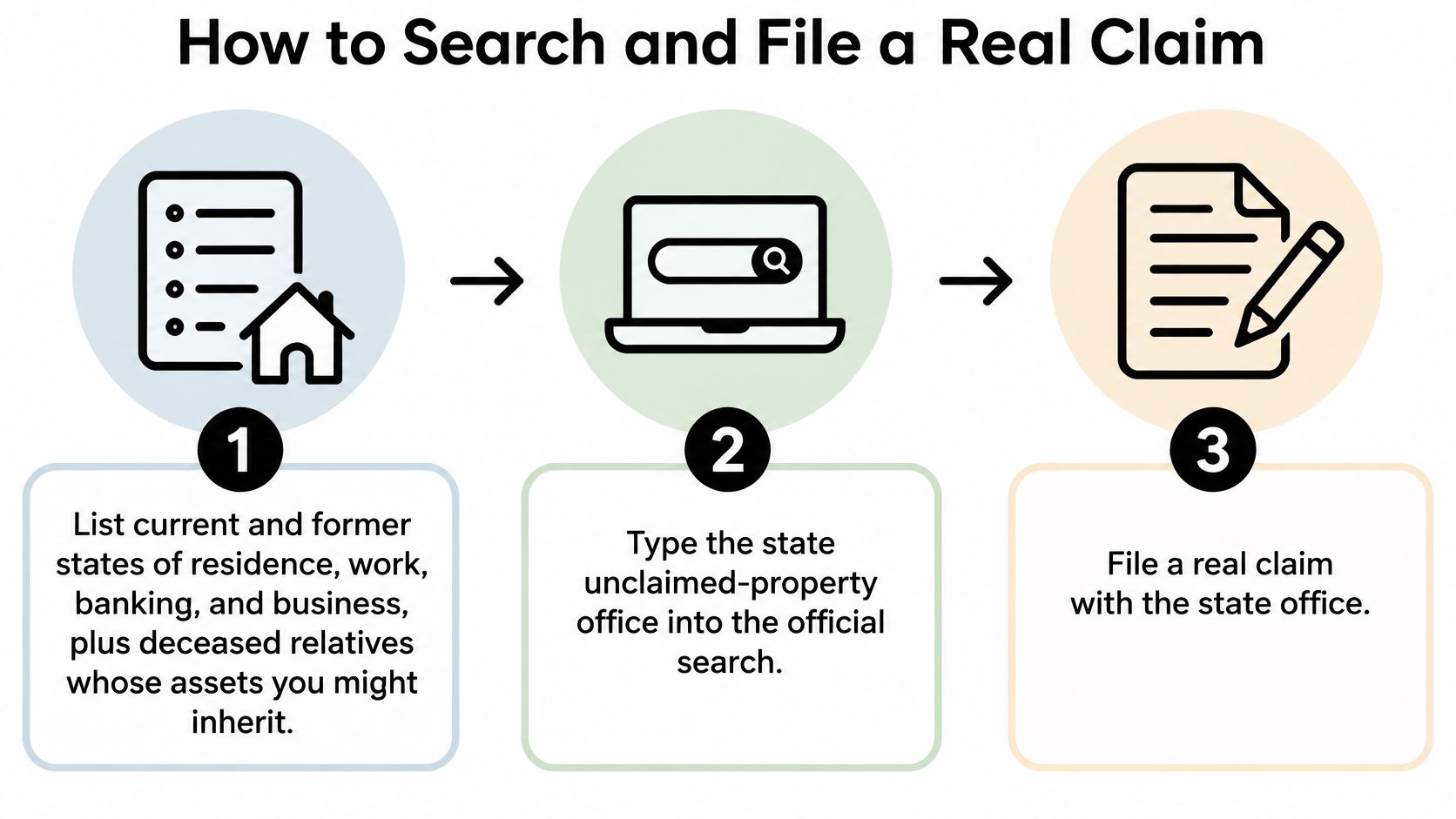
- List the states before you search. Your current state, every state where you've lived or worked, where you've banked, where you've run a business, and where a deceased relative lived. Property is held state by state, so a clean result in one proves nothing about the next.
- Type the address yourself. Open a new tab and type the state office's address or MissingMoney.com. Starting from a text, an ad or an email link is how people land on a paid copycat.
- Search every version of each name. Legal name, maiden name, a dropped middle initial, the spelling a payroll system used. Run one state at a time and write the results down.
- Treat a hit as a lead, not a balance. Note the reported holder, the property type and any amount shown, then compare it with your own bank or card records. Records exist for other people with your name.
- Open only that office's claim instructions. Each state lists what it wants. A generic document packet wastes a filing cycle.
- File on the official site. Searches are free. A page asking for a card number before it shows you results is not a state office.
- For a federal refund, start at the agency's case page. Confirm you're in the case before you believe any message about it.
- Deposit or claim what arrives. An issued refund can sit uncashed for months, so open the envelope and treat the deadline as real.
- Chase store credits on the store's clock. A merchant refund that never reached a state office runs on a policy window. Use the order receipt and the policy text.
Whatever a program quotes, check anything you intend to act on against your bank before you spend it or share details about it. The same habit does double duty elsewhere, because the rules for claiming flight delay compensation turn on two things you already control: a dated document and a deadline you can prove.
If you'd rather watch the sequence than read it, this walkthrough covers both the search and the filing.
A name in a database is a lead. It's never permission to send a fee, a password or a card number.
Real Payouts and Fee Scam Checks
State offices publish how much they return, giving you a concrete way to distinguish real programs from claims that exist only in a message. Those totals show that money is being paid, but they do not prove that a particular person is owed money.
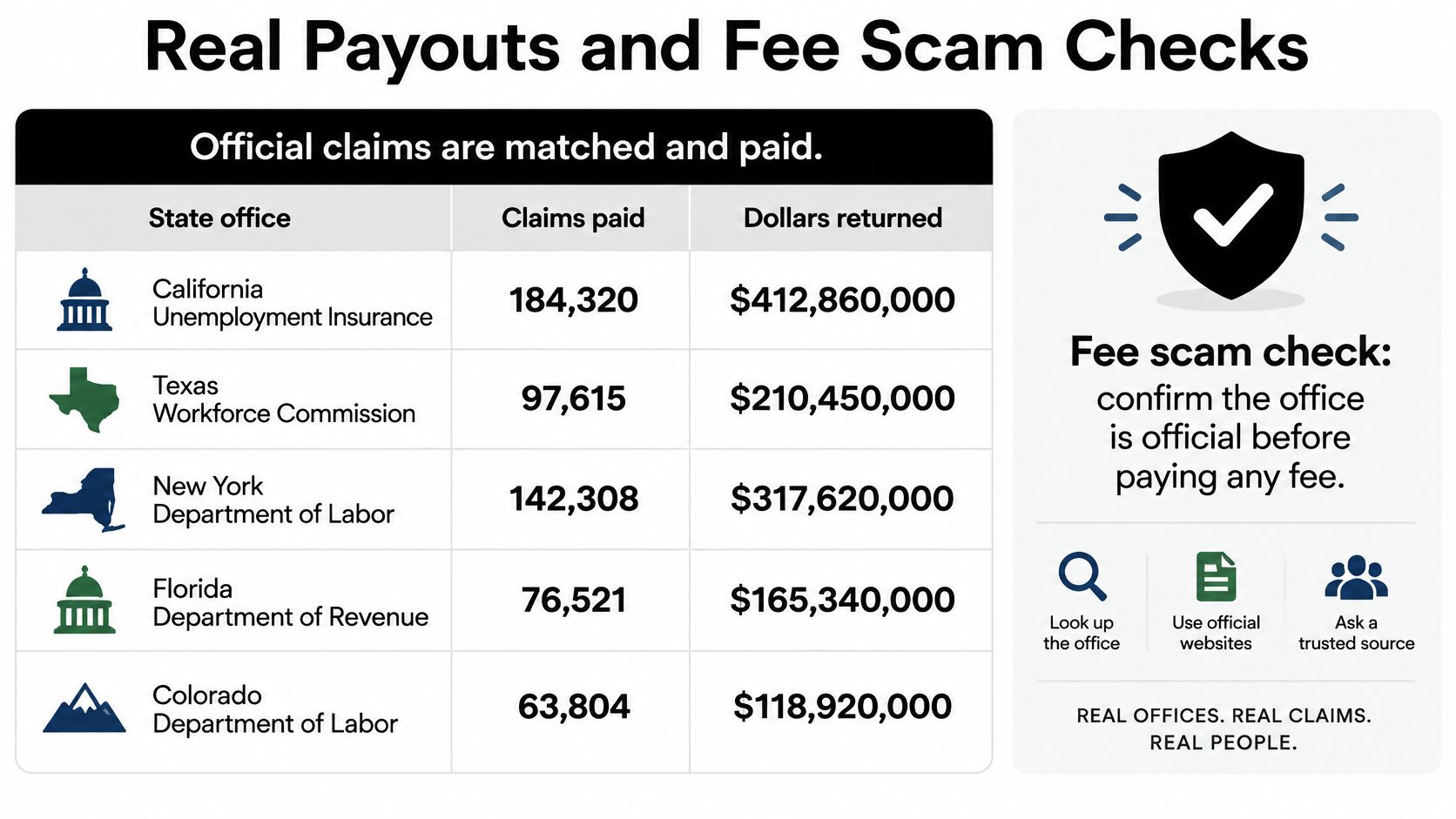
Recent results reported by the paying offices:
| Program | Period | Amount returned | Claims or payment detail |
|---|---|---|---|
| Pennsylvania | 2025 | $334.1 million | Prior record was $272.2 million in 2024 |
| Tennessee | FY2025 | $125 million | More than 168,000 claims paid |
| Colorado | FY2024–25 | Nearly $79.9 million | More than 86,000 claims; 22.5% above the prior year |
What a record total does and doesn't mean
Large statewide totals combine payments of many sizes. In the states reporting both dollars and claim counts, dividing the total returned by the number of claims gives an average in the high hundreds, not the thousands. That average is only a rough guide: a handful of large payments can raise it, while many smaller claims make up the rest.
A low amount does not prove an offer is fraudulent, and a high amount does not prove you have a windfall. Treat any quoted sum as a lead. Confirm the official program, the holder of the money, and the records that connect you to it before taking action.
The payment almost nobody deposits
A refund can be approved and still fail to reach the person it belongs to. Checks may go uncashed because an address changed, an envelope looked like junk mail, or the recipient did not recognize the notice. The FTC returned more than $324 million in consumer refunds in 2023, according to its annual refund report.
Federal refunds and state-held property follow different paths. A federal refund is tied to an agency or case; state-held property is generally listed in the state's records. In either case, the holder determines how the money is issued, while the recipient must recognize the payment and follow the stated instructions. Keep track of mail and account details so a real payment does not get mistaken for junk.
Five checks before you trust a call about money
Scammers borrow the language of public programs to make an unexpected call or message feel official. They may name a supposed entitlement, create urgency, request personal information, or demand an upfront processing fee. The FTC consumer alert on unexpected calls about unclaimed funds explains the warning signs. Use these checks before responding:
- Close the message and enter the address yourself. Find the agency's official site in a fresh browser tab. A link in an unsolicited message does not prove who sent it.
- Check the office independently. A convincing agency name or logo is easy to imitate. Follow these steps to check suspicious agency names, including checking the domain, letterhead, and phone number against the government office.
- Expect proof requirements after a match, not a search fee. Identity or heirship documents may be needed to establish a claim. A charge to “release” the money is a reason to stop.
- Never share card numbers, banking passwords, or send wires or gift cards. A legitimate property office or refund program does not need these to return money.
- Look up the amount through the official program. A precise figure can sound convincing, but it is easy to invent. Check the program's own record before sharing details or acting on the offer.
A fee is a warning sign. State unclaimed-property offices and federal refund programs do not charge you to search for or return your own money.
Tracking Merchant Credits Before They Expire
A state database will never show the credit that expires in three weeks. That's why the second track is a log you keep yourself, one row per promised credit, reviewed on a schedule rather than when you remember.
- Pull the last 90 days of card and bank activity. List every refund promise, duplicate charge, price drop and late delivery you can find. The statement is the record of what happened.
- Sort each item into received, pending or missed. A credit marked received with no matching deposit is the one to chase first, because it will never reach a state office later.
- Write to the merchant with the order number. Quote the policy that sets the window, including any price adjustment policy the store publishes, and ask for written confirmation of the deadline and the amount.
- Keep the email thread and the statement line together. A deadline you can't prove is a deadline the merchant can ignore.
- Repeat on the first of each month. Fifteen minutes beats a lost credit, and the review catches renewals that repriced.
Estate claimants should keep the same log for a relative's pending refunds, noting whose name each claim sits under so the same credit never gets filed twice.
A refund you can't document is a refund the merchant can decline to pay.
Check Official Records Then Watch Everyday Credits
Two tracks, one week of work. Start with the official record. Search the unclaimed-property site for your current state and every prior state of home, work or banking, plus any deceased relative whose affairs you handle. File only the matches you can document, and deposit any government check you already recognize as tied to a real case.
Then scan the last 90 days of charges, receipts and refund emails for promised credits, late-delivery promises and duplicate charges. Those never appear in a state database because their deadline arrives first, and the receipt is the only proof you'll have.
That second track is where a monitor earns its place. Compass+ is a money-saving agent for U.S. users that reads connected bank and card activity and looks across subscriptions, refunds, charges and renewals, and every find arrives with its amount and the action to take: cancel it, claim it, or get it back. It doesn't replace a state unclaimed-property search or an agency case page, and its read-only bank connection can't move money.
The decision is simple. Claim what an official record already holds, and catch the rest before the receipt is your only evidence.
Compass+ watches the everyday side of unclaimed money owed to you: the refund that never landed, the price that dropped after checkout, the free trial that became a charge. Every finding comes with an amount and a next step, so you know whether to cancel it, claim it, or get it back. Visit Compass+ and let it read the statements you'd otherwise have to audit by hand.