Recurring Payment Definition: Meaning, Types and Control
Recurring payment definition explained in plain English: how automatic charges work, fixed vs variable types, your legal protections, and how to cancel.
20 min read
Open this month's card activity and the pattern is easy to miss: the gym, a streaming app, and a cloud backup you set up once all sit there as if you had tapped pay again. A recurring payment is a charge you approve once so it can repeat without a fresh checkout, and the subscription economy built on those charges had reached approximately US$650 billion by the end of 2021, with an expectation of US$1.5 trillion by 2025, according to Visa's industry analysis.
None of those lines asked you anything this cycle. They moved because an earlier yes is still on file. The useful question is what you agreed to, and which piece of evidence ends it: the confirmation number, the cancellation record, and the first statement that comes out clean.
Table of Contents
- What a Recurring Payment Means in Plain Terms
- Fixed, Variable, Subscription and Service Types Side by Side
- How a Recurring Charge Gets Processed
- Legal Protections Every Recurring Charge Should Meet
- Three Recurring Charges Worked Through
- Spotting Recurring Charges in Your Statement
- Cancelling and Proving a Charge Has Stopped
- Confirm Your Cancellation Before the Next Billing Date
What a Recurring Payment Means in Plain Terms
A recurring payment is a charge you authorize in advance that repeats on an agreed schedule until you end that authorization.
Picture a standing order at your bank. You tell the bank, once, to pay a named payee on a named day. After that, the money leaves without a new signature. A gym that keeps your card on file works the same way. You said yes at the desk, and the debit on the 3rd is that yes, still running.
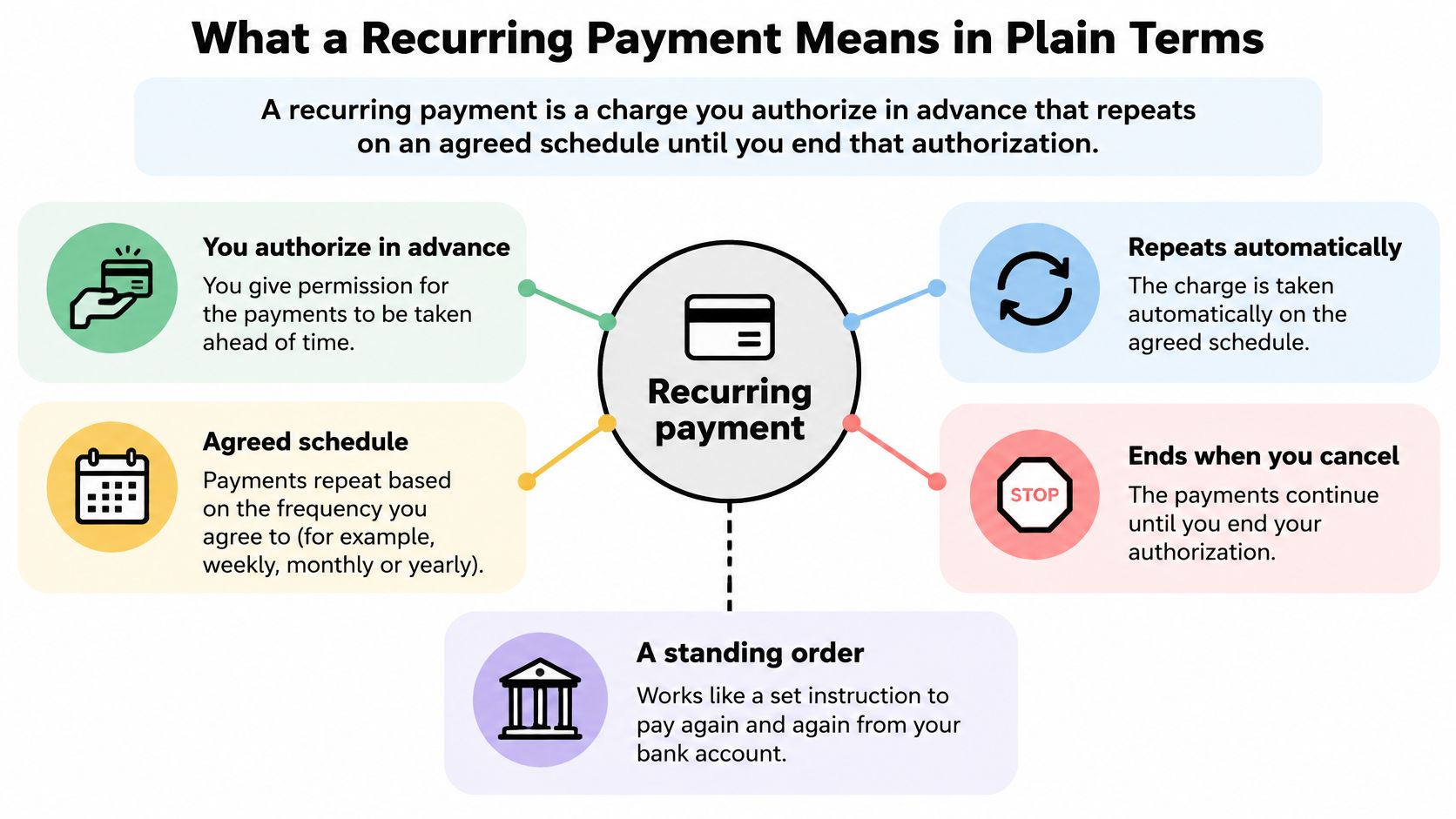
Every recurring payment needs three parts. Miss one, and you don't have this kind of charge.
- Authorization: You agreed, in a checkout box, a signed form, or a similarly recorded consent, that later charges may run.
- Schedule: The agreement names an interval, whether weekly, monthly, annual, or another defined gap.
- Stored payment method: A credit, debit, or prepaid card kept on file, or a bank-debit mandate that pulls from your account.
The permission is what makes the charge recurring, not the merchant logo and not a matching dollar amount. A one-time purchase is the opposite. You buy headphones, you approve that checkout, and the seller can't bill you next month unless you start a new order.
A streaming plan at a fixed monthly price is the clean case. You authorize it when you subscribe, and the service then bills you each cycle for continuing access. A single online order paid at checkout ends when that payment clears.
An installment plan looks similar on a statement and isn't the same arrangement. Installments divide the price of one specific purchase into scheduled portions, then stop. A recurring payment buys continuing access or service, so it keeps going until the agreement ends or you cancel. Visa's industry analysis reported that the global subscription economy had reached approximately US$650 billion by the end of 2021 and was expected to reach US$1.5 trillion by 2025. That scale sits on access that renews, not on a balance that runs out.
The test: Is there a standing permission, and what exact step ends it? If you can name both, you understand the charge. If you can name only the amount, you don't control it yet.
Those charges also depend on renewal dates, and on what happens when a payment fails, a card expires, or you ask for a refund. The payment can occur with no new checkout decision each cycle. That only stays fair when the authorization, the renewal terms, and the way you cancel stay visible, especially after a price change or after you've stopped using the service.
Fixed, Variable, Subscription and Service Types Side by Side
A recurring charge works like lending someone a spare key. The important question is not only what they take each visit, but what permission lets them come back and what action takes the key back. Read each row for amount, interval, and the exact condition that ends the permission.
| Type | Amount per charge | Interval | What ends it |
|---|---|---|---|
| Fixed subscription (streaming, software) | Same each cycle | Monthly or annual | Cancellation before the renewal date |
| Free trial that converts | $0 during the trial, then the plan price | One switch to paid, then monthly or annual | Cancellation before the trial ends |
| Annual plan billed monthly | Same monthly amount | Monthly, within a 12-month commitment | End of the contract term, plus any early-cancellation fee |
| Membership service (gym, club) | Same each cycle | Monthly | Written notice period or a cancellation form |
| Variable utility bill | Changes with usage and rates | Monthly or bi-monthly | Closing the account or switching provider |
| Usage-based service (cloud, mobile overage) | Metered, and it can spike | Monthly | Stopping usage and cancelling the plan |
| Installment plan | Fixed share of one purchase | Scheduled until the balance is paid | Final installment; it retires one purchase rather than continuing access |
Amount versus purpose
Start with amount, because it is the easiest attribute to see on a statement. A fixed subscription repeats the same figure each cycle. A utility, cloud, or mobile bill can move with usage, rates, or a plan change, so a different total does not by itself prove the charge was wrong.
Then ask what the payment buys. A subscription buys continuing access to media, software, or a membership tier. A service pays for ongoing availability or work, such as power, a gym, insurance, or storage. An installment plan belongs in the same export, but it is paying down one specific purchase until the balance reaches zero.
The confusion usually comes from rows that share a monthly rhythm. A $19 streaming plan, a $19 cloud bill, and a $19 installment can look identical in a list of card lines. The amount matches, the cadence matches, and still the stopping rules are different: cancel the subscription, stop usage and cancel the plan, or make the final installment payment.
Four attributes, and where the monthly figure lies
Each arrangement becomes clear when you name four attributes: the payment trigger, the frequency, how much the amount can change, and the termination condition. The trigger is the event that allows the debit: renewal, usage, a converted trial, or a scheduled installment. The termination condition is the evidence you need before assuming the next debit cannot happen.
Annual plans billed monthly are the row people misread most often. The statement shows a modest charge every 30 days, while the commitment can run for twelve months and leaving early can add a fee. Legal coverage of these plans has flagged automatic renewal and early-cancellation fees that were allegedly not clearly disclosed, which is why the termination cell matters more than the monthly cell.
A free trial is a different trap because the trigger is silence at the end of the trial. The FTC's description of negative-option programs treats a consumer's failure to act as consent to be charged, and it reports more than 100,000 related complaints over five years, including unauthorized billing and difficult cancellation. If you want the timing that keeps a trial from converting, our guide on how trial conversions turn into paid charges walks through the window before the first paid debit.
Keep two stopping rules separate. Cancelling a future cycle does not automatically reverse the charge already taken, and a failed payment, replacement card, or merchant account updater does not reliably end the underlying contract. The permission can survive the plastic, so the proof you want is the cancellation record that matches the row: before renewal for a subscription, before trial end for a conversion, notice for a membership, account closure for a utility, or the final installment for a purchase plan.
When you sort a long export of card lines into these rows, keep merchant, interval, and end condition in one working list instead of a notes app; if you want a statement tool for that job, you can explore BankStatementWizard account options.
How a Recurring Charge Gets Processed
Say you subscribe to a design tool on a Tuesday. That first charge is yours. You typed the card, ticked the terms, and approved the amount. Everything after that Tuesday can run without you.
What you granted is a standing permission, and the stored credential works like a key copy you handed over once: the merchant can collect on schedule until you cancel the arrangement or the credential stops working. The diagram below splits that into the two-stage model card payments commonly use.
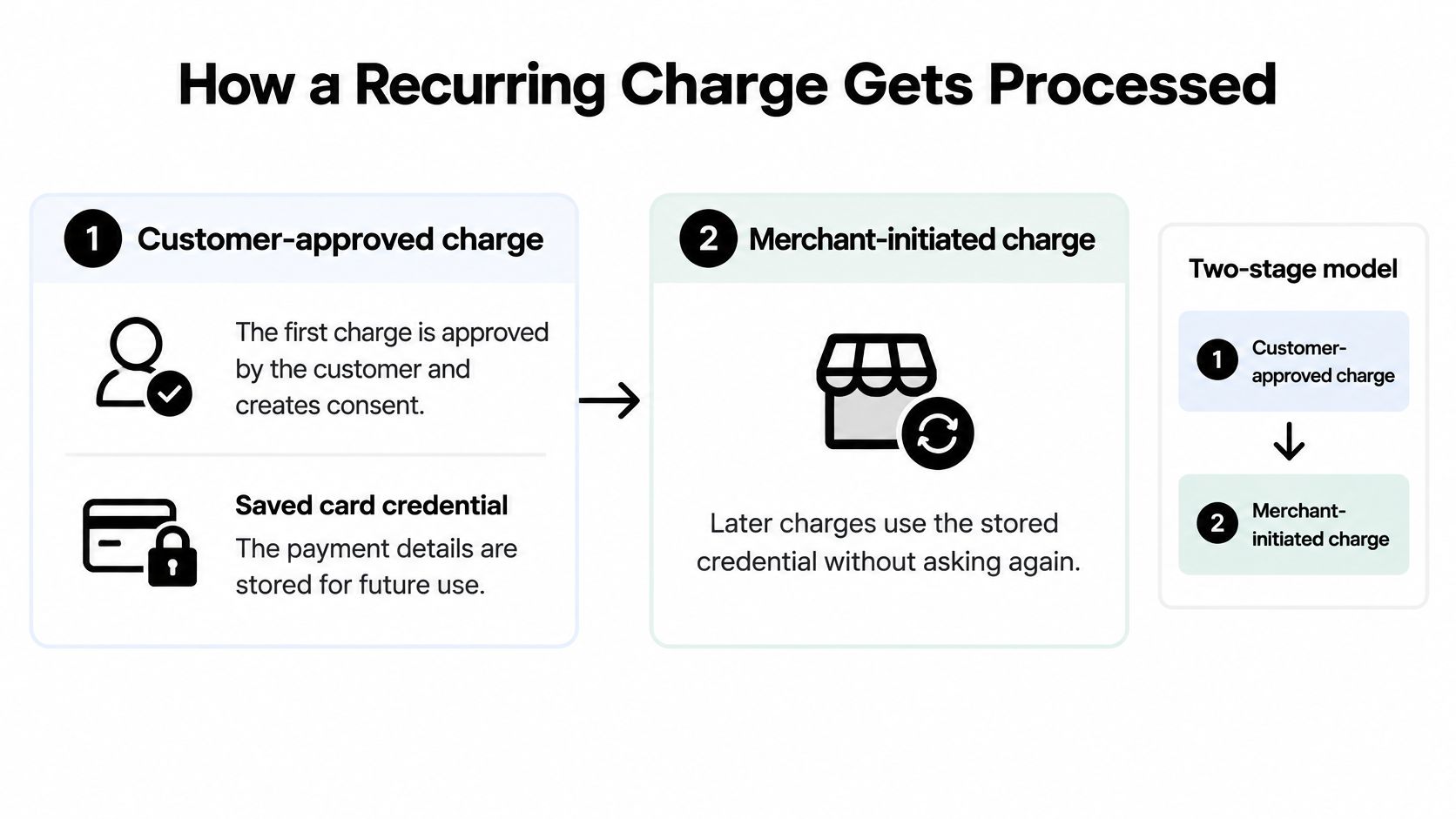
Nuvei's documentation of merchant-initiated transactions describes that split: an initial customer-approved transaction establishes consent and credential-on-file permission, then one or more merchant-initiated transactions use the stored credentials. The first transaction is the approval. Every transaction after it is the permission exercising itself.
A bank-debit mandate is the other common route. Your bank account is debited under a standing authorization instead of a saved card.
The life of one charge
- You authorize the charge and its terms, including when it repeats and what it costs.
- The payment credential is saved, as a card token or as account details on a mandate.
- A schedule sets the interval, such as the same calendar day each month.
- Each later debit runs on that schedule. You don't click anything.
- A failed debit triggers retries. An expired card or a closed account can break the chain, and a replacement card sent through an updater can restart it.
- Cancelling is meant to stop future debits. It may leave the underlying contract intact, and it may not reverse the last charge that already cleared.
Steps 1 through 3 happen once. Steps 4 through 6 can repeat for years, which is why the record of step 1 still matters long after you've forgotten the Tuesday.
What a clean record holds
Because the permission was granted once, your evidence has to show both that it existed and that it ended. For each arrangement, keep the merchant, the payment instrument, the transaction type, the original authorization reference where you have it, the expected cadence, the amount, and the renewal terms. Under U.S. rules for preauthorized electronic fund transfers, that authorization must be in writing or similarly authenticated, and you must receive a copy. The copy should state the significant terms, including timing and amount. If your confirmation email leaves out either one, ask for the copy before the next cycle runs.
Flag a shortened interval, an unexplained price increase, a duplicate debit, or a charge after cancellation. Those deviations can mean a billing error, a plan migration, a cancellation that didn't stick, or a charge that continued without a fresh okay. Each one is a reason to ask the merchant, stop the next payment, or pursue a refund, while you keep the original pattern as evidence.
If you want the sequence in motion, this short walkthrough shows the first approved charge and the later merchant-initiated ones side by side.
Legal Protections Every Recurring Charge Should Meet
Under U.S. Regulation E, this kind of arrangement is a "preauthorized electronic fund transfer." You authorize a merchant or a financial institution in advance to initiate substantially regular transfers, and you don't approve each one. The transfer itself can start through a computer, a telephone, an electronic terminal, or a similar mechanism, and it can debit or credit your account. The Electronic Fund Transfer Act rules in the eCFR are the place those words live.
Repeated merchant names, or amounts that match, are not the legal test. The arrangement combines prior authorization, a cadence, and no further action from you to start each debit. A monthly or annual subscription qualifies. So can a utility or a usage-based service with a changing total, if you authorized the ongoing debit. Irregular renewal dates don't take it outside the definition.
What to check, separate from the pattern
A string of charges is evidence that something is repeating. It isn't proof you authorized it. Treat authorization as its own attribute. When you review a line, combine the merchant identity, the gap between transactions, whether the amount is similar or trending, the account or card, and any renewal language. Don't stop at "the dollars match."
On any charge you intend to keep, verify five things before the next date:
- Amount: The figure you agreed, or the rule that lets it change with usage.
- Billing date: The day the next debit is expected, not a guess from last month.
- Cancellation route: The screen, form, or address that ends it.
- Notice period: How many days before renewal your stop request must arrive.
- Any fee: An early-exit charge, a restocking-style penalty, or a remaining term you still owe.
This is general information, not legal advice. Outside the United States the core idea of advance authorization still applies, but the dispute path and the paperwork differ. Check your national regulator or consumer body before you rely on a U.S. rule with a local bank.
A matching amount on three statements doesn't prove you said yes. It only proves the merchant kept charging.
Three Recurring Charges Worked Through
These four sketches are illustrations, not reports of a particular person's account. Each one answers the same three questions: what authorized the charge, what ends it, and the first action to take.
A gym at 42 dollars
You joined in January and signed a form that sets the membership at 42 dollars a month, cancellable on 30 days' written notice. March's debit isn't a new sale. It's the form. The charge continues until that notice period ends, so sending the letter on the 20th doesn't stop a debit due on the 25th.
Authorized by the signed membership form. Ends when the 30-day written notice runs out. First action: send the notice now, and keep a copy with the date, before the window for next month closes.
A trial you meant to cancel
A streaming app offered 14 days free. You signed up on the 1st and forgot. The first paid charge lands on day 15. Cancelling on day 13 means that charge never starts, because the trigger is the trial ending with the plan still active.
Authorized by the trial signup, which treated inaction as consent to convert. Ends when you cancel before the trial ends. First action: cancel on day 13 or earlier, and save the confirmation the same hour.
Power that moved from 78 to 112 dollars
Your electricity total was 78 dollars, then 91, then 104, then 112 across four months. Nobody migrated you to a secret plan. You used more power, or the tariff moved. Cancelling the autopay doesn't close the account, and it can leave you with a manual bill plus a late fee.
Authorized by the utility mandate for ongoing service. Ends when you close the account or switch provider. First action: compare usage and the tariff to the four totals before you treat the rise as a billing error.
Two 19-dollar charges, three days apart
After you changed a software plan, the same merchant posts two identical 19-dollar charges within three days. A plan change can create one prorated line. It doesn't explain a twin debit.
Authorized by the original subscription, not by a second signup. Ends for the extra line when the merchant refunds the duplicate. First action: query the merchant with both dates and both amounts, and ask which authorization reference each one used.
The pattern across the four is simple. The authorization decides what you're allowed to stop. The termination condition decides when the stopping happens.
Spotting Recurring Charges in Your Statement
Detection is a sort, not a hunch. Do it the same way every quarter so a new trial doesn't hide between the groceries.
- Export 90 days of transactions from every bank and every card, not only the one you think of as your bills card.
- Group the lines by merchant name. The descriptor often isn't the brand. "GOOGLE *YOUTUBE" and the app you remember are the same seller.
- Mark any merchant that charges on a steady interval, roughly every 28 to 31 days for monthly, or about 365 days for annual.
- Check the amount second. A fixed charge and a metered charge can both be recurring.
- Look for a small opening debit followed by a larger one, and for a quiet step-up in price.
- List each recurring charge with its monthly cost and its next expected date. That list is what you'll cancel from.
A 2025 Mastercard study of the subscription economy found that 59% of consumers in the United States consolidate recurring payments on one preferred card, and that 25% of consumers had blocked a payment because they believed it might be fraudulent. One preferred card makes the export easier, and it also piles many renewals onto a single statement. If the descriptor column is hard to read, the autobankstatement guide to credit card statements shows how those lines are laid out before you start grouping them. Our walkthrough on how to find all your subscriptions covers the accounts people usually forget, including app stores.
| Signal | What it usually means | What to do |
|---|---|---|
| Same merchant, same amount, monthly | Active subscription or membership | Confirm you still use it and note the renewal date |
| Same merchant, amount rose | Price increase or plan migration | Check the renewal notice; cancel or ask for a rollback |
| Two identical charges within days | Duplicate charge or failed cancellation handling | Ask the merchant for a refund first |
| Charge after you cancelled | Cancellation not processed, or contract still running | Save evidence, escalate to the merchant, then to the card issuer |
| Irregular amounts from one utility | Variable bill tied to usage | Compare usage and tariff rather than cancel |
| Small trial charge followed by a larger one | Free trial converted to paid | Cancel before the trial ends |
| Charge with an unfamiliar descriptor | Forgotten service or platform billing | Search the merchant name and your inbox for its receipts |
Stay on detection here. Stopping a charge, and proving it stopped, is a separate job with its own paperwork.
Cancelling and Proving a Charge Has Stopped
Calendar reminders fail when the billing date, the renewal window, and the price all move. You need a record someone else can read. Enforcement allegations describe cancellation flows that take real work: one cited Uber case alleges as many as 12 actions and seven screens, rising to 32 actions and 23 screens near the billing date, according to an Arnold & Porter advisory on FTC and state scrutiny of subscription practices. The FTC has also alleged that some businesses continued charging, or attempting to charge, after cancellation confirmations.
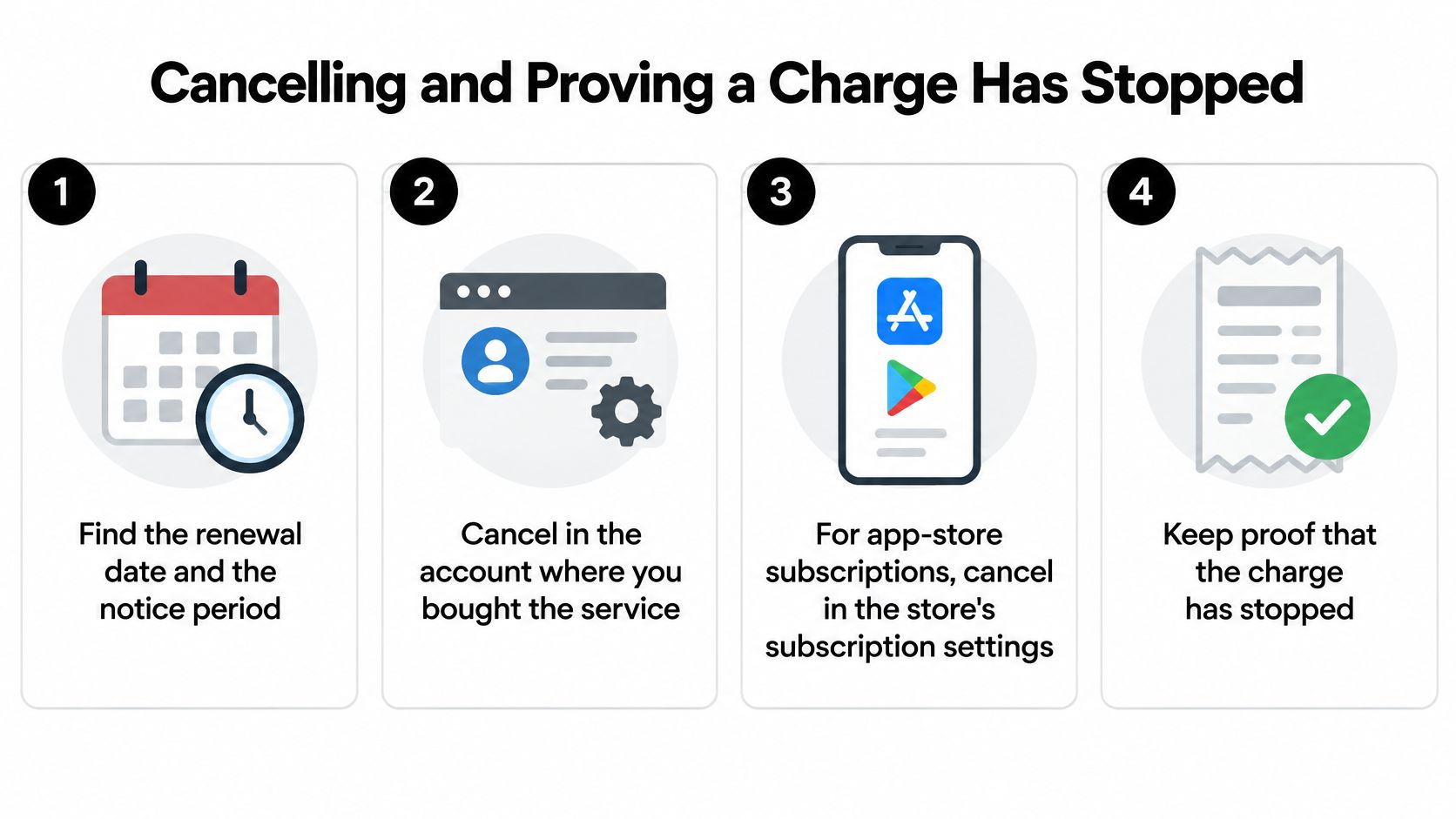
- Find the renewal date and the notice period in the confirmation or the account's billing screen. A 30-day written notice and a "cancel any time before renewal" button are not the same deadline.
- Cancel in the account where you bought the service. For an app-store subscription, that means the store's subscription settings, not a button buried in the app. Subscriptions are cancelled in the App Store or Google Play subscription settings, and the app's Profile, then Subscription, screen takes you there. The store charges a renewal up to 24 hours before the current period ends, so cancel at least 24 hours before renewal to avoid the next charge.
- Save the confirmation, the timestamp, the account identifier, and the final invoice. Screenshot the success screen and keep the email. A chat transcript counts if it shows the date and the account.
- Check whether the cancellation applies now or at the end of the paid period. After you cancel, you keep access until the end of the period you already paid for. Budget for that last cycle instead of expecting a same-day refund.
- Watch the next statement for that merchant, on that card, around the old billing date.
- If a debit continues, write to the merchant first with the evidence from step 3. Then, where it's appropriate, dispute the charge with the card issuer or the bank. Replacing the card or blocking the merchant can stop one transaction and still leave a contractual balance, or allow a later collection attempt.
A fuller click-path for the store screens is in our guide on how to cancel subscriptions.
Three myths keep charges alive:
- Deleting the app: The subscription lives in the store account, so the app's absence doesn't end the billing.
- Cancelling the card: The contract can remain, and an updated card number can be charged later.
- Saying nothing: Silence isn't a cancellation. In a negative-option setup, silence is how the charge continues.
Confirm Your Cancellation Before the Next Billing Date
Set each reminder at the start of that charge's notice window, not seven days before the renewal date. On the gym illustration, a 30-day written notice is already running by the time a one-week reminder fires, and you've missed the chance to skip the next debit.
Take the list from your 90-day sort. For each line, check the monthly cost and the next expected date, confirm you still use it, and cancel any you don't before its notice window closes. Then put a quarterly review on the calendar. Prices and plans change without a fresh decision from you, and a list you built in January lies by April.
If the list is hard to keep current, our Home screen shows what Compass+ found and what to do about it, and the Recurring screen lists every repeating charge with its monthly cost. You review them in one place instead of rebuilding the export from scratch.
This week, export last month's statement, pick one charge you no longer need, and cancel it before its notice window closes. Save the confirmation in the same folder as the statement.
Compass+ monitors the bank and card accounts you connect, reads the transaction history, and surfaces repeating charges, low-use subscriptions, duplicate or increased bills, and refunds you haven't claimed, each with a next step. That is the practical side of a recurring payment definition: not another glossary line, but a charge you can see before the next date and stop with proof. Visit Compass+ to see what those linked accounts already show.