Purchase Receipt Example: Labeled Fields and Template
Get a labeled purchase receipt example with date, amount, order ID, items, taxes, and refund policy fields, plus how Compass+ parses receipts.
23 min read
The box is still on the counter, the card charge posted yesterday, and the paper slip is already in a coat pocket you cannot find. The store's site says returns close soon, the bank shows a second line that looks identical, and the warranty form asks for a purchase date you only half remember. That is the moment a receipt stops being clutter and starts being the only record that can settle the argument.
A useful purchase receipt example is not a thank-you for paying. It is a dated evidence file. It names the seller, the day money moved, the item, the tax, the payment path, and the deadline that still applies. Read it that way before you need it, and the later fight is shorter.
Table of Contents
- Why Purchase Receipts Matter Beyond Proof of Sale
- Labeled Purchase Receipt Example Template
- Core Transaction Fields From Date to Order ID
- Refund Policy, Return Deadlines, and Delivery Terms
- Proving a Purchase When the Receipt Is Missing
- How Compass+ Parses Receipts Compared to Manual Tracking
- Quick Reference Checklist for Receipt Fields
- Next Step to Put Your Receipts to Work
Why Purchase Receipts Matter Beyond Proof of Sale
You are standing at a counter, or staring at a chat window, and you cannot prove the purchase. The associate wants a date. The card issuer wants an amount that matches. The warranty desk wants the exact model. A payment confirmation only says money left your account. It does not say which headphones, which store, or which return clock started ticking.
That gap is common, and it is large. Green America reports that U.S. receipt production uses about 3.68 million trees and 10 billion gallons of water each year, with emissions estimated to match the annual carbon impact of more than 471,000 passenger cars. The same analysis puts U.S. point-of-sale receipt consumption at 280,000 metric tons in 2019, 268,000 metric tons in 2020, and 284,000 metric tons in 2021. Shoppers then throw away or lose 49% of the paper receipts they receive, including ones they meant to keep. The paper is generated at retail scale, and nearly half of it never stays usable.
What the slip is actually holding
A working receipt carries merchant identity, transaction date, purchased items, taxes, payment details, and return-relevant information. Those lines are what a return desk, a warranty claim, a reimbursement, a price adjustment, and a dispute over a wrong or duplicate charge all ask for. Lose the slip and you are rebuilding that set from memory.
A receipt you cannot retrieve is not proof. It is a story you hope the other side will accept.
Price adjustments are a clear case. The original price, the date, and the item description are what a later drop gets compared against. If those three do not match the charge, the request stalls. Keeping the record in a form you can search is the practical half of following price adjustment policies.
Treat the document as an evidence and rights record. The template later in this article only helps if you already know why each label exists. The date starts a clock. The order ID is the handle a system can search. The tax line shows what was added on top of the goods. The policy note, when it is printed at all, is the seller's own statement of how long a remedy lasts.
Labeled Purchase Receipt Example Template
Compare any slip you hold against one labeled model. The point is not pretty formatting. The point is that every field answers a question someone will ask after checkout. Below is a single purchase receipt example you can use as that model. Example values are illustrative, not a real sale.
| Field | What It Records | Example Value |
|---|---|---|
| Merchant legal name and store | Seller identity plus the location that fulfilled the sale | Northline Audio LLC, 14 Harbor St, Seattle |
| Receipt or order ID | Unique reference for this sale | ORD-20481 |
| Transaction date | Day the sale was recorded | 12 Mar 2026 |
| Payment method | How the buyer paid | Visa ending 4242 |
| Line item, quantity, unit price | What was bought and the price of each unit | Over-ear headphones, 1 × 89.00 |
| Discount | Reduction applied before tax | Loyalty credit 10.00 |
| Subtotal | Goods total after discounts, before tax and shipping | 79.00 |
| Tax type and amount | Which tax applied and the dollars added | WA sales tax 6.5%, 5.14 |
| Shipping or fees | Delivery or service charges | Ground shipping 0.00 |
| Total paid | Amount that left the buyer | 84.14 |
| Currency code | The money unit, stored explicitly | USD |
| Tax jurisdiction | The place whose tax rule was used | Washington |
| Refund policy note | Stated window, method, and any fee | 30 days, refund to original card, no restocking fee |
How to read the rows
Start at the top. Merchant legal name is the party a dispute names. A marketing logo is not enough when two stores share a brand. Store or fulfillment location tells you which counter, warehouse, or online node handled the goods. Receipt or order ID is the search key. Without it, you are matching on a fuzzy merchant name and a dollar amount that other purchases may share.
Transaction date is the sale date printed on the slip. Later sections separate shipment, delivery, refund, and posting dates, because those are not the same day. Payment method should show the instrument, not a full card number. A masked last four digits is enough to tie the slip to one account.
Line items need description, quantity, and unit price. A single total of 84.14 cannot support a partial return of one item from a three-item order. Discounts belong on their own line so the price you can claim is the price after the promotion, not the shelf price. Subtotal, then tax type and amount, then shipping or fees, then total paid should add in an order you can recheck with a calculator. If the tax line is buried inside the total, you cannot tell whether the extra dollars were tax, a fee, or a second item.
Payment receipt versus tax invoice
A simple payment receipt and a tax invoice are not the same document. Stripe's tax invoice guide describes the pattern used where tax documentation is required. The document commonly needs a clear document type, seller identity and address, applicable buyer details, a unique sequential number, an issue date, itemized goods or services, quantities, prices, tax rate, tax amount, and a gross total. Precise rules change by jurisdiction. Do not assume a U.S. card slip satisfies a foreign tax invoice rule, or the reverse.
For a digital record, keep a few extra keys even when the paper slip omits them. An ISO-style currency code such as USD stops a later system from guessing whether 84.14 uses a comma or a period as the decimal mark. A tax jurisdiction records which rule produced the tax line. A globally unique receipt or order ID supports deduplication when the same sale appears in email, in a banking app, and in a merchant account. Product identifiers such as a GTIN or SKU, and party identifiers such as a GLN, give a stable join when the merchant name is abbreviated differently on the bank line.
Store both the normalized numbers and the original text or image. Corrections happen. You want the extracted total and the picture that extraction came from.
Core Transaction Fields From Date to Order ID
The full template shows the form. These four fields are the ones a verifier reaches for first. Group them as a transaction level sitting above item lines and tax lines. If the transaction level is wrong, the item detail underneath cannot rescue the match.
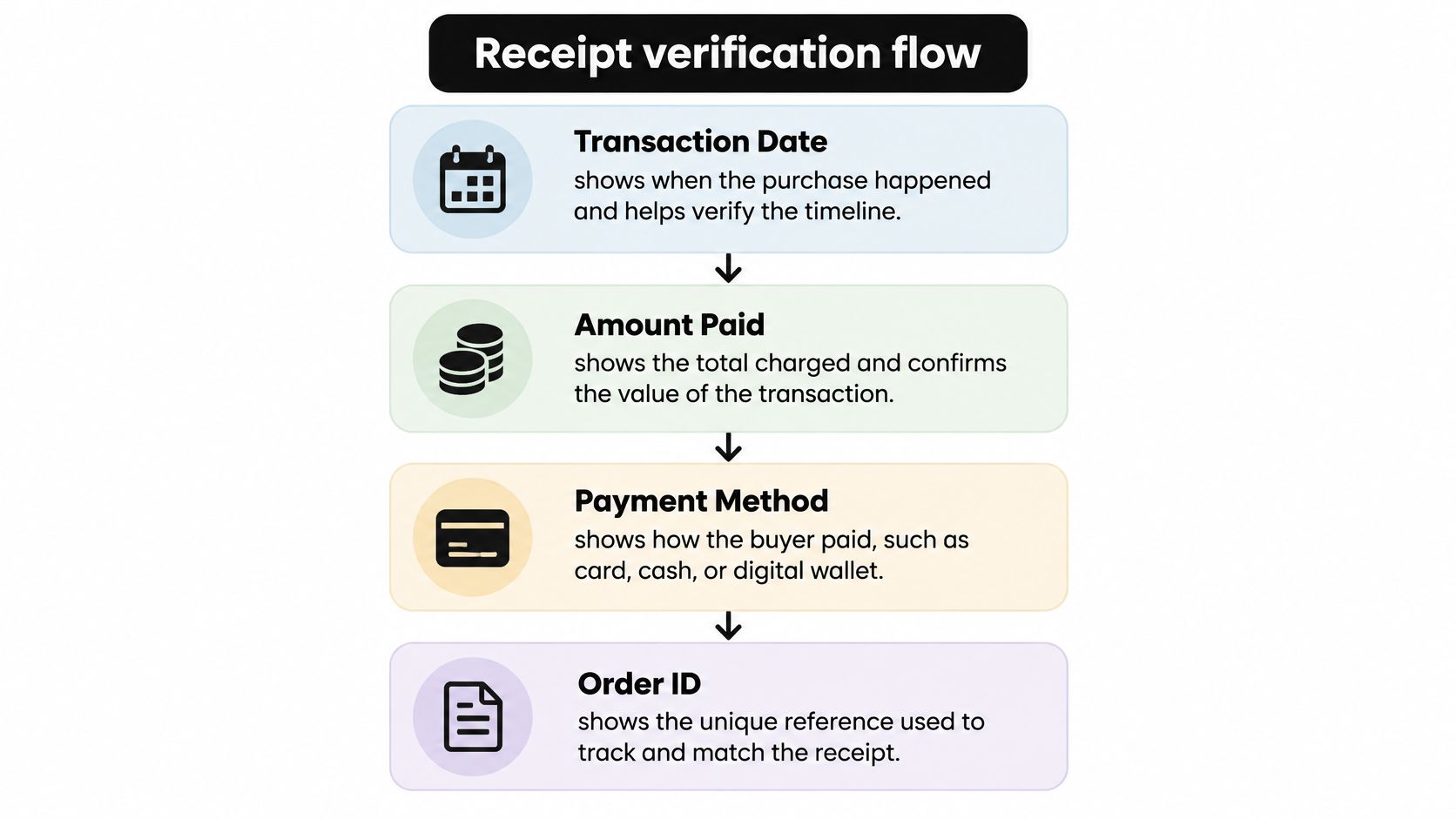
The flow below is the order to check them in. Date first, then amount, then payment method, then the ID that ties the three together.
Transaction level
Transaction date shows when the purchase was recorded and anchors the timeline. It is the date you quote when a return desk asks "when did you buy this?" It is also the date you line up against a bank posting, which often lands a day or two later. Mixing those two dates is how people think a charge is a duplicate when it is only a delayed post.
For a business purchase, U.S. IRS recordkeeping guidance treats the payee, amount paid, proof of payment, date incurred, and item description as core support. A shopper is not filing a business return every time, but the same five pieces are what make a personal claim believable. A date with no payee, or a payee with no amount, fails that test.
Amount paid is the total charged, not the shelf price and not the subtotal. It is the figure a bank debit should equal, after you allow for a pending versus posted difference. If the receipt says 84.14 and the card says 84.14, you have a match. If the card says 168.28, you either have two units, a second order, or a duplicate. The amount alone cannot tell you which.
Payment method shows card, cash, wallet, or store credit. Cash has no bank line to fall back on, so the slip is the only proof of payment. A wallet charge may post under the wallet's name rather than the store's name. Note the method on the record so a later search does not assume every purchase appears as the merchant's name on a checking account.
Order ID is the unique reference used to track and match the receipt. It is what customer service types into a lookup. It is what an email confirmation and a refund confirmation should share. When it is missing, matching falls back to merchant name plus amount plus date, and those three collide across ordinary shopping.
Dates that are not the sale date
One sale can carry five dates, and each can open a different window.
- Order date: the day you placed or paid for the sale. Return windows often start here, but not always.
- Shipment date: the day the seller handed the goods to a carrier. Useful when a delivery promise is measured from dispatch.
- Delivery date: the day the goods arrived. Some guarantees and some "item not received" claims run from this day.
- Refund date: the day a refund was issued. It is not the day the money appears in your account.
- Payment-posting date: the day the bank or card shows the charge or the credit. Dispute windows with a card issuer often look here.
If you collapse those five dates into one "purchase date" field, you will argue the wrong clock.
Item level and tax level
Under the transaction block, the item level holds description, quantity, and unit price. That is what identifies the thing being returned. A missing description forces you to prove a purchase of "something" for 84.14, which a merchant can shrug off.
The tax level holds tax type, rate, amount, and jurisdiction. It explains the gap between subtotal and total. When a price-match or a partial refund is calculated on the goods only, you need that split. Shipping sits beside tax, not inside it. A free-shipping order should still show a zero shipping line so you know the fee was considered and waived, not forgotten.
A short walk-through of how those fields get checked in practice sits in this video. Watch it after you have the four transaction fields in mind, not before.
What fails when a core field is absent is specific. No date, and you cannot tell whether a window is open. No amount, and you cannot match a bank line. No payment method, and a cash sale has nowhere else to live. No order ID, and every later email about that sale is a guess.
Refund Policy, Return Deadlines, and Delivery Terms
Most templates stop at what you bought and what you paid. The questions you ask come later. Can I return it after the printed deadline? Where does the money go? What proves the package was late? A receipt that cannot answer those is an accounting slip, not a rights document.
Policies are not universal. One seller gives 30 days to the original card. Another gives store credit only. A third posts the rule on a website and prints nothing on the slip. FTC guidance on returns and other resolutions tells shoppers to look for return policies, deadlines, customer-service details, and related terms on receipts, packaging, warranties, or the merchant's site. It also warns that policies vary, and that retailers may impose deadlines such as 30 or 90 days. Without a receipt, you may get only store credit or the lowest selling price.
The receipt does not override a newer posted policy or a statute that gives you a remedy the slip never mentioned. It is evidence of what was said at purchase, not a court order.
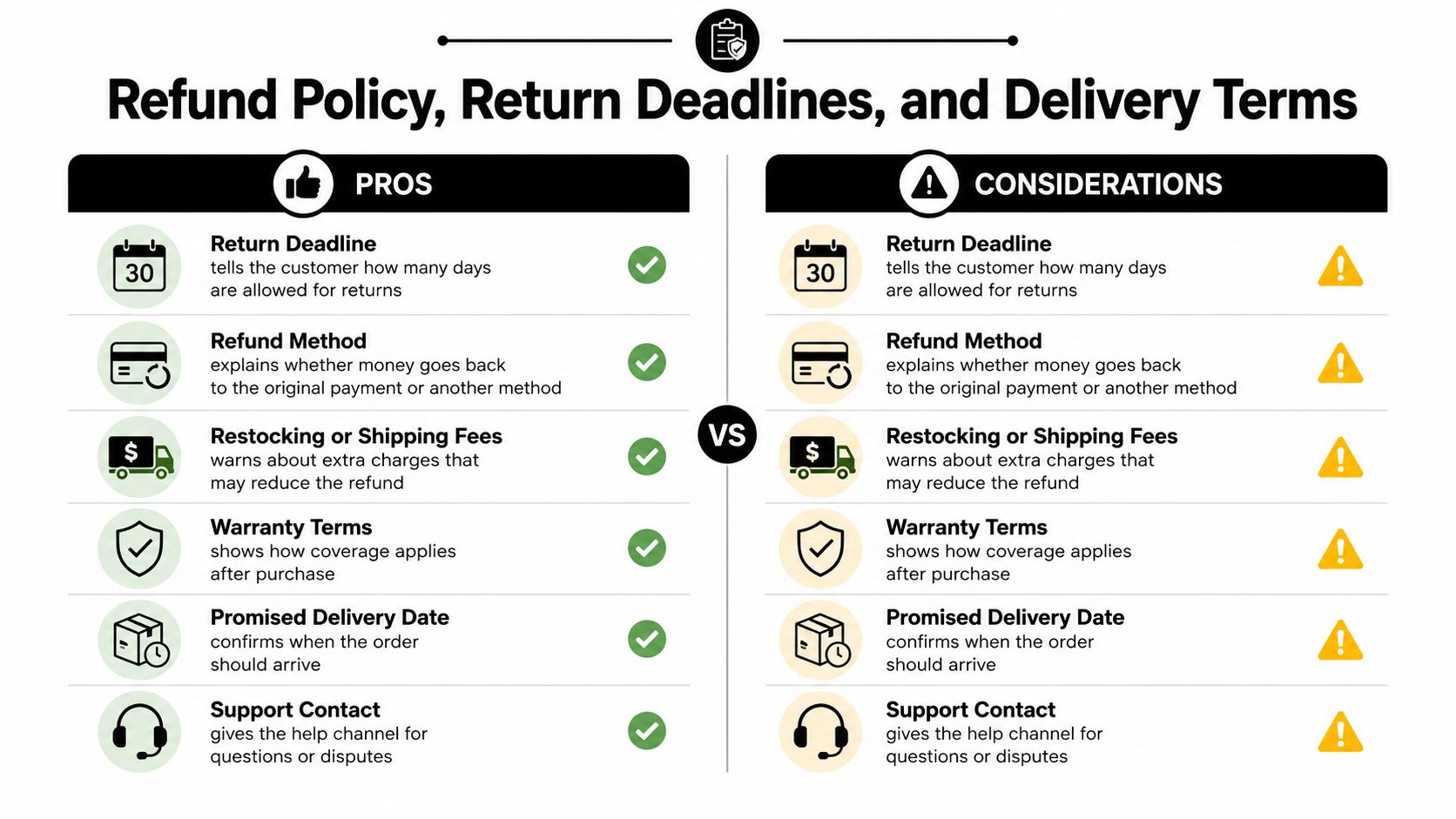
Fields a useful slip carries after checkout
Return deadline states how many days you have, and from which date. "30 days" is incomplete if you cannot tell whether day one is purchase, shipment, or delivery. Write the expiration date in your own note once you know the start date. A relative phrase on a thermal slip fades, and so does your memory of when you opened the box.
Refund method says whether money returns to the original card, to a gift card, or to store credit. That single line changes what "I got my money back" means. If the method is store credit, a bank statement will never show a deposit, and you will think the refund failed.
Restocking or shipping fees warn you that the refund may be smaller than the total paid. A 15 percent restocking fee on an opened item is a different outcome from a full refund. If the slip is silent, look up the current policy before you ship the item back and pay postage you cannot recover.
Warranty terms show coverage after purchase, or point to the document that does. A warranty claim often needs the purchase date and the product identity more than it needs the tax line. If the slip only says "see warranty card," keep that card with the receipt image.
Promised delivery date is the seller's own commitment. A late-delivery credit usually requires that date plus proof the goods arrived after it, or never arrived. A tracking screenshot with no promised date is a weaker file than both together.
Support contact is the channel that can act. A generic homepage is not a channel. An order-specific email address, a chat path inside the account, or a phone number on the slip is.
When the slip stays quiet
Sellers publish terms in places the receipt never repeats. A kitchen retailer that spells out timing, condition, and refund destination on its own return information page is doing the job a blank slip refuses to do. Read that page while the window is open, and save a copy with the order ID. Pages change.
A clear policy on a website you did not save is not a policy you can show next month.
Once a refund is promised, the remaining work is watching where it lands and when. The practical sequence is covered in how to track a refund. Match the refund confirmation to the original order ID, then to the payment method, then to the posting date. Three different documents, one claim.
A receipt with these fields lets you decide before you miss the window. A receipt without them forces you to hunt a policy that may already have changed, and to argue from a total and a date alone.
Proving a Purchase When the Receipt Is Missing
"No receipt" is not the same sentence as "no remedy." Acceptance still depends on the merchant, the type of transaction, and the jurisdiction. You need a substitute that reasonably shows the purchase, and you need to know which substitutes only show that money moved.
Australia's consumer regulator draws that line cleanly. The ACCC's guidance on receipts and proof of purchase says a consumer only needs to reasonably demonstrate that the purchase occurred, and that digital receipts can qualify. The FTC's earlier advice points the same direction for U.S. shoppers. Keep invoices, canceled checks, card statements, warranties, and contracts, not only the thermal slip.
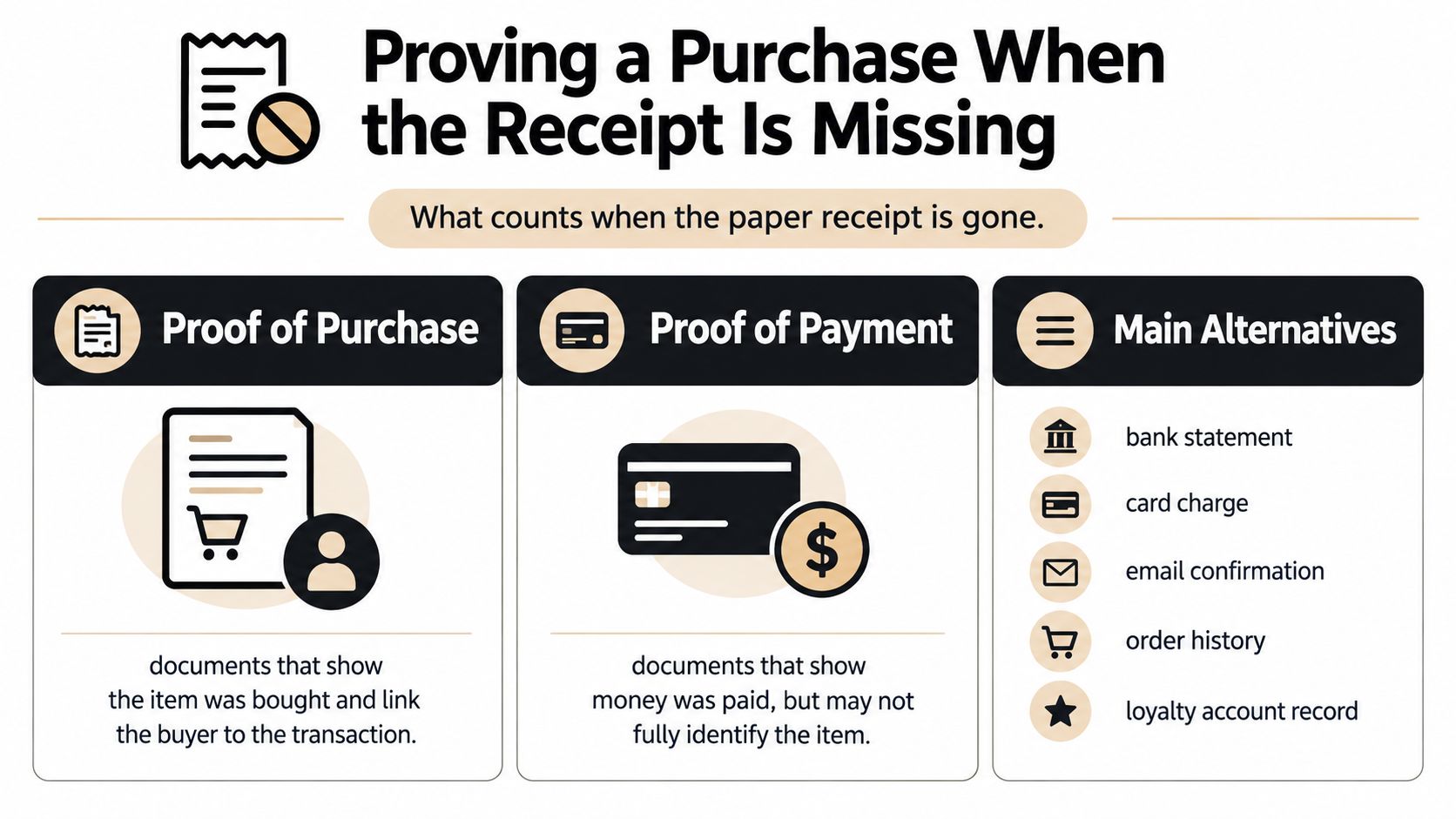
Proof of purchase versus proof of payment
Proof of purchase ties you to the item. It shows the goods or service, the seller, and enough of a date and amount to link you to that sale. Proof of payment shows that money left an account. A card line that reads "NORTHLINE 84.14" proves a charge. It does not, by itself, prove you bought headphones rather than a gift card or a different order the same day.
The two work best as a pair. Payment without purchase detail is thin at a return desk. Purchase detail without payment is thin if the seller says you never paid. When you assemble a file, label each piece as one or the other so you can see the hole.
Four substitutes, side by side
Standard receipt. Strongest when you still have it, paper or digital. Match merchant, date, items, tax, total, and order ID. Weakness is loss and fade. Photograph it the day you get it, and keep the image with the order ID in the file name.
Email order confirmation. Often the best digital stand-in. It usually carries the order ID, item names, totals, and a delivery promise. Match the email address on the account to the buyer, and match the total to the card. Weakness is a confirmation that shows the order placed but not the final captured amount after a later edit.
Card or bank statement plus a photo of the item. Use this when the slip and the email are both gone. The statement supplies date, amount, and a merchant descriptor. The photo, serial number, or packaging supplies the item. What must match is merchant name (or a descriptor you can explain), date window, and amount. Weakness is a descriptor so shortened that it does not look like the store, and a photo that does not show a serial the seller can look up.
Merchant-account history. Log in and open the order. Many retailers can reprint a receipt from that history, which is a reconstructed receipt rather than a guess. Match order ID, items, and total to the charge. Weakness is an account you cannot access, or a guest checkout that never created a login.
A warranty record or a product serial number can support the same file. So can a photocopy. None of these is automatic acceptance. Offer the set that lets the seller see the same item, the same amount, and a plausible date.
Keeping the substitute trustworthy
Treat the copies as a small evidence file. Note when you saved the screenshot, which account it came from, and whether anyone edited the image. That habit is the consumer version of protecting business data during device retirement. A dated original export beats a cropped image nobody can trace.
One mismatch looks like a different problem. Two card lines for the same amount, same day, same merchant may be a duplicate charge rather than a missing slip. Sorting that case is the job of checking a duplicate charge on a bank statement, using the order ID if you have it and the posting dates if you do not.
Build the file in this order. Strongest item proof first, then payment proof, then a short note of what is missing. Hand the seller a packet, not a scavenger hunt.
How Compass+ Parses Receipts Compared to Manual Tracking
Manual tracking means you find the slip, read it, and line it up with the bank yourself. That works when you do it the day of the purchase. It fails in the exact place the retention problem lives. The record is in a pocket, a junk folder, or a photo roll with no order ID in the name. You remember the charge when the window is already tight.
Automated parsing flips the sequence. The record is collected when it arrives, and you review exceptions instead of every sale. The trade-off is blunt. A parser can only use fields the receipt contains. No order ID, no clean total, no refund terms, and the tool has less to join. Careful manual labeling still wins on a messy cash receipt, a handwritten invoice, or a seller whose email is an image with no text.
What each approach is doing
Manual filing is a folder, a spreadsheet, or a photo album you control line by line. You decide the merchant name, you type the date, and you notice when tax does not add up. It is slow, and it depends on you opening the email before it scrolls away. It is the better choice when a purchase is unusual, when you need a note about business purpose, or when the document is a tax invoice with buyer details a generic parser may skip.
Account monitoring watches linked financial, email, calendar, and shopping accounts and reads the messages that look like receipts, renewals, and refund confirmations. Compass+ is one tool in that category. It uses read-only bank transaction data to surface duplicate or increased charges, and it links an email receipt, a bank transaction, a refund confirmation, and a later price or delivery event. The receipt total can be compared with the debit. A refund can be tied back to the original item. A post-purchase price change can be detected without relying only on a fuzzy merchant name.
That link only holds when the receipt carries the fields in the template above. Currency and locale should be explicit so a decimal mark is not guessed. Order date, shipment date, delivery date, refund date, and payment-posting date should stay in separate fields, because they start different windows. If your slip has none of those dates except a single total, automation will not invent them. You still write them down.
Choose manual entry for the odd, high-stakes, or poorly printed purchase. Use monitoring for the stream of ordinary card and email sales where the same fields repeat and the risk is that you never look. Many people end up with both. The spreadsheet holds the exceptions. The monitor holds the volume.
Quick Reference Checklist for Receipt Fields
Use this as a one-minute pass on a new purchase, or when you are assembling a claim file. Definitions sit in the labeled template and in the core-fields breakdown above. If the original slip is gone, switch to the fallback proofs in the previous section instead of forcing this list.
- Merchant and location: Legal name is present, and store or fulfillment location is present, not only a logo.
- Order ID: A receipt number or order ID is readable and copied into the file name.
- Transaction date: The sale date is visible, and you have not confused it with the bank posting date.
- Delivery dates: Shipment date and promised delivery date are noted if the purchase is shipped.
- Line items: Each item has a description, quantity, and unit price.
- Discounts: Any promotion is on its own line so the net price is clear.
- Tax lines: Tax type, rate or jurisdiction, and tax amount are separate from the goods total.
- Total paid: Subtotal, tax, shipping, and total add up, and the currency code is clear.
- Payment method: Card, cash, wallet, or credit is named, with only a masked identifier.
- Return terms: Deadline, start date, refund method, and any restocking or shipping fee are written down or saved from the policy page.
- Support contact: You have the channel that can look up this order ID.
- Fallback pair: If the slip is missing, you have one proof-of-purchase piece and one proof-of-payment piece that share merchant, date window, and amount.
Check refund and return items before you check anything else when a window might close this week. Check tax and total first when the question is a wrong charge rather than a return.
Next Step to Put Your Receipts to Work
Start with receipts you already have. Open the inbox, the card app, and the folder on your phone. Pull the three most recent purchases, not an archive project. Set each one next to the labeled template and mark what is missing.
Look for three gaps. An order ID that is absent or unreadable. A return deadline that is missing or written only as "see website." A tax line that does not explain the gap between subtotal and total. Those three gaps cause most of the later confusion, and you can close them while the memory of the purchase is still fresh.
The fastest win is usually a purchase whose return window is still open, or a charge that appears twice. For the open window, write the expiration date in the same note as the order ID, and save the policy page. For the double charge, pair the receipt total with each posting date before you call it a duplicate. Fixing one live case teaches the checklist better than labeling a year of old slips.
If you want that comparison to continue after today, use a monitor on the accounts where those receipts and charges already land, and keep manual notes for the purchases the monitor cannot read cleanly. Do the first pass yourself this afternoon. Ten minutes on three recent orders will show you which sellers print a usable record and which ones leave you to rebuild it.
Compass+ monitors linked accounts and reads receipt, renewal, and refund emails so a missed refund, a duplicate charge, or a price drop is surfaced with a next step and an estimated amount, instead of waiting on the slip in your pocket. That is the same matching work this purchase receipt example is built for, run against the sales you already made. Visit Compass+ if you want that feed instead of another manual pass.