How to Get Overdraft Fees Refunded After a Denial
Learn how to get overdraft fees refunded with a balance check, a precise request, and a clear plan if the bank says no.
15 min read
11% of U.S. adults with bank accounts paid an overdraft fee in 2024, according to the Federal Reserve's report on household banking and credit. Getting that money back isn't always a matter of finding a sympathetic representative. The stronger approach is to establish whether you're asking the bank for a favor or asking it to correct a questionable charge.
Table of Contents
- Why Overdraft Fee Refunds Are Worth Asking For
- Check the Charge Before You Request a Refund
- Write a Refund Request Banks Cannot Brush Off
- Decide When to Escalate a Denied Refund
- Catch Repeat Overdraft Fees Before They Pile Up
- Take the Next Step on Your Overdraft Fees
Why Overdraft Fee Refunds Are Worth Asking For
You check your account and find an overdraft fee attached to a debit purchase you thought had already cleared. Your first instinct may be to call and explain that you wouldn't have made the purchase if you'd known. That explains your frustration, but it doesn't yet identify why the bank should reverse the charge.
Surprise is common. In the CFPB's Making Ends Meet findings reported in December 2023, more than one-quarter of consumers said someone in their household had incurred an overdraft or NSF fee during the previous year; 22% expected their most recent overdraft, 43% were surprised, and 35% thought one was possible, as documented in the CFPB's discussion of consumer experiences and complaints.
A small charge can deserve serious attention
Those same findings showed an uneven burden: 34% of households earning less than $65,000 incurred overdraft or NSF fees, compared with 10% earning more than $175,000. Among households frequently charged these fees, 81% reported difficulty paying a bill during the year, compared with 25% of households that weren't charged, according to the same CFPB report.
That's why I wouldn't dismiss a refund request as more trouble than it's worth. When your account is already stretched, recovering a fee matters. But your request should give the bank something more specific to evaluate than financial stress alone.
Practical rule: Ask for goodwill when the fee follows the agreement. Ask for an investigation when the fee appears to conflict with it.
Know which conversation you're having
CFPB complaint records describe fees involving unpaid or unauthorized transactions, held deposits, recurring debits, disputed payments, and posting-order changes. They also describe partial refunds and customers being told that annual refund caps applied.
Those are different problems, not interchangeable reasons to demand a waiver:
- A valid but painful fee: Request a courtesy reversal and explain the circumstances truthfully.
- An unexpected processing outcome: Identify what happened between authorization and settlement.
- A disputed charge: Point to the transaction type, consent record, or account provision that needs investigation.
If you're researching how to get overdraft fees refunded after a denial, this distinction is your starting point. Don't assume a refusal means you've exhausted a legitimate dispute. Don't assume persistence creates a right to a discretionary refund, either.
Before mentioning a regulator, be ready to name the fee date and amount, explain what you're challenging, and support it with balance or deposit-timing evidence. That's a stronger position than repeating that the charge feels unfair.
Check the Charge Before You Request a Refund
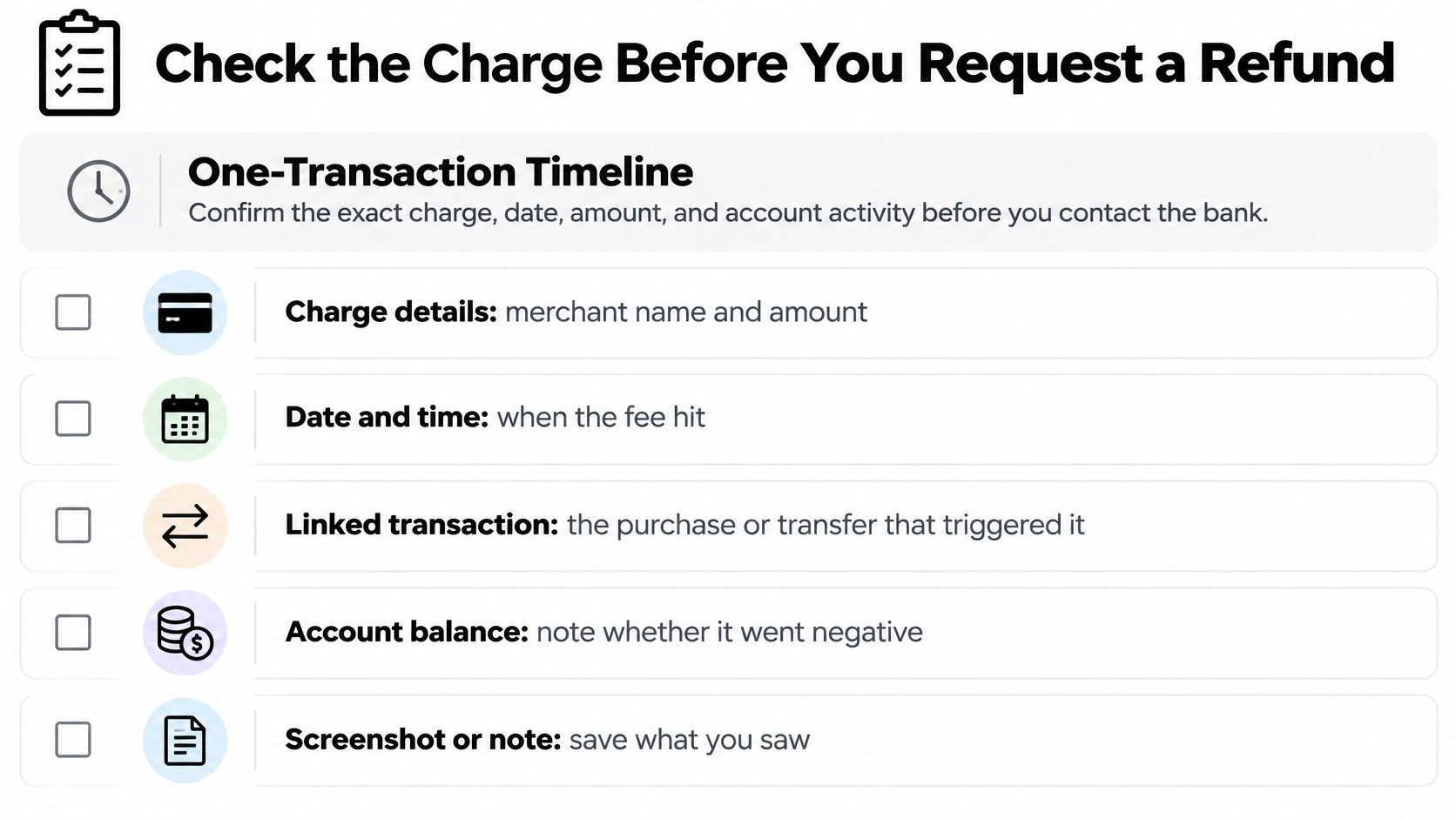
Reconstruct the transaction before you contact the bank. Your statement shows what posted, but the refund argument may depend on what happened earlier, when the merchant first requested authorization.
Use this checklist to gather the basic records before building the detailed timeline.
Build a one-transaction timeline
Start with the purchase that apparently triggered the fee. Save the statement, relevant app screenshots, deposit notices, and account agreement, then record:
- Before authorization: The available balance immediately before the purchase.
- At authorization: The purchase amount and any pending hold.
- Between authorization and settlement: Subsequent credits, debits, and changes to holds.
- At settlement: The timestamp, posted amount, and resulting balance.
- At the fee posting: The charge description, amount, and posting time.
If the bank doesn't show historical authorization details, ask it to provide them. Mark missing information as missing rather than substituting today's balance or guessing what the app displayed.
The strongest technical argument may be an authorize-positive, settle-negative transaction, often abbreviated APSN. Your available funds covered the purchase when it was authorized, but the bank assessed an overdraft fee when it settled after your balance changed. CFPB guidance has identified these surprise charges as potentially unfair or abusive because customers may reasonably understand authorization to mean the purchase won't incur an overdraft fee.
Holland & Knight's analysis of CFPB overdraft scrutiny discusses that concern and supervisory actions reporting approximately $184 million in refunds for unfair unanticipated overdraft fees and $66 million for unfair repeat NSF fees. The distinction matters: your argument concerns the processing sequence, not just your belief that you had enough money.
Check the scope before assigning a label
Look for every fee generated by the same practice, including another NSF charge when the same item was presented again. Institutions may charge a flat fee for a paid overdraft and, in some cases, a daily fee while the account remains negative, so don't stop at the first line item.
Keep these errors out of your packet:
- Confusing balances: Available balance and ledger balance aren't interchangeable.
- Missing related charges: Check adjacent dates for daily or additional fees.
- Misidentifying a duplicate: A repeated merchant entry needs its own review; use this guide to a duplicate charge on a bank statement to separate that issue from the overdraft charge.
If you're also dealing with a collection notice, treat that as a separate task. Tanner Law's steps to dispute a collection notice provide a resource for that situation, rather than a substitute for disputing the bank fee.
Finish by labeling the charge: possible APSN, repeat NSF, processing error, or apparently permitted fee. You don't need a polished legal argument. You need a documented explanation the bank can investigate.
Write a Refund Request Banks Cannot Brush Off
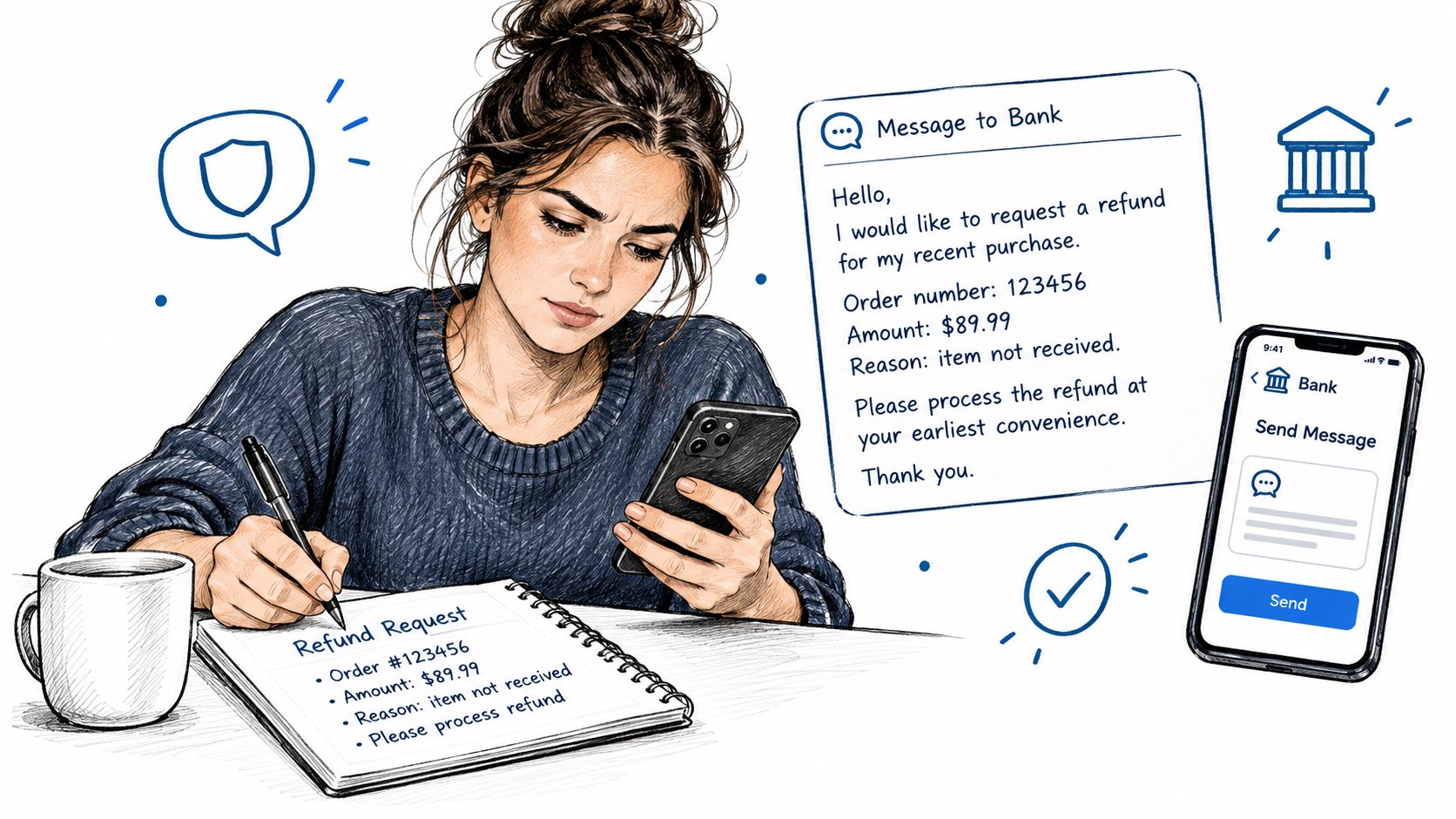
A useful written request makes the disputed fee easy to locate and the requested action unmistakable. Send it through the bank's secure messaging system or another contact method the bank provides, then use the same wording if you call.
Keep your supporting records beside you while drafting.
Choose the request that matches the evidence
For U.S. accounts, banks generally can't charge overdraft fees on ATM withdrawals or one-time debit-card transactions without affirmative opt-in. Recurring electronic payments and checks can still generate fees without that consent, as explained in the CFPB's guidance on challenging overdraft fees.
Identify the transaction category explicitly. If consent is the issue, ask the bank to produce the opt-in record rather than assuming you remember every account-opening selection.
Use this adaptable message, deleting the alternative that doesn't fit:
I'm requesting reversal of the overdraft fee of [amount] posted on [date], associated with [transaction and transaction type].
My reason is [brief explanation tied to the attached evidence].
If the fee was assessed correctly under my agreement, please consider a courtesy reversal. If my records indicate a consent, processing, or disclosure mismatch, please open a formal investigation and provide a written explanation addressing that issue.
I've attached [statement and supporting records]. Please review the related fees identified in the attachment and provide a case confirmation number.
The bracketed text is yours to complete, not a claim to copy without checking. Keep the explanation factual. If you don't know whether you opted in, say that you're requesting verification.
Preserve the response, not just the promise
Save the submitted message, attachments, confirmation number, and any promised follow-up date. If someone approves a refund, record which fees they agreed to reverse and check that the credit posts. This guide explains how to track a refund without treating an approval as completed payment.
The same document-first habit is useful for other recovery tasks. If you're separately reviewing a property-tax issue, property tax refund advice from INTELLI is a topic-specific resource, not authority for an overdraft dispute.
For an additional walkthrough of the refund conversation, you can watch:
Keep your expectations grounded. The complaint outcomes described in the CFPB material include financial relief in more than one in four bank-service complaints, monetary relief in nearly half of low-funds complaints, and median monetary relief of $110 across complaints. Those outcomes aren't personal refund odds or a promised payment.
A vague balance argument leaves the bank room to respond with pending holds, merchant information, deposit restrictions, or the fee schedule. Your written request should address the relevant explanation directly.
Decide When to Escalate a Denied Refund
Another supervisor call isn't always the right next move. If the bank has clearly denied a discretionary waiver, repeating the same request may consume time without changing the answer. If it hasn't addressed evidence of an improper fee, the problem is no longer a lack of sympathy.
The large-bank overdraft-fee rule was rescinded in 2025. Don't base your request on the assumption that there's a universal federal cap or an automatic entitlement to a goodwill refund.
What to Do After the Bank Denies the Refund
| Fee situation | What the bank owes you | Next move |
|---|---|---|
| Fee appears permitted under the agreement | A courtesy waiver isn't automatically owed | Ask whether an authorized reviewer can reconsider, then stop repeating an unchanged request |
| Charge may conflict with the agreement or required opt-in rules | The dispute concerns proper charging, not discretionary generosity | Seek a documented investigation through the executive-complaint channel, then the CFPB if unresolved |
| Fees keep arising from the same timing or coverage pattern | Repeated courtesy refunds aren't a dependable solution | Change coverage settings, payment timing, or the account used for recurring debits |
The table separates the refund decision from the prevention decision. A recurring pattern can still include a questionable fee worth disputing. You don't have to abandon the dispute to fix the conditions that keep exposing you to charges.
Use a stopping threshold
My recommendation is to escalate after a documented denial that fails to address a plausible rule or agreement mismatch. You don't need to restart the same conversation with a succession of representatives.
Likewise, if the bank offers a courtesy credit but ignores related fees you specifically identified, ask for a written decision on the remaining items. A partial credit isn't an explanation of why the rest were assessed correctly.
Don't let a goodwill offer replace an answer to a documented charging problem.
For escalation, preserve:
- The denial wording: Save the actual message rather than your recollection of the call.
- The agreement citation: Ask which provision the bank relied on and how it applies.
- The case record: Keep confirmation numbers, correspondence, and attachments together.
- The unresolved question: State exactly what the bank still hasn't answered.
Send that packet to the bank's executive-complaint channel. If the issue remains unresolved, use the CFPB complaint process with the same organized evidence and a specific requested resolution.
For a valid fee, I'd draw a different line. Once someone authorized to reconsider has denied the courtesy request and there's no new evidence, stop negotiating. Change the account setting or payment arrangement that created the risk.
That's not conceding that the fee was affordable or reasonable. It's choosing the action most likely to improve your position from here.
Catch Repeat Overdraft Fees Before They Pile Up
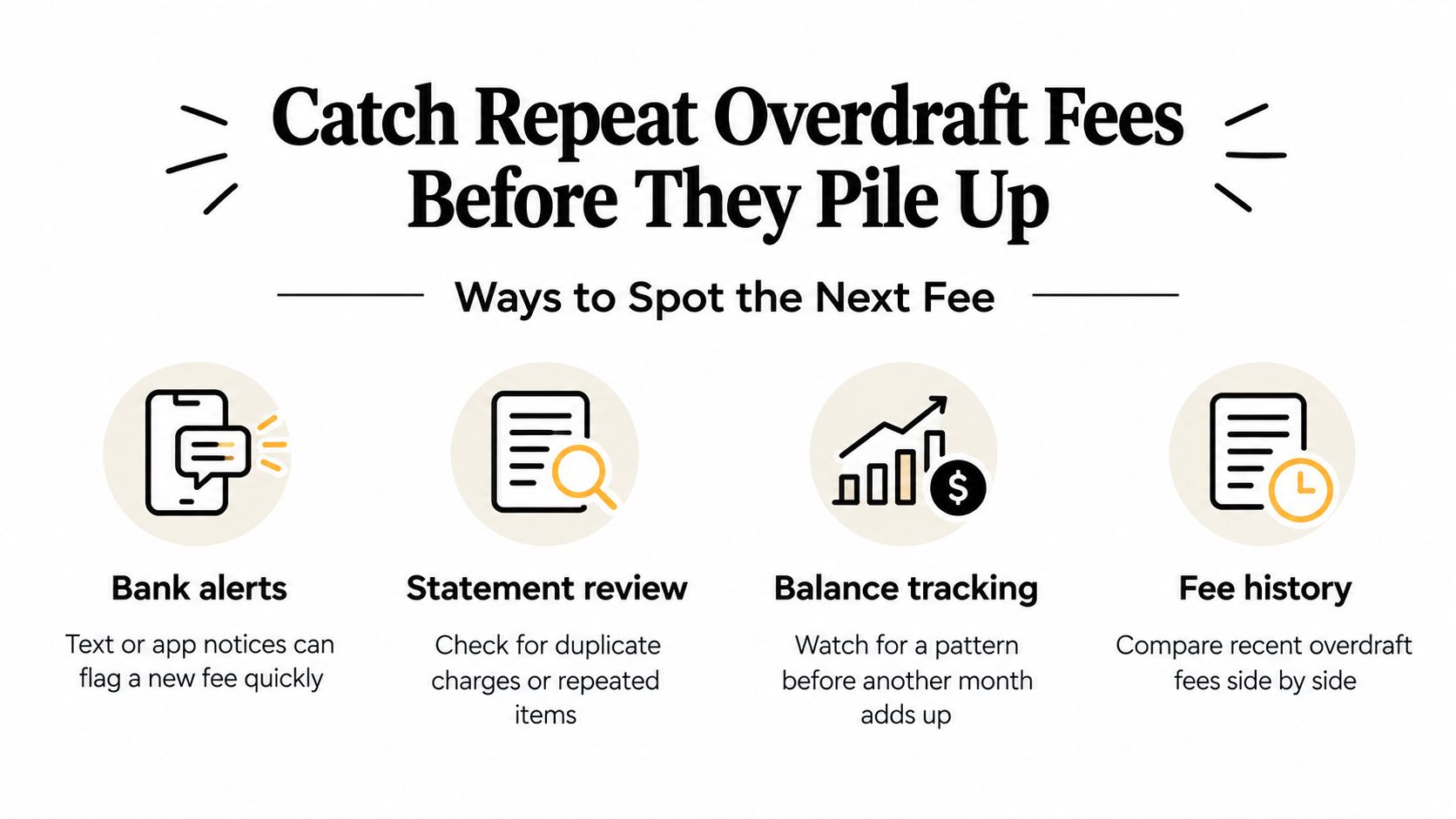
Monitoring should help you identify a pattern, not just tell you that your balance is already negative. Choose a method you will maintain, then make sure you can connect each fee to its underlying transaction.
The CFPB's 2023 supervisory review reported more than $98 million in consumer refunds following work on problematic overdraft practices, with reviewed institutions charging $15 to $36 per item, according to its special edition on junk fees. In the reviewed data, overdraft and NSF charges accounted for 53% of consumer checking-account fees in 2022; average annual charges were approximately $65 per accountholder, exceeding $165 for opted-in accounts and $220 for lower-balance accountholders, the same review reported.
Match the method to the problem
| Monitoring method | What you do | What still needs attention |
|---|---|---|
| Manual statement review | Compare fee history, posting order, authorization records, and settlement dates | You must return to the records consistently |
| Bank alerts | Enable available low-balance and transaction notifications | You still need to connect notices to holds, settlements, or re-presented items |
| Read-only monitoring | Connect an account so a service can review balances and transactions | A flagged finding still needs verification and an appropriate next action |
For an isolated charge, manual review may be enough. Save the completed packet and make a habit of checking subsequent statements for related entries.
If you keep being surprised, bank alerts can make the review more timely. But a balance notification doesn't itself establish why the bank charged a fee or whether the charge was proper.
Use these monitoring tasks as a practical checklist.
Consider account watching without giving up control
Compass+ is one read-only monitoring option. It connects bank activity through Plaid to view balances and transactions, but can't move money and doesn't store banking passwords. Optional email access is limited to money-relevant messages such as receipts, renewals, and refund confirmations.
Its savings feed pairs a finding with an estimated amount and a recommended next step, such as requesting a refund. The standalone product is available by waitlist, while an embedded assistant is available to U.S. users inside Gerald. Neither a flagged opportunity nor an estimated amount guarantees that the bank will reverse a charge.
Whatever method you choose, use the findings to change recurring conditions, not just collect notifications:
- Coverage settings: Review whether optional overdraft coverage still suits your needs.
- Payment timing: Compare recurring debits with when your income becomes available.
- Account buffer: Keep funds available for payments you've already committed to, where possible.
For a recurring timing problem, this guide to avoiding overdrafts through bill timing focuses on the prevention work that a refund request can't accomplish.
Take the Next Step on Your Overdraft Fees
Open your latest statement and choose the unresolved fee you can act on today. Copy its date and amount into your request, then match it to the classification you established from the records.
Don't spend another call explaining the entire history of your account. Send the relevant evidence and ask for a defined action.
Give this week's fee a destination
Use this sequence to finish the task rather than leave it half-open:
- If you haven't submitted the request: Complete the written message, attach the supporting records, and save the submission confirmation.
- If a questionable fee was already denied: Send the existing packet through the escalation route rather than beginning the courtesy script again.
- If a valid courtesy request was refused: Record the decision and make a prevention change you can sustain.
- If a reversal was approved: Check the posted credit against the fees the bank agreed to refund.
Keep the packet somewhere you can retrieve it without searching through scattered screenshots. Give the saved records clear descriptions, especially if your account shows several similar merchant entries.
Define what finished looks like
A refund task is finished when you know its status and your next action. That may mean waiting for a documented investigation, pursuing an unresolved complaint, verifying a credit, or accepting a discretionary denial while changing how the account operates.
Your stopping point: A clear disposition for the fee, plus a way to notice the next problem.
If manual reviews don't fit your routine, activate one of the monitoring methods above. You can use bank alerts immediately, consider the standalone monitoring waitlist, or use the assistant available inside Gerald if that suits how you manage your accounts.
Don't wait for a new tool to handle an existing charge. Your statement, agreement, and written request are enough to begin.
The practical objective isn't to win an endless argument with customer service. It's to put the fee into the right process, insist on an answer when the evidence warrants one, and stop relying on goodwill to manage a recurring account problem. Submit the request, escalate the unresolved mismatch, or close out the courtesy denial with a concrete prevention change.
Compass+ offers read-only account monitoring that surfaces potential savings opportunities with an estimated amount and a concrete next step, helping you notice charges that deserve review. Visit Compass+ to join the standalone waitlist and make monitoring part of your overdraft-prevention routine, without treating any flagged fee as a guaranteed refund.