Best SIM Card in 2026: Real-World Picks for Every Need
Find the best SIM card in 2026 with our guide to eSIM vs physical SIM, local vs travel plans, coverage tradeoffs, and use-case recommendations.
16 min read

The most popular advice for choosing a SIM card is also the least useful: compare the price per gigabyte and buy the cheapest plan. That can leave you with plenty of data on a connection that lags during calls, drops in the places you need it, or routes traffic through a distant roaming hub. The best SIM card is the one that delivers dependable service for your device, destination, and routine, without creating avoidable account or recovery headaches.
| Buyer | Best starting point | Check before paying |
|---|---|---|
| Frequent international traveler | eSIM with a verified host network, or a local SIM for a longer stay | Host network, roaming status, latency, and whether calls or SMS are included |
| Light everyday user | Prepaid plan or MVNO on a strong local network | Coverage where you live and work, data allowance, and renewal terms |
| Data-heavy user | Local operator plan with suitable 5G and hotspot access | Network consistency, fair-use limits, and tethering rules |
| Dual-line worker | Compatible phone with eSIM plus a separate work or travel plan | Carrier support, line-transfer process, and account protections |
Table of Contents
- What Best SIM Card Actually Means in 2026
- Physical SIM vs eSIM and Why the Format Matters
- Native Network vs Travel eSIM and the Performance Gap
- Comparing the Main Plan Types Side by Side
- Matching the Plan to the Trip or Daily Routine
- Security, SIM Swaps, and Recovery Tradeoffs
- Direct Picks for Every Type of Buyer
What Best SIM Card Actually Means in 2026
The best SIM card isn't the one with the lowest price per gigabyte. It's the one that connects reliably where you use your phone, fits how you manage your lines, and works with your device. Price matters, but a generous allowance can't rescue a plan that has weak coverage or a roaming setup that makes real-time apps frustrating.
Mobile service is already a mass-market utility, and many people manage more than one connection. The International Telecommunication Union reported approximately 9.1 billion mobile-cellular subscriptions worldwide in 2024, equal to 112 subscriptions per 100 inhabitants. The total includes postpaid subscriptions and active prepaid accounts, so it reflects more than primary personal phone lines. Secondary numbers, work lines, travel SIMs, and data-only connections all help explain why one plan can't be the universal winner. The same report put global mobile-broadband subscriptions at 95 per 100 inhabitants. The ITU's 2024 subscription figures underline the practical point: compare the connection you'll use, not just the advertised allowance.
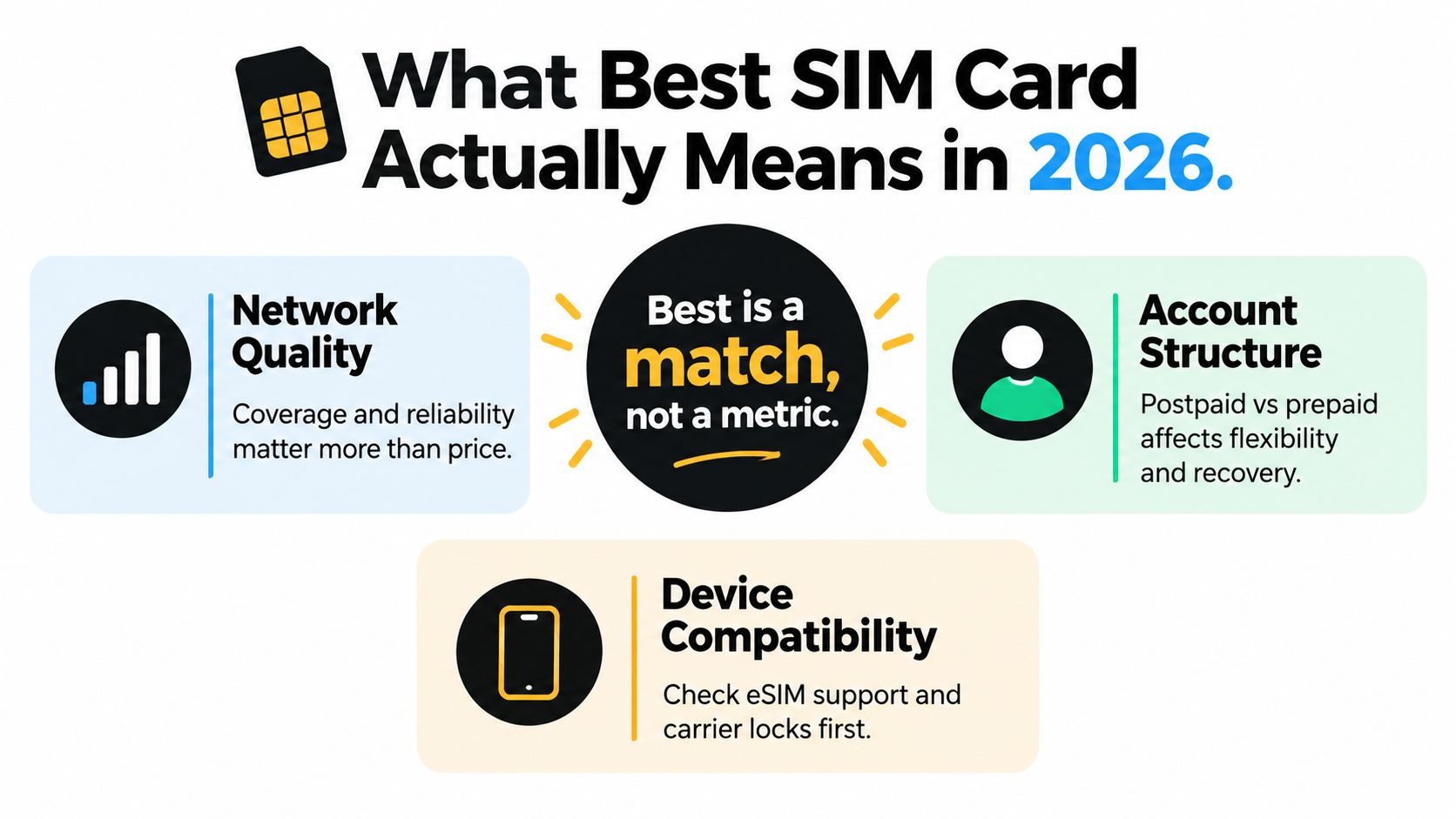
Five criteria that decide the winner
Network performance comes first. Check availability and consistency where you'll spend time, then look at speed. A fast peak result is little help if the connection keeps faltering.
Pricing transparency means understanding what happens after the headline offer: renewal terms, roaming charges, fair-use thresholds, and any hotspot limits. A plan is only cheap if its rules suit your use.
Plan flexibility covers how easily you can add data, switch providers, use multiple lines, or cancel. A short trip and a long-term home connection call for different kinds of flexibility.
Security and recovery matter because your number may receive account-verification messages. Know how the carrier protects transfers and how you'll regain access if your device disappears.
Device compatibility and lock-in can rule out a plan before price even matters. Confirm that your phone supports the format and that it's eligible for the carrier's service.
A surface-level comparison of price and data allowance misses the tradeoffs. For travel, that can mean buying a plan with awkward roaming performance. At home, it can mean overlooking account protections or renewal rules. Match a plan against all five criteria, and the "best" choice becomes specific to you instead of a marketing label.
Physical SIM vs eSIM and Why the Format Matters
A physical nano-SIM and an eSIM do the same essential job of identifying your subscription to the mobile network. Neither format gives you faster 4G or 5G directly. Your experience depends on the operator's network and the plan's terms, not on whether the SIM is plastic or embedded in the phone.
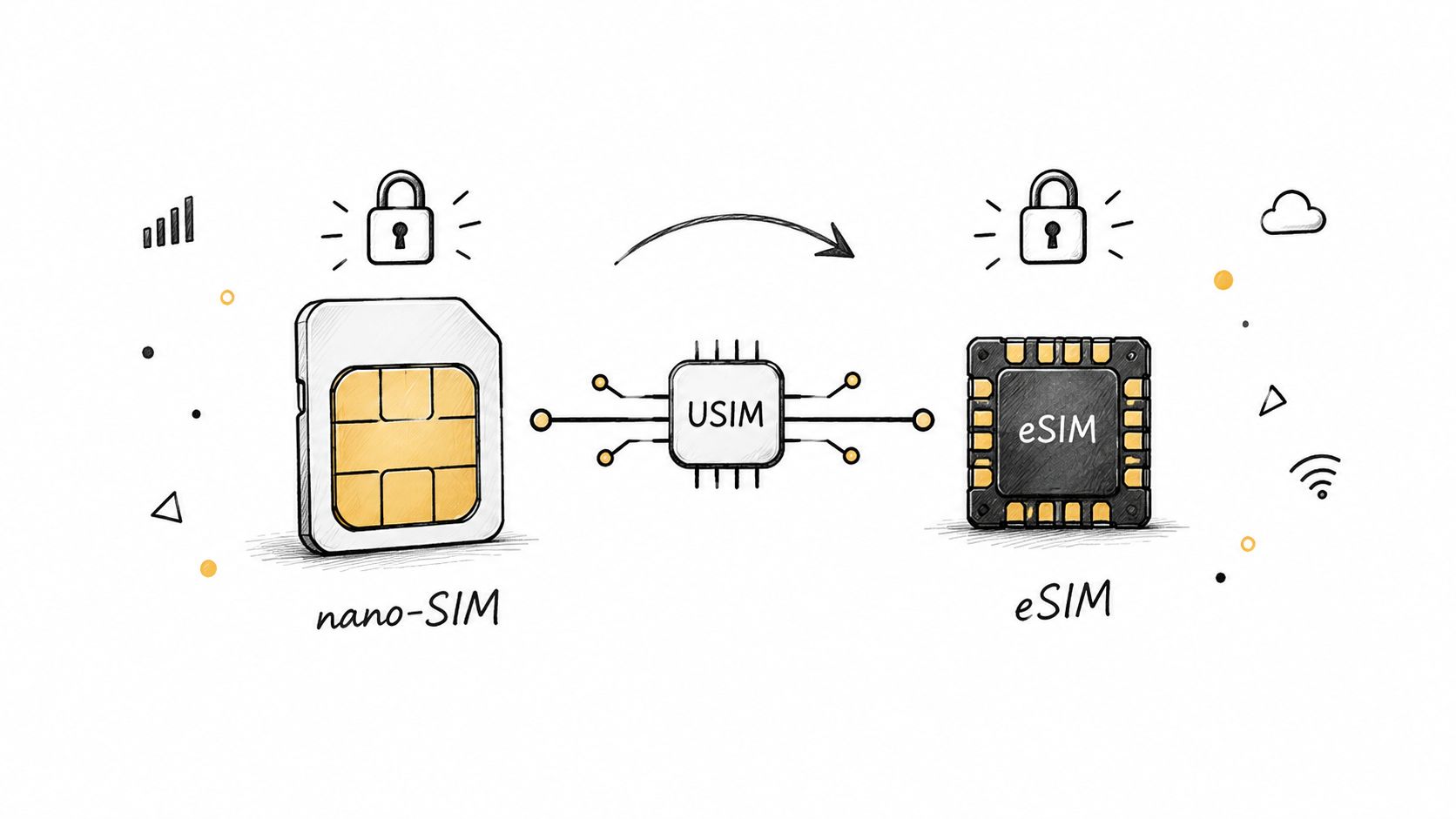
An eSIM's advantage is convenience. Consumer eSIMs use GSMA remote provisioning, including the SGP.22 standard, to download carrier credentials over the air. On a compatible phone, you can store multiple carrier profiles and switch between them in your device settings. That makes it easier to keep a home number available while adding a separate travel data plan, or to use distinct personal and work lines without swapping cards. The GSMA describes the wider shift toward eSIM adoption in its market analysis of eSIM in the United States.
Choose the format your phone and carrier support
A physical SIM is still the straightforward choice for an older handset, a carrier-locked phone, or a destination where eSIM activation is limited. It can also be handy if you want to buy a local SIM in person and insert it immediately. If you replace phones often, a physical card may be easier to move, though carrier rules still apply.
An eSIM can make switching profiles simpler, but don't assume every plan will activate the way you expect. Some setups require Wi-Fi during installation, and support can vary by carrier, plan, and country. Check whether the offer includes a local phone number or data only, and confirm hotspot permissions before buying.
Run this compatibility check first
- Check the handset: Look in its mobile or cellular settings for an option to add an eSIM, then confirm support for your exact model.
- Check the carrier: Verify that the operator supports eSIM activation for your plan, not merely that your phone can use eSIM in general.
- Check the plan: Confirm number type, hotspot policy, and whether setup requires an internet connection.
- Check your fallback: If losing access during a phone replacement would cause trouble, learn how the carrier transfers the profile before you rely on it.
For most travelers and people who switch carriers regularly, eSIM is the more flexible format when both the phone and provider support it. For everyone else, a physical card remains a sensible choice, not an outdated one.
Native Network vs Travel eSIM and the Performance Gap
Don't buy a SIM based on its advertised maximum speed. Start with whether the network is available where you need it, then look at consistency, and only then compare download speeds. Opensignal's global benchmarking framework evaluates 4G/5G Availability, Excellent Consistent Quality, and Download Speed as distinct measures. That's a better way to think about service than treating a speed headline as a promise. Opensignal's benchmarking framework supports a practical order of operations: coverage first, consistency second, peak performance third.
A travel eSIM may connect you through a roaming partner rather than give you native access to a local operator. Available measurement cited in coverage found that 87.5% of tested travel eSIM plans used roaming arrangements, with reported latency penalties ranging from 64% to 621%. Those findings come from the cited travel eSIM analysis, not a guarantee that every plan or destination will perform the same way. The travel eSIM performance discussion is a reminder to ask how traffic is routed, not just how much data is included.
Check the measures that affect real use
Extra latency can make video calls feel delayed and interfere with cloud gaming, mobile payments, navigation, and remote work. A plan can still be fine for messaging or browsing, but the difference matters when you need quick back-and-forth communication or dependable app responses. For a longer stay, a local operator plan may be worth the extra setup if it gives you more direct access to the local network.
| Priority | Metric | Why it matters | Where to confirm |
|---|---|---|---|
| First | Availability in your locations | No speed rating helps where service drops | Operator coverage maps and location-specific independent benchmarks |
| Second | Consistent quality | Stable everyday performance beats occasional peaks | Independent network results for your city or route |
| Third | Host network and roaming status | Roaming arrangements may affect routing and latency | Plan details or provider support |
| Fourth | Typical speed and latency | These shape downloads and real-time apps | Destination-specific tests and plan documentation |
| Fifth | 5G, hotspot, and SMS terms | Features may be limited even when data is included | Plan terms and carrier confirmation |
Before you pay, confirm the host network, whether the plan is native or roaming-based, and whether it supports 5G and tethering. Ask whether incoming SMS works, especially if you need your number for verification. If the seller won't identify the underlying network or explain the plan's limits, treat that as a reason to keep comparing.
Comparing the Main Plan Types Side by Side
There isn't one plan type that wins for everyone. A major-carrier postpaid plan can make sense if you need its network priority, device financing, or family-line setup. A prepaid option or MVNO may be a better buy if you want a straightforward monthly connection without paying for features you won't use.
| Plan type | Cost profile | Contract and credit friction | Network and international use | Hotspot and best fit |
|---|---|---|---|---|
| Postpaid on a major carrier | Often carries a premium | May involve credit checks or account commitments | Direct carrier plan; international features depend on terms | Check the specific plan; suited to priority data, financing, or family lines |
| Prepaid on a major carrier | Pay upfront, often easier to control | Typically avoids a long commitment | Uses the carrier's network; roaming depends on the offer | Confirm tethering rules; good for users who want carrier coverage with upfront payment |
| MVNO | Often competes on lower prices | Usually simpler account setup than postpaid | Uses a major operator's network, but plan priority and roaming vary | Check the plan; fits budget-minded users who don't need every premium feature |
| Local-data-only prepaid | Can be economical for local data | Usually an upfront purchase | Local operator access, with no voice or SMS on data-only offers | Hotspot varies; useful for longer stays when data is the priority |
| Travel eSIM | Price depends on destination and allowance | Often quick to buy and activate | May use roaming rather than native local access | Tethering varies; suits short trips when host network and routing are clear |
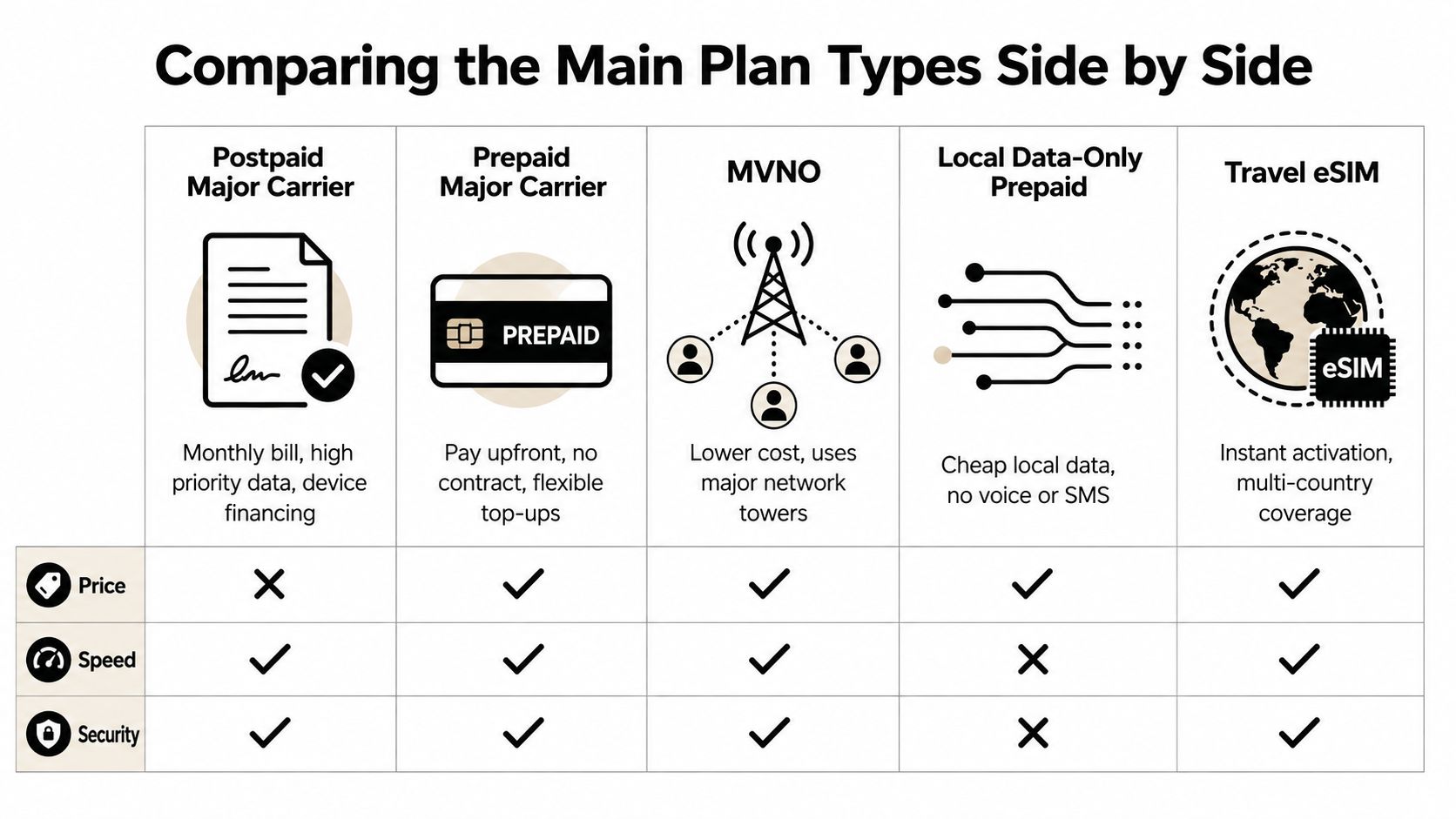
An MVNO can offer a lower-cost route onto a major network's towers, but don't assume that means identical priority, roaming, or support. Read the actual plan terms. Likewise, local prepaid can be the stronger option for an extended visit because you can choose a local operator directly instead of relying on a travel plan's roaming arrangement.
Postpaid earns its higher cost when its specific benefits matter to you. If you don't need device financing, premium data treatment, or bundled family lines, compare prepaid and MVNO offers first. For a New Zealand-focused checklist on weighing plan details before signing up, see Mobile Systems Limited buying tips. Use the same discipline anywhere: compare the underlying network and terms, not just the brand name.
Matching the Plan to the Trip or Daily Routine
The right SIM changes with the trip. A vacationer who mainly needs maps and messaging has different priorities from a remote worker who can't afford lag on a client call. These scenarios show how to choose without letting the cheapest data offer make the decision for you.
A short vacation in one country
For a one-week holiday, a data-only travel eSIM is often the simplest starting point if your phone supports it and the host network is clear. You can keep your home SIM available for important texts while using the travel profile for mobile data. If you need a local number for calls or SMS, choose a local prepaid plan that explicitly includes those services instead.
The common trap is leaving the home line active for calls and data without checking its roaming settings. Before departure, select the travel plan for mobile data and review what the home line will do abroad. That small setup check can prevent an unexpected bill.
A multi-country business trip
For a trip with frequent video calls, prioritize network access and latency over the lowest per-gigabyte price. A regional travel eSIM may be convenient, but only choose it after checking the host network and whether the plan uses roaming. If the trip is long or work is latency-sensitive, a native local-network plan in the main destination is the more dependable bet, even if it takes extra effort to arrange.
A cheaper travel eSIM can win for a low-stakes holiday. For work calls, a verified native network is the better purchase when reliability and responsiveness matter.
A daily line with a separate cheap data option
For regular home use, start with the strongest suitable prepaid or MVNO plan in your usual locations. If you also want low-cost data for a trip, add a separate travel eSIM rather than changing your primary number. A dual-line setup keeps the everyday account distinct, but only if you understand which line handles calls, texts, and data.
That separation is useful when travel disrupts plans at home, too. For practical guidance on what to do if delays change your itinerary, consult this flight-delay compensation guide. Across all three scenarios, return to the same criteria: network performance, transparent pricing, flexibility, recovery protections, and device compatibility.
Security, SIM Swaps, and Recovery Tradeoffs
An eSIM isn't automatically safer in every way. It removes the risk of someone physically taking your SIM card, but it doesn't prevent a carrier account from being targeted or your number from being transferred through a SIM-swap or port-out attack. If criminals take control of your number, they may intercept calls and text messages used for two-factor authentication. The FCC's eSIM guidance explains that eSIM reduces physical-theft risk while these broader account risks remain.
Protect the number, not just the card
Ask your carrier whether it offers a transfer lock, an account PIN, or additional identity checks before moving a number. These protections matter whether your phone uses a physical card or an embedded profile. If your email, financial, or social accounts rely on SMS codes, add another recovery method where available, such as an authentication app or a recovery code stored securely.
Moving an eSIM to a replacement phone can also require carrier support or a new activation process. Before you travel, find out what happens if your handset is lost or damaged and whether you can restore the line without the original device. A physical SIM may be easier to move between compatible phones, but it can still be lost, stolen, or misused.
Avoid the data-only eSIM roaming trap
A data-only travel eSIM doesn't necessarily replace your home line. You may keep the home SIM active to receive texts, but that can also leave roaming enabled if the settings aren't configured carefully. Choose which line supplies mobile data, check whether the home line can roam, and understand what calls or messages may cost before leaving.
Use this recovery checklist before relying on either format:
- Secure the carrier account: Set an account PIN and enable any available transfer lock.
- Confirm recovery steps: Find out how to restore service if the phone is lost or replaced.
- Reduce SMS dependence: Add alternative authentication and account-recovery methods where possible.
- Check line settings: Set the correct data line and review roaming for the home number.
- Verify number portability: Understand what the carrier requires to transfer your number.
A SIM format is only one part of security. The stronger choice is the plan and carrier account you can protect, regain control of, and use without exposing yourself to avoidable recovery problems.
Direct Picks for Every Type of Buyer
If you want one quick answer, choose by how you'll use the connection, then verify the details that can make or break it. These are the picks I'd start with, not unconditional endorsements of any specific provider.
| Buyer | Preferred format | Plan type | Non-negotiables |
|---|---|---|---|
| Frequent international traveler | eSIM where supported; physical SIM as a fallback | Travel eSIM for short trips, local prepaid for longer stays | Verified host network and roaming status |
| Light everyday user | Physical SIM or eSIM, whichever is easier with the phone | Prepaid or MVNO | Reliable local coverage and clear renewal terms |
| Data-heavy power user | Either format | Local operator plan or a suitable major-carrier plan | Strong availability, fair-use threshold, and hotspot permission |
| Dual-line worker | eSIM if both carriers support it | Separate work and personal plans | Easy profile transfer and strong account protections |
For destination-specific research, check Jasumo's 30-day SIM guide when comparing options for a longer trip in Japan. Apply the same checks wherever you're going: know the network behind the offer, whether it supplies a local number, and what happens when the plan runs out or you change phones.
Here's the decision tree. First, check whether your handset supports eSIM and whether your carrier and destination support the activation you need. For a short trip, choose a travel eSIM only when you can verify its host network and roaming setup. For a stay over two weeks, or for work that depends on low latency, favor a native local-network plan. For everyday home service, start with prepaid or an MVNO, then pay extra for postpaid only when its network priority, financing, or family features earn the premium.
The cheapest plan is rarely the best plan if it leaves you with weak service, surprise charges, or a hard-to-recover phone number. Real-world performance and recovery safety are the benchmark.
Compass+ monitors connected financial, email, calendar, and shopping accounts to surface possible refunds, price drops, duplicate charges, and subscriptions worth reviewing, with a practical next step for each finding. If you want help spotting savings that might otherwise slip by, visit Compass+ to learn how it works.