Automatic Renewal Laws Explained for 2026
Automatic renewal laws now depend on your state and plan. Compare notice windows, consent rules, and what to do if a renewal still charges you.
18 min read
Search for advice on automatic renewal laws and you'll hit the same instruction everywhere: cancel before the renewal date and you're protected. It's clean, memorable, and wrong in a way that costs people money.
The advice assumes one national rule sits behind every subscription. It doesn't. The federal click-to-cancel standard that dominated headlines was struck down in court, and what remains is a state-by-state patchwork where the answer to "can I cancel this online?" turns on where you lived when you signed up, what kind of plan you bought, and which company processes the bill.
The better question isn't "what does the law say?" It's "which rule reaches this subscription, and what evidence do I need if a charge lands after I cancelled?" Answer those in the right order and most of the confusion disappears.
Table of Contents
- Which Automatic Renewal Rule Applies to You
- Why State Rules Still Differ and Which Law Governs
- What Disclosure and Consent Must Cover
- California Reminder Rules and the Right Channel
- Cancellation That Matches How You Signed Up
- Before the Next Renewal Date
- When You Cancel and the Charge Still Hits
Which Automatic Renewal Rule Applies to You
No single nationwide click-to-cancel rule is in force in the United States. The Eighth Circuit vacated the FTC's Click-to-Cancel rule on July 8, 2025, while state automatic renewal laws stayed in force, as legal analysis of the Eighth Circuit's negative-option decision sets out. More than half of U.S. states have a statute of their own, and some are as strict as or stricter than the federal rule that no longer exists.
That single fact reshuffles the whole question. You're not looking for "the" law. You're working out which of several overlapping rules a given subscription falls under.
Three checks, in this order
1. Which state were you in at enrollment, and which state are you in now? A move can change your reminder schedule and cancellation rights, because these statutes generally follow the consumer's residence rather than the company's headquarters. Keep both dates and both addresses in view when you read a renewal notice.
2. What type of plan is it? A free trial that converts to paid, a month-to-month renewal, and an initial term of one year or longer are three different legal events. The trial conversion and the long initial term each trigger notice duties that a plain monthly plan never faces.
3. Which channel bills the charge? If Apple or Google processes the payment, cancellation runs through that store's subscription settings, not just the merchant's app. A merchant can't cancel a charge it doesn't collect.
When the checks point to different answers, the strictest applicable rule usually shapes what you can accomplish. A national seller that has built its checkout to satisfy a demanding state tends to run that same flow for everyone, though that's a business decision rather than a guarantee your own state grants identical rights.
| Situation | Timing | What it must cover | Where it applies |
|---|---|---|---|
| Annual plan with an initial term of one year or longer | 15 to 45 days before renewal | Renewal-period length, charge amount or range, billing frequency, and cancellation method | California |
| Qualifying free trial | 3 to 21 days before conversion to paid | Notice before the trial becomes a paid plan | California |
| Price change | 7 to 30 days before the new price applies | Notice of the changed price | California |
| Annual reminder | Once a year, in the enrollment medium or the customer's usual channel | Product or service, charge frequency and amount, and how to cancel | California |
| FTC Click-to-Cancel rule | Vacated July 8, 2025 | No longer a single nationwide cancellation standard | United States |
| State automatic-renewal statutes | Ongoing, often stricter than any federal baseline | Disclosure, consent, reminder notices, and cancellation ease vary by statute | More than half of U.S. states |
California as the benchmark
California's Automatic Renewal Law is the version other states borrow from, partly because it has been running longest: it became operative on December 1, 2010, and was later amended by Assembly Bill 2863 in 2024. It covers the full enrollment cycle rather than one moment: disclosure before purchase, consent at signup, and a workable cancellation path afterward.
That structure explains why the law spreads. It gives legislators a template and gives businesses something concrete to build against, which is also why a company's compliance posture often tells you more about its checkout design than about your home state's statute.
One boundary worth setting now. A legally valid signup doesn't prove you can still find the terms, and it certainly doesn't prove you can stop the next bill. The table maps which rule to read first. It doesn't promise a refund, and it can't tell you what a merchant will do when you ask.
Why State Rules Still Differ and Which Law Governs
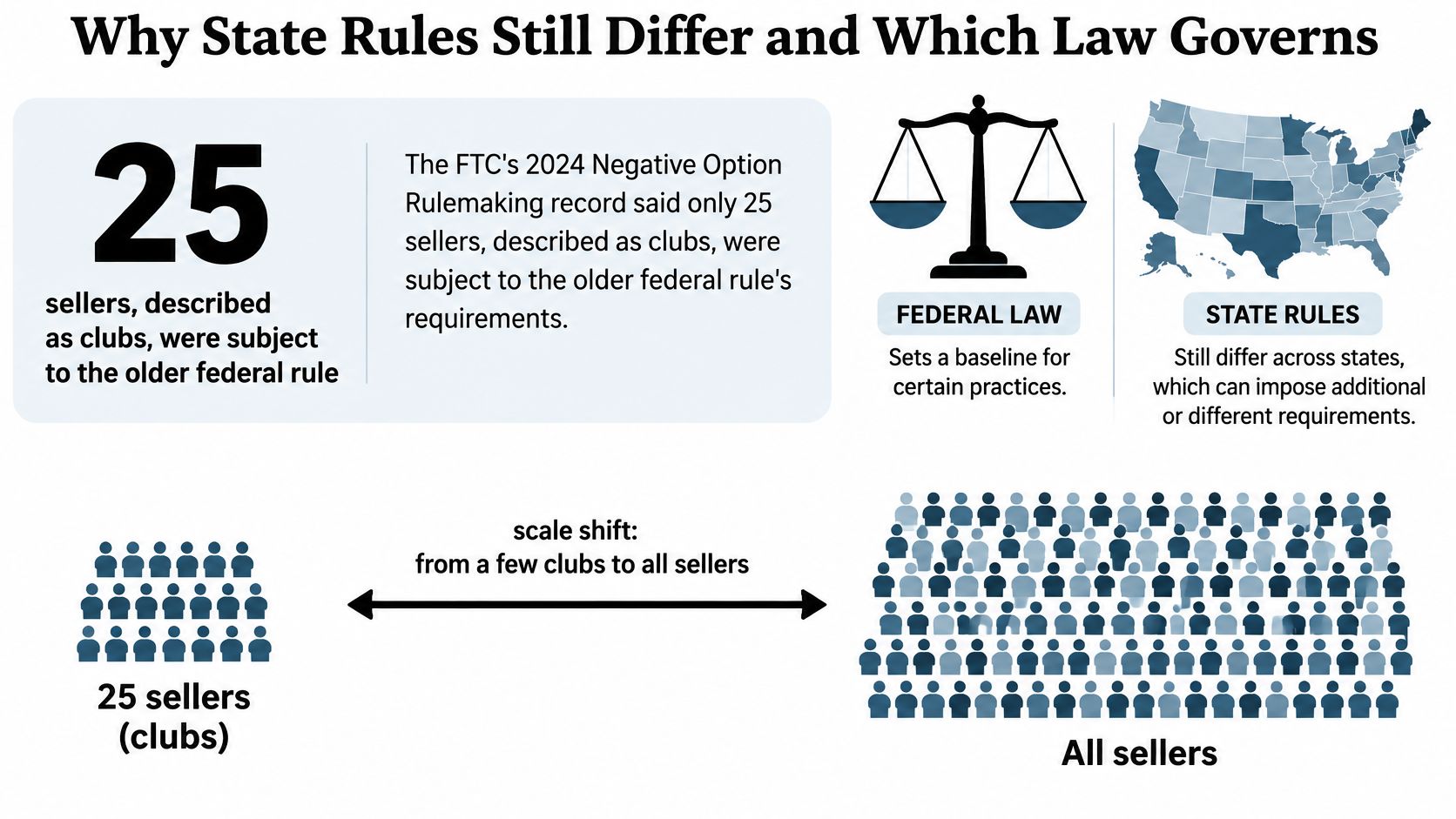
The regulatory shift here is one of scale, and the numbers make it vivid. The Federal Trade Commission's 2024 Negative Option Rulemaking record noted that only 25 sellers, described as "clubs," were subject to the older federal rule's specific requirements. The same record reported legal tracking that counted 28 states and the District of Columbia with laws or regulations addressing automatically renewing consumer subscriptions, plus six more states regulating automatic renewals within particular industries.
Twenty-five clubs became every seller with a recurring charge, and a single narrow federal text became dozens of state texts with different obligations.
Where the differences actually sit
Coverage is the first divide. Some statutes reach streaming, software, memberships, and subscription boxes. Others are written for a single industry and never touch a digital plan at all, which is why six states regulate automatic renewals only within particular sectors.
The second divide is the extra duty each state bolts on. One state adds a reminder notice for long-term contracts. Another demands one-step online cancellation. A third says nothing beyond disclosure and consent. Federal rules function as a baseline, and states can stack stricter requirements on top of it.
What this means in practice: your state of residence is the first thing to check, because a national seller may already be running a stricter state's process and handing you rights your own statute doesn't require.
For a seller, the risk runs the other way. A single checkout flow can satisfy forty states and still miss the one that wants a pre-renewal notice or a visible online cancel button.
Two details in your own agreement deserve a look: the governing-law clause and the merchant's location. Either can shape which state's rule a dispute raises, even when the statute that protects you is the one where you live.
This article covers U.S. rules only, so if a seller sits outside the country, check the law where it operates. Everything below returns to the table above, which stays the fastest way to orient yourself.
What Disclosure and Consent Must Cover
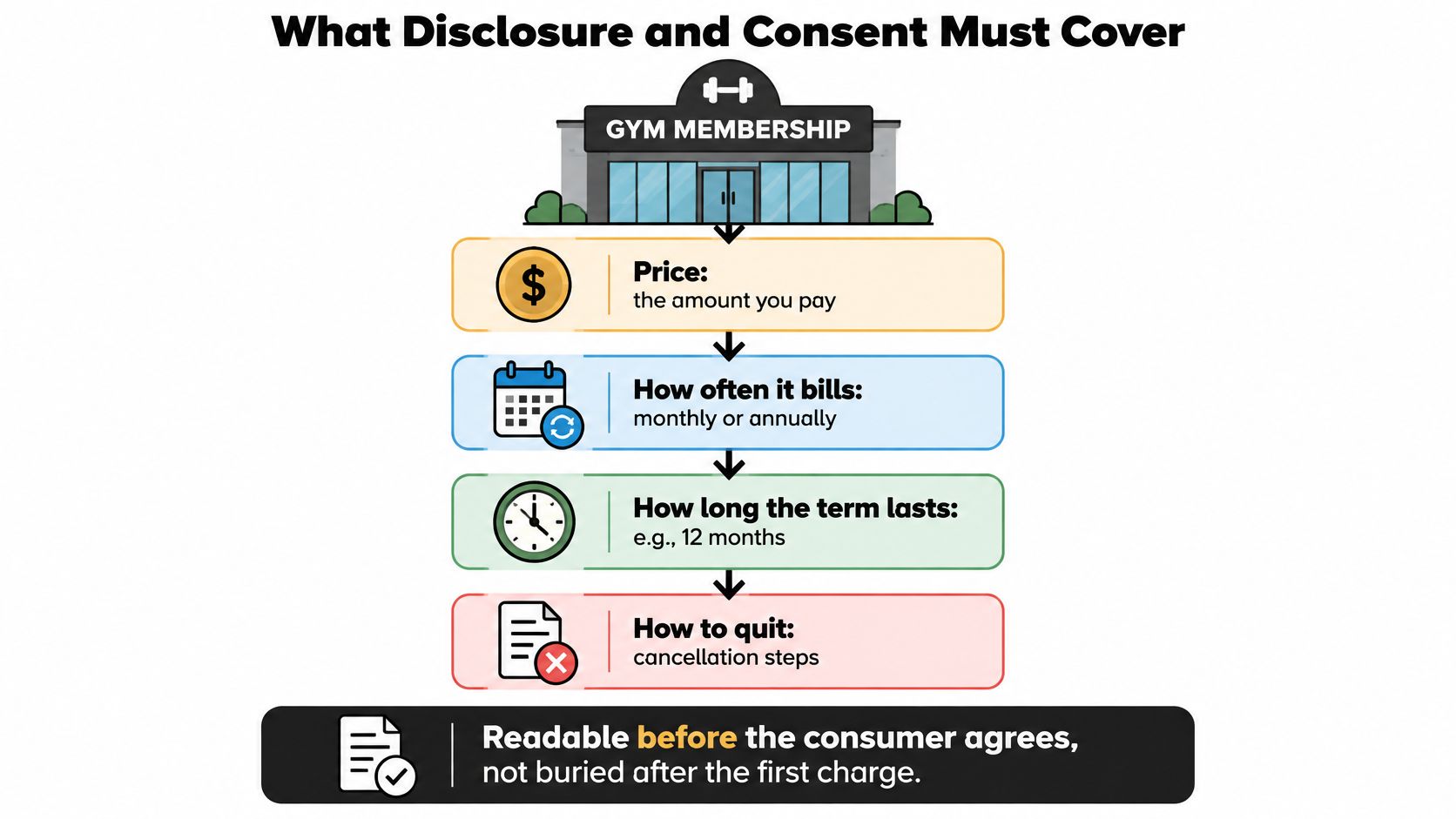
Say you join a gym on a January promotion. Four things should be readable before you agree, not discovered on your first statement: the price, how often it bills, how long the term lasts, and how to quit. If any of those four hides behind an expandable panel or appears after the payment fields, the enrollment has a problem regardless of what you clicked.
The FTC's 2024 amended Negative Option Rule treated cancellation, consent, and disclosure as separate control requirements rather than one combined step, as Kirkland's analysis of the final rule describes. Separating them matters, because a checkout can disclose perfectly and still fail on consent.
Disclosure arrives before the commitment
Clear and conspicuous pre-purchase disclosure covers the recurring price, the renewal frequency, the term length, and the cancellation method. Conspicuous means near the button, in the same visual weight as the rest of the offer, and legible on a phone, where a panel that sits beside the buy button on a desktop screen can fall three scrolls down.
The same duties attach whether a plan delivers software or a physical box. A look at how curated tasting boxes ship and bill shows shipping cadence and billing cadence described together, which is the level of clarity the disclosure rule is chasing.
Consent is a record, not a completed checkout
Affirmative consent applies to the recurring feature itself, and finishing a purchase doesn't demonstrate it. The FTC described a compliance safe harbor when a business uses a separate checkbox, button, or signature relating solely to the recurring charge.
A durable consent record looks like a timestamp, the terms as displayed, the control the customer selected, the channel, and the price version in force that day. Stored that way, the record can be reconstructed. Inferred from an order confirmation, it can't.
The acknowledgment is the document you will need
An acknowledgment the customer can keep restates the renewal terms, the cancellation policy, and usable cancellation instructions. It should match both the offer accepted at checkout and the billing schedule stored on the account, including for promotional pricing and alternative payment methods.
The document to keep: that acknowledgment email or in-app receipt is what you'll produce if a merchant later disputes what you agreed to. Search your inbox for it before you search for the phone number.
Material misrepresentation of the offer is barred outright, which is why a banner reading "free" over a page that bills monthly is a compliance failure and not clever marketing.
These controls now work as a compliance model and a state-law pattern rather than a nationwide mandate, and not every state offers the same checkbox safe harbor. Look for the acknowledgment anyway. It's the only piece of the enrollment you control after the tab closes.
California Reminder Rules and the Right Channel
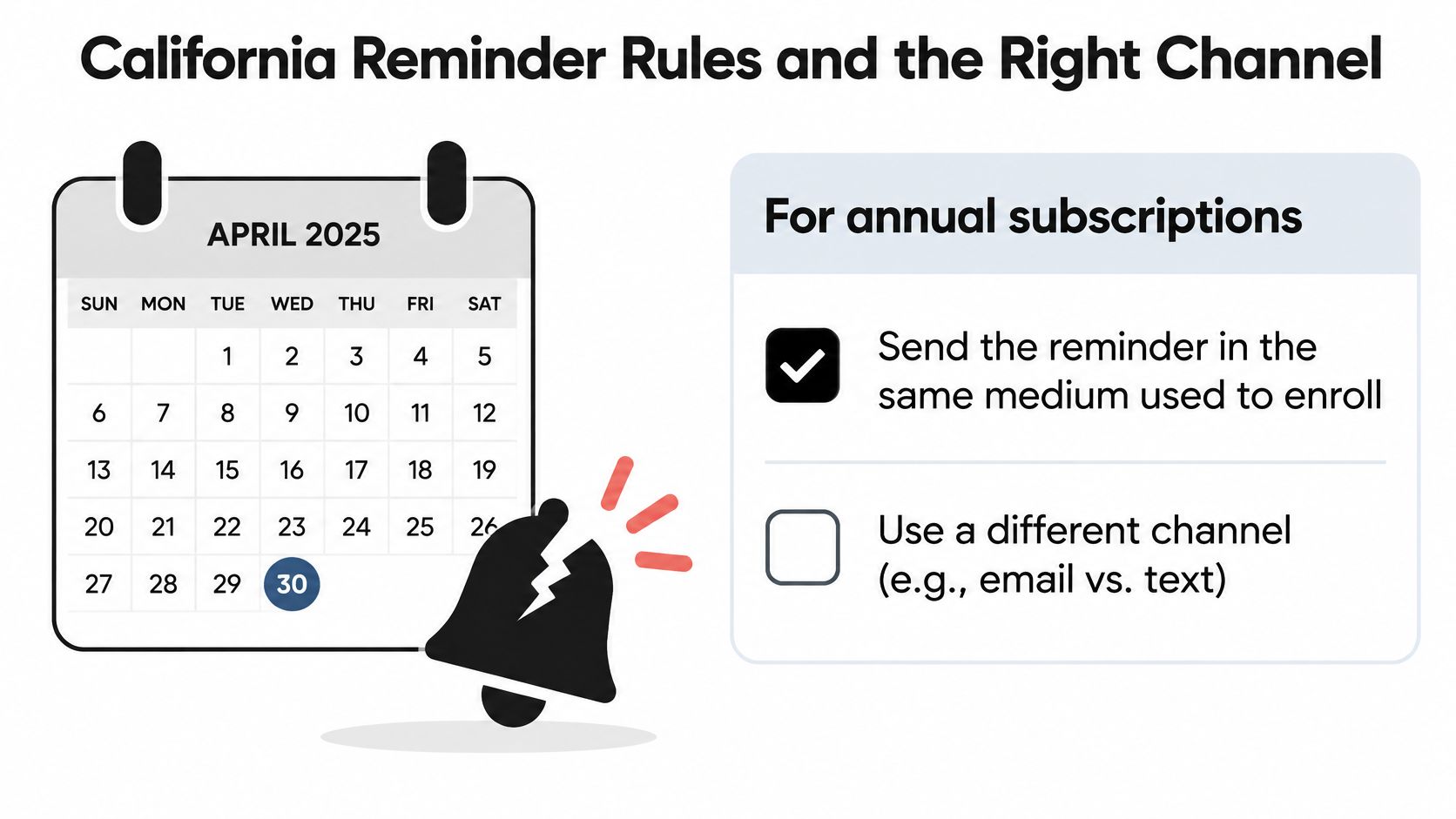
A reminder can be perfectly timed and still fail. California requires the annual reminder for a subscription to go out in the same communication medium used to enroll, or in the medium through which the customer normally interacts with the business, according to Business and Professions Code section 17602. Get the date right and the channel wrong and the notice doesn't do its job.
That reminder must identify the product or service, state the charge frequency and the amount, and explain how to cancel. Each element is separate. A cheerful "your plan renews soon" with no amount and no cancellation path misses all three.
The channel is a data field, not a preference
Picture a customer who signs up inside an app and manages everything there. The company's renewal reminder arrives as a promotional email that lands in a promotions tab. The date was compliant. The delivery channel wasn't, because the customer's usual medium with that business is the app itself.
For a renewing plan with an initial term of at least one year, the amended law layers on a separate renewal notice covering the renewal-period length, the charge amount or range, the billing frequency, and the cancellation method. The California Attorney General's consumer alert on the state's automatic renewal law dates that notice duty to July 1, 2025. For the day counts, use the table above.
Three channels to compare
When a notice never showed up, or showed up somewhere odd, line up three facts:
- The signup channel: the app, the website, the phone line, or an in-store tablet where the plan was created.
- The reminder channel: where the renewal message arrived, if it arrived at all.
- Your usual channel: where you normally deal with that company, which is the standard the law points to.
A mismatch between the first and the third is the detail worth writing down.
Your own calendar alert isn't a legal reminder. The seller's notice is the one that has to carry the amount and the cancel path, so a home reminder protects your wallet, not your rights.
Save a copy of whatever notice does arrive, whether it came by email, text, or an in-app message. If it names the amount and the cancellation steps, it's doing the job the statute assigns it. If it's missing either, you've found the gap to raise.
Cancellation That Matches How You Signed Up
The test is equal friction. If signup took four taps on a website, cancellation should be findable and usable online, without a forced phone call during business hours, a retention queue, or a verification step that wasn't part of enrolling. A growing number of state statutes put that expectation into words: an online signup should be cancellable online, without obstruction or added delay.
The classic failure looks like this. A customer signs up in an app, then discovers the only cancellation route is a toll-free number answered on weekdays, or a web form that emails a confirmation within ten business days. Routing a digital enrollment into a burdensome telephone process is the pattern regulators single out.
The app store exception
Then there's the split that's easy to miss. Billing is handled by Apple through the App Store or by Google through Google Play, using the user's store account and that store's terms. The merchant never sees your card details and can't stop a charge it doesn't run.
Two consequences follow. A subscription bought on an iPhone is managed by Apple, and you should cancel at least 24 hours before the renewal date to avoid the next charge. Deleting the app or uninstalling it does not cancel the subscription, because the store account keeps the obligation. The merchant's profile screen usually just routes you to those store settings.
Practical rule: name the signup medium, open cancellation in that same medium, and if Apple or Google bills the charge, finish the cancel in that store rather than only inside the merchant's app.
Merchant-published cancellation pages are part of the same test. A consumable refill plan, such as the page on managing a fluoride-free toothpaste subscription, should state in one place how the plan bills and how it stops, so you're not hunting across three pages to find the exit.
When the path is unclear, our walkthrough on how to cancel subscriptions breaks down the channel-by-channel routes, including the store settings that override a merchant's own instructions.
Before the Next Renewal Date
The week before a renewal is when preparation pays. Run this sequence once and you'll know whether the next charge is legitimate, avoidable, or already cancelled.
- Find the last charge on your statement and match it to the signup email and any renewal notice you received.
- Identify the biller. The merchant, Apple, or Google. That answer decides where step three happens.
- Cancel in that place before the period ends. The store can charge a renewal up to 24 hours before the current period ends, so cancel at least 24 hours before renewal to avoid the next charge.
- Keep the confirmation. A screenshot with a visible timestamp beats a memory of a support chat.
- Check what access remains. After you cancel, access normally lasts through the period you already paid for, so cancelling doesn't end the current term.
- Read any price-change notice before the renewal and decide before the new price applies.
That fourth step is the one people skip, and it's the one that decides a dispute later.
If the plan is a trial rather than a renewal, the deadline moves earlier and the stakes are different. Our guide on how to avoid free trial charges covers the timing rules that apply when a free period converts.
Monitoring shortens the work. Our free private audit estimates subscriptions, duplicate charges, missing refunds, fees, renewals, and bill increases worth investigating, and Compass+ surfaces findings such as upcoming renewals and price increases, then answers questions about your own data in chat.
An alert is a prompt to act, not a legal finding. A renewal reminder tells you the date. It doesn't tell you whether the charge is lawful, and state rules differ widely, so keep your own screenshots regardless of what any app tells you.
When You Cancel and the Charge Still Hits
Four different events get bundled as "an unwanted charge," and they carry different weight. An enrollment you never agreed to is a consent problem. A renewal that arrived with no required reminder is a notice problem. A cancellation that was accepted and then followed by another bill is a process problem. A merchant that blocked, delayed, or refused your cancellation is an obstruction problem.
The distinction matters because a failed cancellation can be more actionable than a charge you regret. Some newer regimes tie remedies to the first cancellation attempt, and a 2026 summary of New York City and Louisiana requirements describes restitution for amounts charged after that attempt, according to California's statutory text and survey of newer cancellation regimes. Connecticut's 2026 amendments add annual renewal reminders, expanded cancellation options, and prompt handling of cancellation requests. None of these rules refunds a charge on its own.
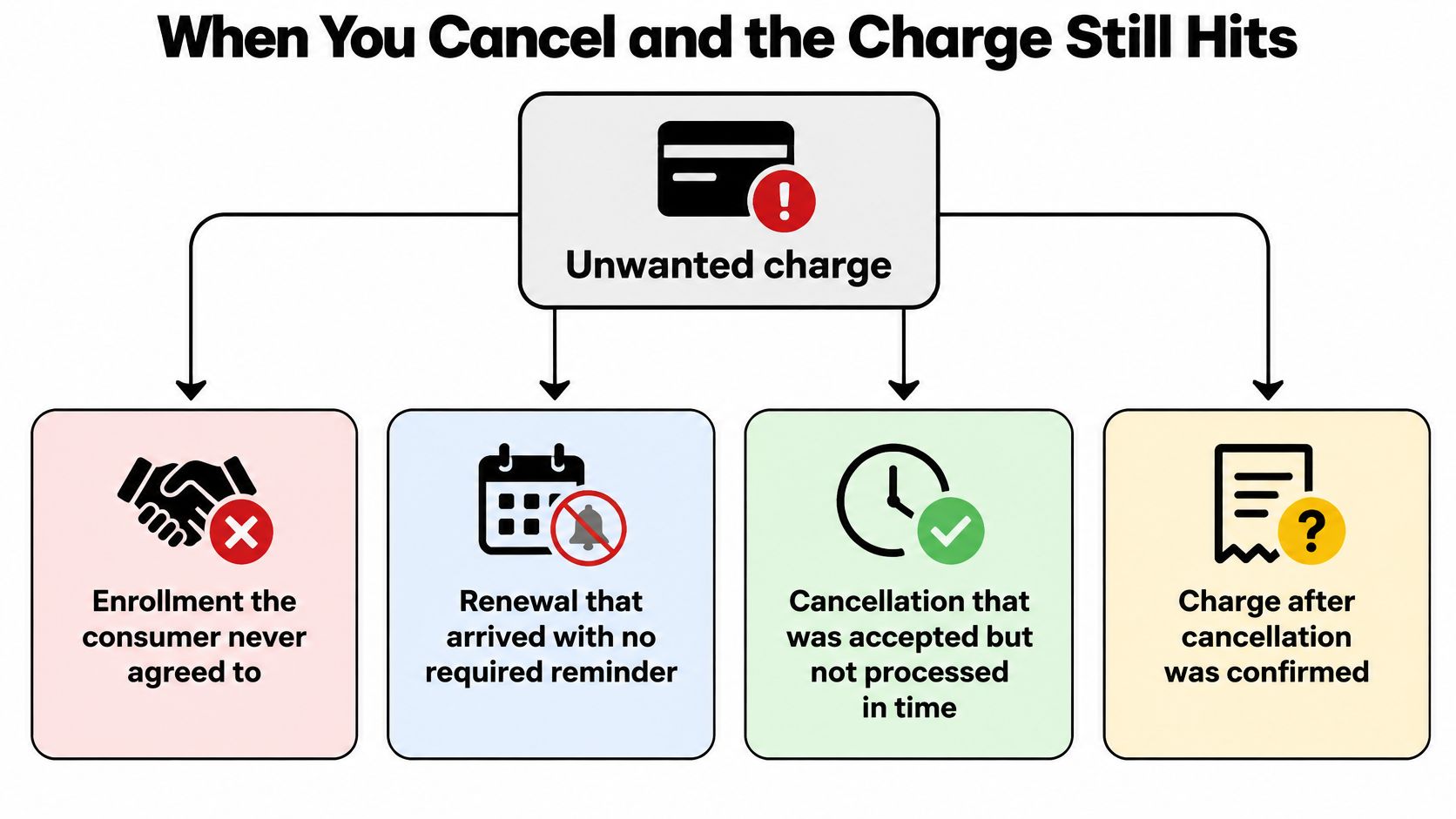
| Event | Why it matters | First action |
|---|---|---|
| Enrollment never agreed to | Consent evidence is missing or unclear | Request the consent record and keep the signup receipt |
| Renewal with no required reminder | The reminder may not have reached the customer's channel | Compare signup, reminder, and usual channels, then save the notice |
| Charge after an accepted cancellation | The cancellation attempt can be the key date for remedies in some regimes | Keep the cancellation confirmation and timestamp, then request reversal |
| Merchant blocked, delayed, or refused cancellation | The cancellation path may fail the equal-ease test | Record each attempt in the channel used, then escalate |
Build the record in this order
Save the cancellation confirmation first. The screenshot, the email, the timestamp of the exact minute you cancelled. That timestamp is the anchor for everything else.
Then collect the charge. The renewal email, the receipt, and the bank or card line showing the later debit. Having both sides of the same event turns a complaint into a chronology.
Add the human contacts. Support chats, call notes, agent names, ticket numbers. A transcript showing you asked and were told "it's handled" is worth more than a summary of the conversation you write from memory.
Ask for the reversal in writing. State the cancellation date, the charge date, and ask the merchant to reverse the post-cancellation amount. Keep the reply whether it grants or refuses.
Escalate only after that. A dispute with the card issuer and a complaint to the state attorney general are the standard next steps. Neither is a guaranteed refund, and a card dispute has its own filing windows.
If the charge you're chasing looks like a repeat of one you already paid, our walkthrough on what to do about a duplicate charge on your bank statement covers how to pair the two entries before you call anyone.
Compass+ connects your bank, email, and calendar so renewals, price increases, and charges that land after a cancellation show up as a single timeline instead of three separate puzzles. You get the finding, the amount at stake, and the next step, whether that's a cancel, a reversal request, or a claim worth filing. Visit Compass+ and let it watch the dates you'd otherwise miss.