Are Flex Spending Accounts Worth It? Tax Math and Traps
Are flex spending accounts worth it? See the tax math, forfeiture risk, eligibility and when an FSA beats an HSA or HRA, with worked examples for 2026.
17 min read
An FSA is worth it if you can name eligible costs you'll pay during the plan year, and it isn't worth it if you're guessing, because at a 22% federal rate plus 7.65% in Social Security and Medicare taxes, a fully spent election saves about 29.65% before state tax. That math only helps when the money gets spent. Every unspent dollar that misses your plan deadline pushes against the tax saving, so the key question isn't whether pre-tax money is valuable. It's whether you can document next year's care with enough confidence to size the election correctly.
Table of Contents
- Quick Verdict by Household Situation
- How the Tax Savings Add Up
- How an FSA Moves Money From Paycheck to Pharmacy
- Where Unused Money Gets Lost
- FSA, HSA and HRA Compared Side by Side
- Dependent Care FSAs Follow Different Rules
- Worked Household Cases With Real Numbers
- Set Your Election Before Open Enrollment
Quick Verdict by Household Situation
If you're asking are flex spending accounts worth it, start with what you can prove, not what you might spend. Your prior claims, pharmacy history, and quoted treatment plans sort you faster than any tax calculator. Find your row first, then test it against the numbers in the sections that follow.
| Household situation | Verdict | Main reason |
|---|---|---|
| Regular prescriptions or copays of known size | Worth it | Predictable spending uses the full election |
| Planned dental, orthodontic or vision work with quoted prices | Worth it | Known invoices can be covered in full |
| Chronic condition with stable monthly costs | Worth it | Recurring costs make forfeiture unlikely |
| Healthy, few claims, no planned care | Usually skip or elect a small amount | Little eligible spending to absorb the election |
| New job or first enrollment with no spending history | Test with a small election | No history makes forecasts unreliable |
| Enrolled in an HSA-eligible high-deductible plan | Compare before electing | A general-purpose FSA generally blocks HSA contributions |
The Two-Minute Sorting Test
Add last year's eligible copays, prescriptions, dental bills, and vision costs. Add any care you've already scheduled with a quoted price. That total is your documented base, and it's the ceiling you should trust.
If the election you're considering sits well above that base, you're not making a tax decision anymore. You're placing a bet that surprise care will arrive before the deadline. Sometimes that bet pays off, but don't call it planning.
Practical rule: Elect the amount you can back up with receipts, quotes, or a repeating monthly cost, not the amount that makes the tax saving look biggest.
A healthy employee with one cleaning and an occasional prescription doesn't need a large election just because enrollment materials highlight the maximum. A parent with orthodontics quoted in writing sits in a different position entirely. The account is the same. The forecast confidence isn't.
Do the addition before you read any further. If your documented base is close to zero, your answer is probably a small election or none. If it's steady month after month, the tax math has something solid to work on.
How the Tax Savings Add Up
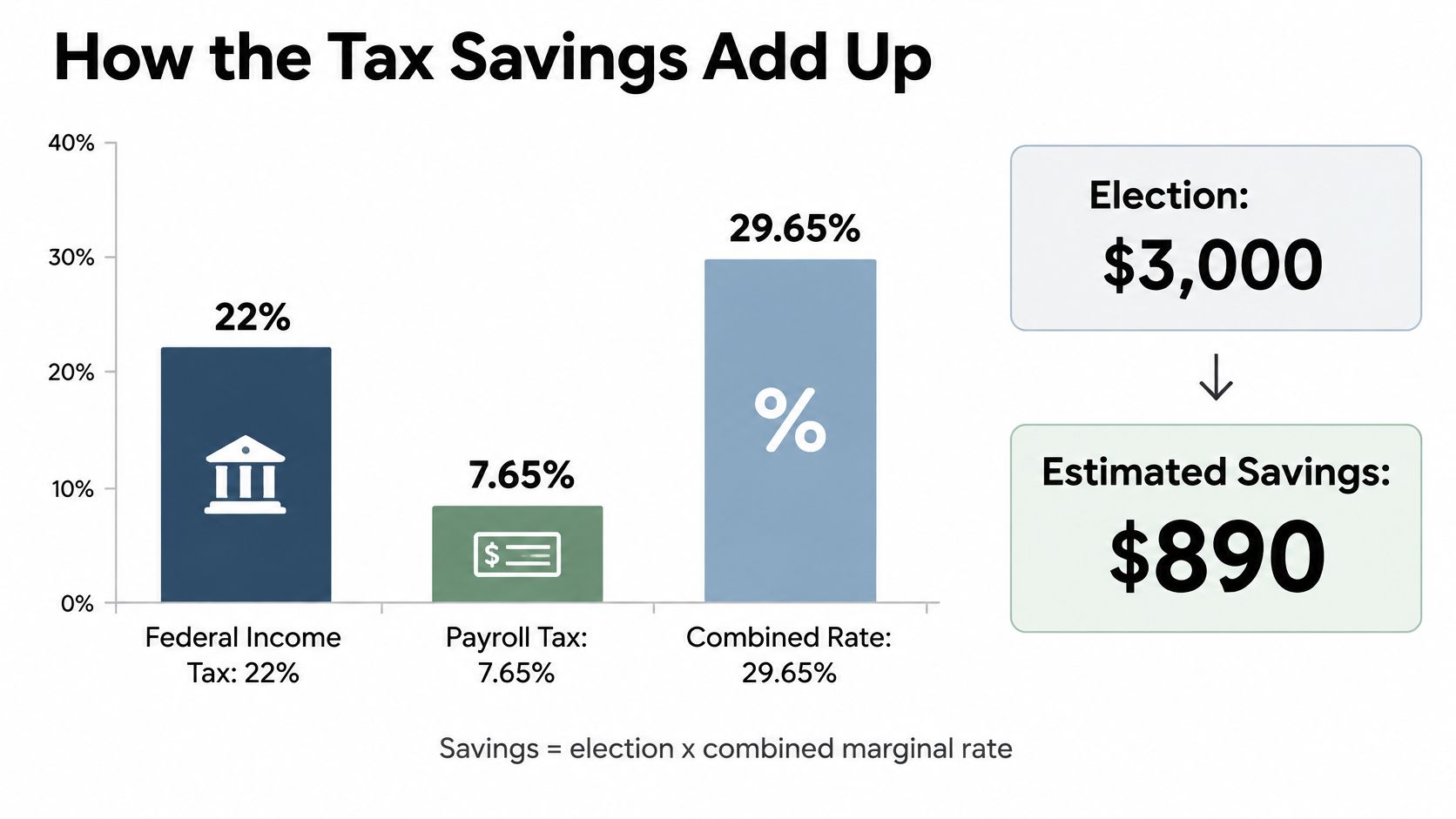
Put $3,000 into an FSA and roughly $890 comes back to you in taxes you never paid. That is the whole appeal, and it works because your employer takes contributions out before federal income tax and payroll tax. You're paying for care you'd buy anyway with dollars that skipped part of the tax bill.
The formula is plain. Election multiplied by your combined marginal rate equals your estimated saving, as long as you spend the money on eligible care. Say your federal bracket is 22%. Add 7.65% for Social Security and Medicare, and you're at 29.65% before state tax enters the picture.
The chart below stacks those two rates so you can see where the combined figure comes from.
| Annual election | Estimated tax savings |
|---|---|
| $2,000 | about $593 |
| $3,000 | about $890 |
| $3,400 (2026 limit) | about $1,008 |
Each row assumes the same thing: every dollar of the election goes to eligible costs. The saving is earned dollar by dollar at the pharmacy and the dentist's office, not granted in full at enrollment. Elect $3,400 but only spend $2,000 of it, and the $1,008 shrinks toward $593 while the leftover balance faces your plan's deadline.
Why Your Bracket Changes the Answer
Drop the federal bracket to 12%, and the combined rate becomes 19.65%. A $2,000 election then saves about $393, not $593. That's still real money on care you'd pay for anyway, but a lower rate gives you less cushion when part of the balance goes unspent. Forfeiting $500 wipes out a $393 saving entirely, while the same forfeit at the higher bracket still leaves you ahead.
State income tax can push your combined rate higher where it applies. Don't guess at that piece either. Check your most recent pay stub and tax return, add the rates that apply to your next dollar of pay, and run your own multiplication.
The tax saving is a percentage of what you spend correctly. It isn't a bonus for contributing the largest amount your employer allows.
One more detail trips people up. A lower tax bill doesn't mean your paycheck grows by the full election amount. Your take-home pay drops because money moved into the FSA, then rises relative to a normal paycheck because that chunk escaped tax. The benefit is the difference, and you only keep it if eligible spending follows.
How an FSA Moves Money From Paycheck to Pharmacy
An FSA works like a prepaid pantry stocked from pay before tax, with an expiry date on the shelf. The useful question at enrollment is how much of that shelf your household can document in advance: regular prescriptions, planned dental work, vision costs, predictable copays. Stock for meals nobody eats and the deadline decides the ending.
The diagram below follows one election from enrollment to a paid claim.
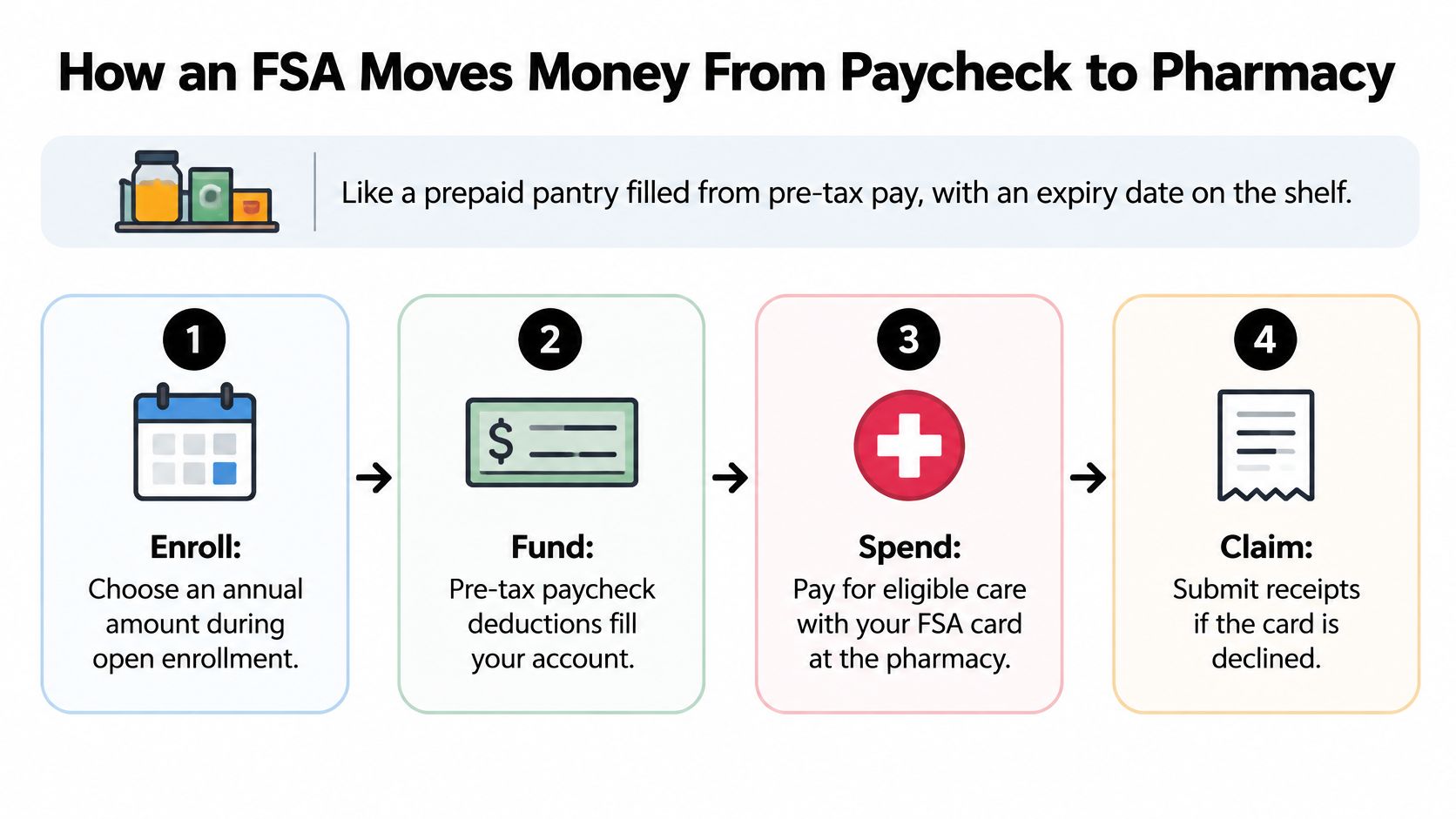
- Enroll during open enrollment: You choose one annual election amount for the plan year.
- Fund through payroll: Your employer deducts that election in equal pre-tax slices from each paycheck, so each check is smaller and taxable wages are lower.
- Access the annual amount early: Many plans make the full election available early in the plan year, even though your deductions continue.
- Pay for eligible care: You use a plan debit card where it's accepted, or pay yourself and file a claim.
- Substantiate the expense: The plan checks an itemized receipt or explanation of benefits before reimbursing you.
- Beat the plan deadline: You submit claims before the cutoff your employer sets for that plan year.
The Step Readers Misread Most Often
Early access is an advance on your election while payroll catches up. That helps with a large dental bill in February, and it can also make the account feel bigger and safer than your forecast really is. The advance does not change how much you will contribute by year-end.
Timing matters on the spending side too. If paycheck dates collide with pharmacy and dental bills while a reimbursement is pending, align bill timing so routine expenses don't trigger overdrafts. An FSA card decline can come from a missing receipt or merchant coding. Save the itemized receipt and file a manual claim.
Where Break-Even Actually Sits
Your break-even point is the share you spend before the deadline. Run the arithmetic as a hypothetical: a $2,000 contribution at a 22% federal rate plus 7.65% Social Security and Medicare taxes produces about $593 in immediate federal payroll-tax savings before any state-tax effect. Spend $1,800 of that election and the $200 leftover stays below the tax saving. Spend only $1,200 and the $800 leftover outweighs it.
That cushion helps, and it still rewards careful aim. Small leftovers may leave you ahead. Large leftovers reverse the result. Set the election to the confident part of your forecast, because dollars above that line become wages converted into a maybe.
Where Unused Money Gets Lost
Tax savings don't always win. That's the part enrollment brochures tend to soften. A use-it-or-lose-it plan can convert an oversized election into wages you never get to use.
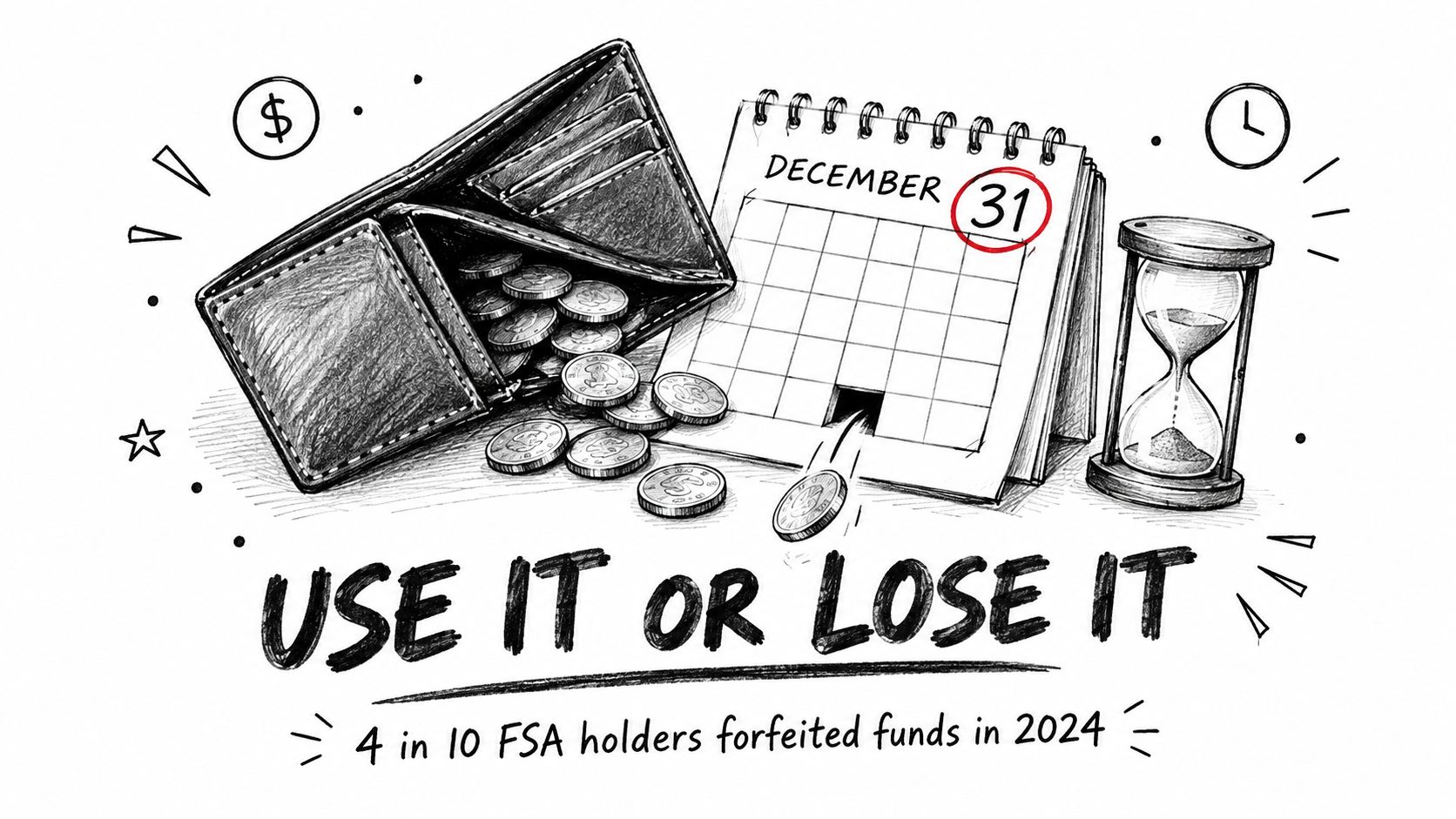
A 2026 report citing Employee Benefit Research Institute data stated that 4 in 10 FSA holders surrendered unused funds in 2024, and people who lost money forfeited an average of $404. Put that $404 against roughly $600 of tax saving, and the remaining benefit gets thin fast. Leave more than you saved in taxes, and you're behind.
Picture the account as a jar with a slow leak at the deadline. Every dollar still sitting there when your plan window closes is exposed. Your employer's exact rules decide how big that leak is.
| Plan feature | What it allows | Effect on your election |
|---|---|---|
| Use-it-or-lose-it only | No rollover and no grace period | Forfeit all unspent funds at the deadline |
| Grace period | Up to 2½ months after the plan year ends | Extra time to spend on eligible care |
| Carryover | Up to $660 for 2025 and $680 for 2026 | Carryover reduces the forecast gap |
| Contribution limit | $3,300 for 2025 and $3,400 for 2026 | A ceiling, not a target |
| Employer choice | Employer may offer grace, carryover or neither | Check the summary plan description |
Read Your Plan, Not a Coworker's
Your employer chooses whether to offer a grace period, a carryover, or neither. A friend at another company may have extra months to spend that you don't have. If you're checking how rollover rules work in practice, Benely's guide to FSA carryovers is a useful companion to your own summary plan description, but your plan document wins every dispute.
Use a rough savings-minus-forfeiture check before you enroll. If 20% of a hypothetical $3,400 election went unused, you'd forfeit $680 against about $1,008 of tax saving, leaving roughly $328. Treat that as a guide only, since forfeited dollars were pre-tax wages, not cash you'd already received.
Most forfeitures aren't caused by obscure rules. People elect too much, forget a balance, or miss the claim deadline. The same habit that helps you find money you're owed or wasting applies here. Set a calendar alert on enrollment day, check your balance midyear, and schedule eligible care while you still control the timing.
FSA, HSA and HRA Compared Side by Side
The HSA conflict should come first, because it can change your decision on the spot. A general-purpose health FSA generally blocks HSA contributions for that year. A limited-purpose FSA, restricted to dental and vision, generally doesn't create the same conflict.
Don't treat these three accounts as interchangeable buckets with different names. They differ on who funds the account, who owns it, and what happens when you change jobs. Those ownership rules matter as much as the tax break.
| Criterion | FSA | HSA | HRA |
|---|---|---|---|
| Eligibility | Any employer offering a health FSA | Must be enrolled in a high-deductible health plan | Set up by the employer, no high-deductible plan required |
| Who funds it | Employee salary reduction, sometimes employer | Employee, employer or both | Employer only |
| Who owns the account | Employer plan | Employee | Employer |
| Unused funds | Use-it-or-lose-it unless grace period or carryover | Roll over indefinitely | Governed by employer rules, often stays with employer |
| Portability when leaving a job | Generally stays with the employer | Goes with the employee | Generally stays with the employer |
| 2026 contribution limit | $3,400 for a health FSA | Set by the IRS for self-only and family HDHP coverage | Set by the employer |
| Investing | No | Yes, in many plans | No |
Matching the Account to the Job
An HSA suits someone who can accept a high-deductible health plan and wants an account that stays theirs. The balance rolls over, travels between employers, and can often be invested. That flexibility is powerful, but it comes attached to a health plan with higher upfront exposure.
An FSA suits an employee on a standard plan who has predictable copays, prescriptions, dental work, or vision costs within one plan year. You're not building a long-term medical fund. You're routing near-term spending through pre-tax pay.
An HRA is different because your employer funds it and writes the rules. You generally don't contribute your own salary. Before you compare balances, ask what expenses it reimburses, whether funds roll over under your employer's design, and what happens if you leave.
Confirm the exact accounts you're eligible for before open enrollment, especially if a spouse's plan offers coverage that could affect HSA eligibility.
Households get into trouble when both spouses enroll during separate open enrollments without comparing notes. One general-purpose FSA election can undercut the other's HSA plans. Sit down together, name each account out loud, and choose once for the household.
Dependent Care FSAs Follow Different Rules
A dependent care FSA is a separate account, not a second drawer inside your health FSA. It pays for childcare or adult dependent care so you, and your spouse if you're married, can work. It doesn't pay medical bills.
Eligible costs commonly include daycare, preschool, and summer day camp for a child under 13. Paid care for a dependent who can't care for themselves can also qualify. You can elect a health FSA and a dependent care FSA in the same year because they cover different expenses.
One Worked Example
Say a household pays $800 a month for daycare and elects a hypothetical $5,000 within its plan limit. If the full amount goes to eligible care and the household's combined rate is 29.65%, the estimated saving is about $1,483. The arithmetic is familiar. The forecasting is often easier because daycare invoices repeat.
Don't double-count the same expense. The dependent care exclusion and the child and dependent care tax credit can't cover the same dollars, so compare both routes before enrolling. Households that want broader context on structuring these elections can review benefits planning for HR leaders alongside their own plan booklet.
Recurring invoices make this account more predictable, but they don't remove deadline risk. Job changes, schedule changes, and a child aging out of eligible care can all shrink your spending midyear. Confirm your care arrangement, monthly rate, and expected months of care in writing before you elect.
Worked Household Cases With Real Numbers
Numbers make the forecasting rule easier to see. Each household below uses hypothetical spending and a 29.65% combined rate, so you can compare the election, the spending, and the outcome side by side.
Maya Funds Quoted Orthodontics
Maya has two children and an orthodontic treatment plan quoted at $2,400 across 18 months. She elects $2,400 for the portion billed in her plan year and spends it all. Her estimated tax saving is about $712. Verdict: worth it, because signed pricing supported the entire election.
Priya Covers a Repeating Prescription Bill
Priya manages a chronic condition with $180 in monthly prescriptions. She elects $2,160, which is twelve months of a cost she already pays, and uses the full amount. Her estimated saving is about $640. Verdict: worth it, because the spending repeats whether the FSA exists or not.
Dev Elects for Safety and Loses
Dev is single, has no scheduled care, and elects $3,000 to be safe. He spends $1,400 on glasses and a dental cleaning, then forfeits $1,600 because his plan offers no grace period or carryover in this scenario. His tax saving of about $890 can't cover the loss, leaving him about $710 worse off than taking the pay and buying the care himself. Verdict: not worth it, because he funded a guess.
Ana Tests a New Job Carefully
Ana starts a new job with no spending history on the plan. She reviews prior claims, elects $500 as a test, and spends $480 on routine care. She gives up a tiny leftover but keeps most of a tax saving of about $148. Verdict: worth the test, because the small election matched her limited evidence.
The winning elections track documented spending. The losing one chased a maximum.
Notice what separated these outcomes. It wasn't income, and it wasn't clever timing. Maya had a quote, Priya had a refill history, Ana limited her uncertainty, and Dev treated the account like insurance against costs that never arrived.
Set Your Election Before Open Enrollment
Build your election from records you already have. The checklist below turns last year's paperwork into this year's number.
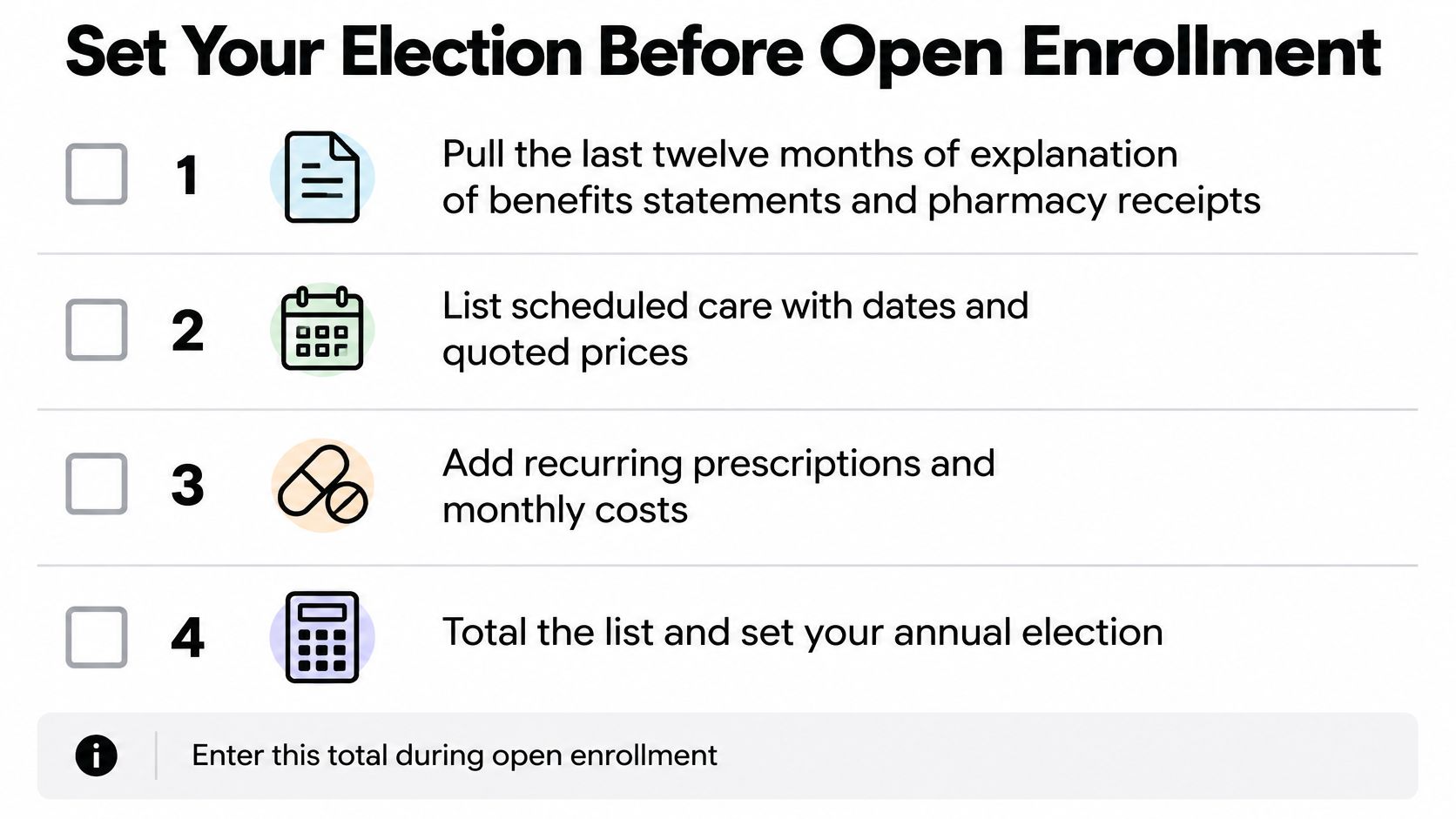
- Pull twelve months of records: Gather explanation of benefits statements and pharmacy receipts.
- List scheduled care: Write down dates, providers, and quoted prices.
- Add recurring costs: Include prescriptions, copays, and deductibles you reliably pay.
- Elect at or below the total: Leave only a modest cushion your plan rules can absorb.
- Confirm plan dates: Check carryover, grace period, and claim deadlines in the summary plan description.
- Set two reminders: Schedule a midyear balance check and a deadline alert.
- Keep itemized receipts: Save proof for every purchase and claim.
Forecasting error is the risk to manage here, and guidance in Mercer's summary of 2026 health FSA limits puts the statutory health-FSA salary-reduction limit at $3,400 for 2026, with an employer-approved carryover as high as $680. Your employer may allow less, or none. If you're deciding how much room the rest of your budget leaves for payroll deductions, first work out how much you can safely spend after fixed bills.
The short video below walks through enrollment timing and common FSA mistakes in a format you can review before you submit your election.
Changing your election midyear generally requires a qualifying life event, so assume the forecast you submit is the one you'll live with. Calculators help you estimate. Your plan document is the final authority on deadlines, eligible expenses, and what happens to money you don't spend.
Before open enrollment closes, run your documented total once more, then let Compass+ watch for the everyday leaks that compete with your healthcare budget, including duplicate charges, price increases, and refunds you haven't claimed. Compass+ connects your financial, email, calendar, and shopping accounts to surface concrete savings opportunities with a clear next step and estimated amount. Join the waitlist at Compass+ so those findings reach you before deadlines and renewal dates pass.