Amazon Price Drop Match Rules for 2026
Amazon price drop match is not a general refund. See what still qualifies, which windows matter, and when a return beats a courtesy credit.
16 min read
Amazon does not run a general post-purchase price-drop match in 2026, so a lower price is a return-and-rebuy or courtesy-credit decision, not an automatic refund.
The popular advice to contact support and collect the difference skips the most important question: what makes that money recoverable? A published guarantee, a discretionary concession, and a refund for a returned item are different things. Treating them as interchangeable can waste your time or leave you paying for a replacement before the original purchase is refunded.
A useful Amazon price drop match check starts with your order status, the exact offer, and the deadline for taking action. The displayed discount comes after those checks, not before them.
Table of Contents
- What Amazon Still Refunds After a Price Drop
- How Amazon Price Protection Changed in 2016
- Decide Return, Rebuy, or Let It Go
- Price Drops Versus A to z Guarantee Claims
- How to Ask Amazon for a Price Drop Credit
- How Monitoring Turns Price Drops into Decisions
What Amazon Still Refunds After a Price Drop
Amazon's price-matching help page says it doesn't offer general price matching. Its Pre-order Price Guarantee is a separate protection for eligible purchases before release, not a promise to reimburse every markdown after delivery.
That distinction leaves several practical routes, but they don't all produce the same outcome. A canceled purchase stops an order; a return reverses an eligible purchase; a courtesy credit is something support may choose to offer. None makes an ordinary later markdown a debt Amazon automatically owes you.
Amazon price-drop paths, windows, and outcomes
| Path | What it covers | Window | Evidence | Realistic outcome |
|---|---|---|---|---|
| No general price match | Amazon's own later price on ordinary items | No standard post-purchase adjustment window | No order needed for the policy answer | No automatic refund |
| Historical TV exception | Televisions under an earlier exception | Historical policy period, not a current general program | Original order and TV listing | Don't assume it covers today's purchase or other categories |
| Pre-order Price Guarantee | Eligible items ordered before release | The eligible pre-release period | Pre-order confirmation and guarantee terms | Lowest eligible Amazon pre-release price, not protection for a post-delivery drop |
| Courtesy credit | Discretionary goodwill on a recent order | While support is willing to review the request | Order ID and dated screenshots of the same offer | Possible credit, not an entitlement |
| Cancel and reorder | An order that hasn't shipped and remains cancelable | Before cancellation becomes unavailable | Current order status and cancellation confirmation | Canceled original purchase, followed by a separate lower-priced order |
| Return and repurchase | A delivered item eligible for return | That item's displayed return deadline | Return terms, seller, condition, quantity, fulfillment, and shipping costs | Savings only after costs and successful refund processing |
| A-to-z Guarantee | Covered delivery, condition, agreed-refund, or excess-charge problems | The applicable transaction's claim rules | Order ID, tracking, refund records, and payment amount | Possible eligible claim reimbursement, not a price-drop adjustment |
Find the reason a refund might apply
Say you bought a Kindle accessory and its price falls after delivery. If it was an ordinary in-stock purchase, the pre-order protection isn't relevant. If the accessory arrived correctly and you paid the authorized amount, a delivery or payment guarantee isn't the right route either.
You're left with a practical choice: ask whether support will offer goodwill, evaluate an eligible return, or keep the item at the price you accepted. A lower listing price alone doesn't select the route.
Practical rule: Match your order's status to a path before contacting support. Ask for the remedy that fits the actual problem.
Keep the original order confirmation and capture the current offer with its seller, condition, fulfillment method, and quantity visible. A product photo alone doesn't establish that you're comparing identical offers.
Confirm current eligibility in Amazon's help pages and your order's return screen before filing anything. Category restrictions, seller terms, and transaction-specific conditions matter more than an old screenshot of someone else's successful chat.
How Amazon Price Protection Changed in 2016
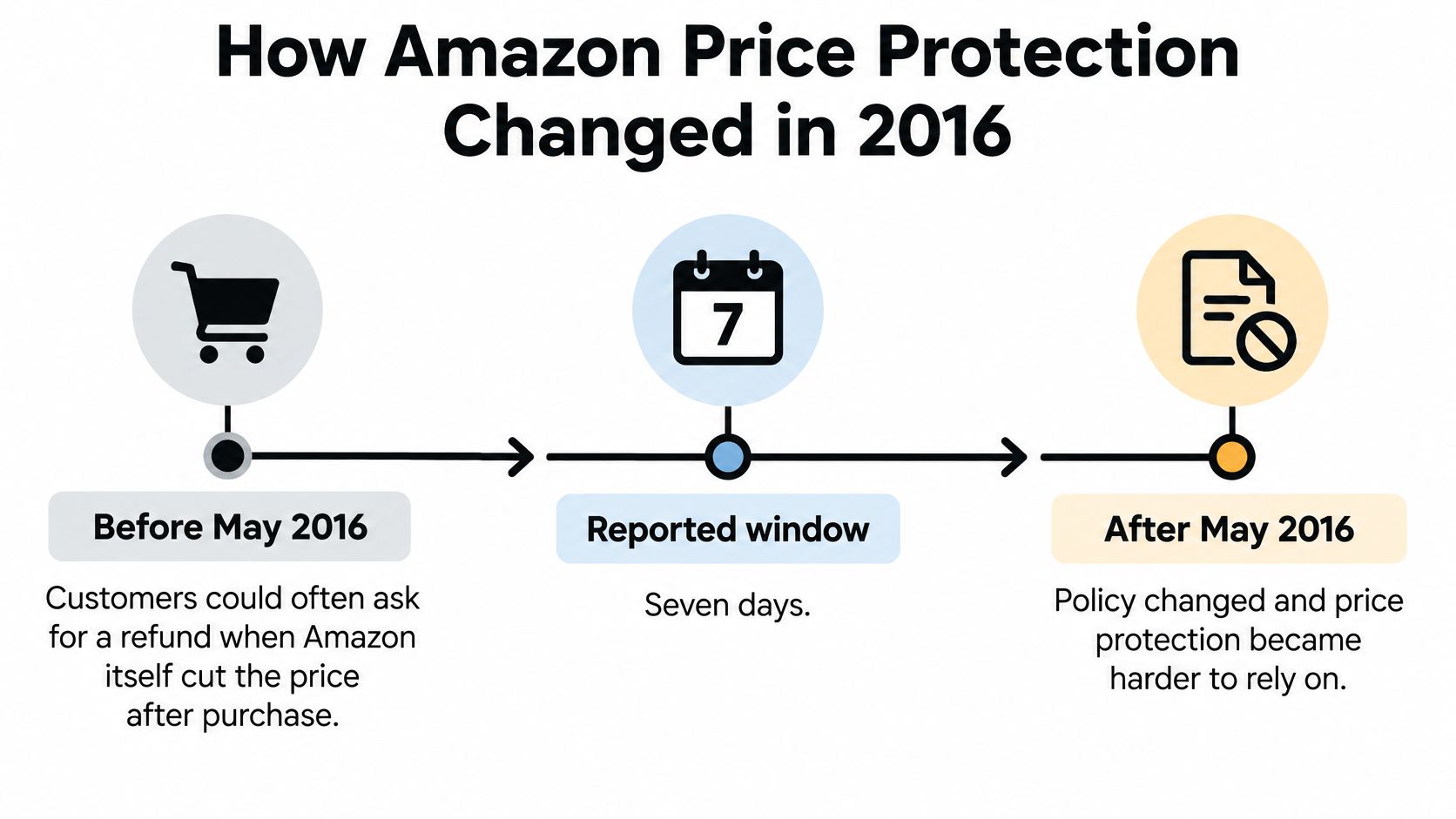
The confusion has a real historical explanation. According to TechCrunch's contemporary reporting, customers could previously request adjustments within seven days of delivery, but Amazon ended that practice for most merchandise in May 2016, with televisions reported as the exception.
This timeline shows why older shopping advice can sound convincing while describing a different policy period.
What the older practice actually covered
Consider a shopper who ordered a coffee maker under the earlier practice. If Amazon reduced its own price during the adjustment window, that shopper could often contact customer service and ask for the difference.
That wasn't the same as finding a cheaper coffee maker at another retailer and requiring Amazon to match it. The older practice concerned Amazon's own post-purchase price reductions, not a broad competitor-price promise.
The distinction matters because people use price match for both situations. A retailer can offer adjustments on its own markdowns without matching competitors, or offer competitor matching without protecting purchases against later reductions.
- Earlier adjustment practice: A shopper monitored Amazon's price after delivery and requested an eligible adjustment.
- Policy change: Ordinary merchandise lost that dependable adjustment route.
- Reported TV exception: A category-specific exception remained in contemporary reporting, not a universal promise for future purchases.
Why old advice persists
An old TV refund story can be genuine without proving that a current household order qualifies. Likewise, a successful courtesy request tells you what support chose to do in that case, not what every shopper can demand.
The video below provides additional context for the price-protection discussion.
When comparing retailers, distinguish their published adjustment rules from informal accommodations. Our guide to price adjustment policies explains how to read those differences without confusing a return window with a price-protection window.
For ordinary merchandise already delivered, the old adjustment practice isn't a dependable basis for a refund request. The useful question is what your present order allows, not whether a shopper once received an adjustment under different terms.
Decide Return, Rebuy, or Let It Go
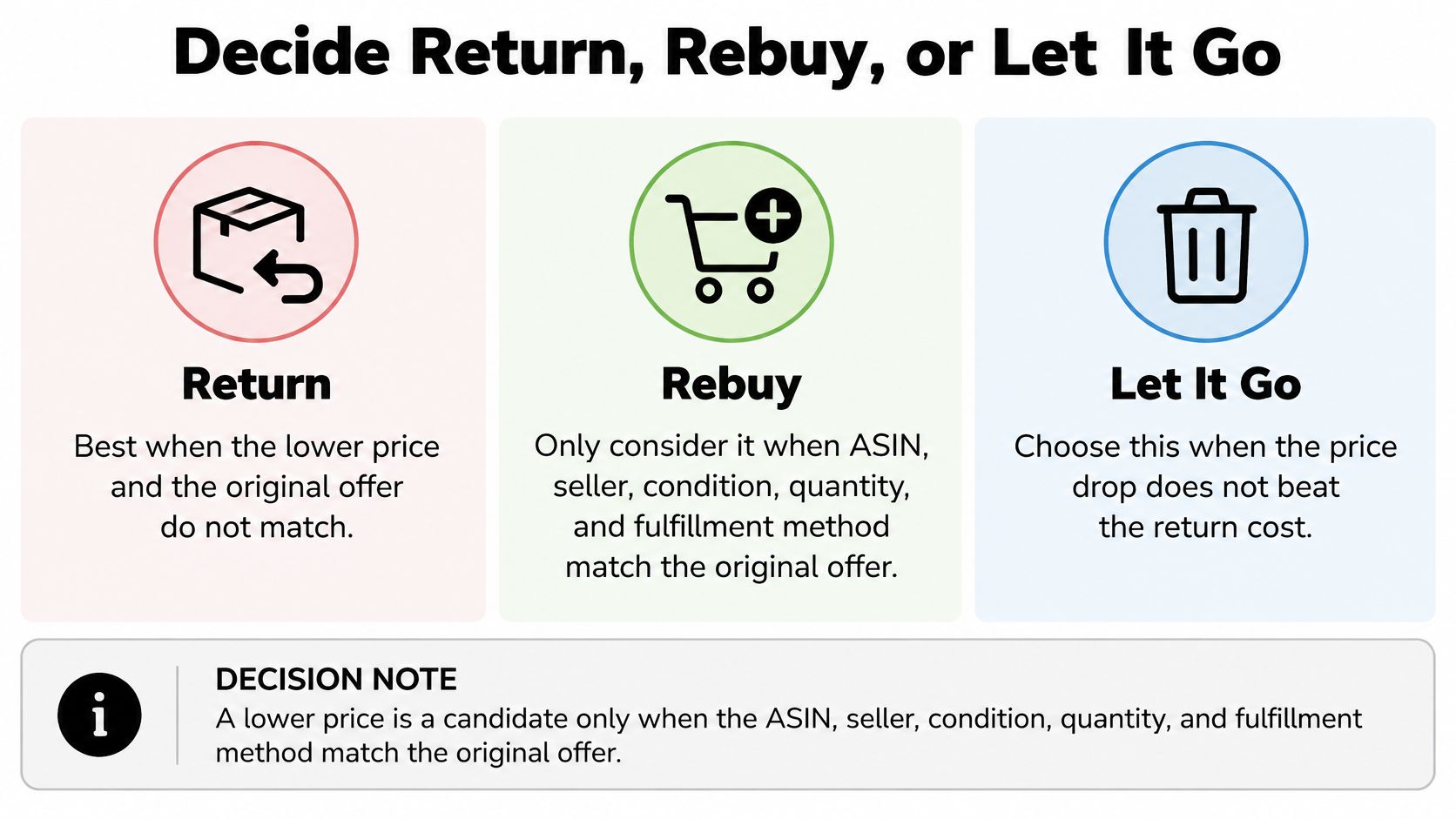
Start with the offer, not the discount. Thrifle's price-drop refund guide describes return-and-repurchase as a possible alternative when standard adjustments aren't available, subject to return eligibility, timing, and costs.
For a like-for-like comparison, check the ASIN, Amazon's product identifier, alongside the seller, condition, quantity, and fulfillment method. A shared ASIN helps identify the product, but it doesn't establish identical seller terms or warranty coverage.
Use the graphic as a starting point, then verify the actual return terms. An offer mismatch is a reason to investigate, not by itself a reason to return.
Calculate the money you would actually keep
Use this calculation:
Estimated net savings = original purchase cost minus replacement purchase cost minus return costs minus the value of your time.
Compare both orders on the same basis. Include shipping and tax in each purchase total, then account for any coupon you can't reuse, membership-dependent delivery cost, or possible restocking deduction.
A gift card needs special care. Paying with a gift-card balance isn't automatically a lost discount, but a return may restore that balance rather than produce cash you can use elsewhere. Keep savings and cash flow separate.
Say a mixer's lower-priced offer looks attractive, but the original return requires paid shipping. Before repurchasing, check whether the label cost and packing effort leave enough benefit to justify the process. If the mixer is heavy, opened, or difficult to transport, a seemingly generous markdown may still be a poor opportunity.
When a price drop is worth acting on
| Situation | Typical gap | Costs to subtract | Worth acting |
|---|---|---|---|
| Small drop and a paid return | Less than, or close to, return costs | Return label and time | Usually no |
| Same ASIN, free returns, still inside the window | Clearly exceeds remaining costs | Tax differences and any lost coupon | Often yes |
| Order not shipped yet | Any meaningful gap | Any change in shipping, tax, or promotions | Yes, if cancellation succeeds |
| Coupon or Subscribe & Save only | Looks cheaper on screen | Eligibility requirements and subscription terms | Usually no adjustment request |
| Different seller, used, or other condition | Any displayed gap | Warranty, condition, and shipping differences | Compare landed cost first |
| Third-party item, no free returns | Any gap | Label and restocking risk | Only if net stays positive |
| Promo or gift card already used | Small remaining gap | Lost promotional value and payment restrictions | Recalculate both orders |
| Recent identical offer, return is a bad fit | A meaningful difference | Chat time, with no guaranteed credit | Courtesy ask only, not a policy claim |
An unshipped order offers the simplest possibility, but a cancellation request isn't cancellation confirmation. Don't assume you've avoided the original charge until the order status confirms it.
For a delivered item, verify the return before committing to a replacement. Starting the return first can establish eligibility, but it doesn't necessarily release your money immediately; avoiding overlapping charges may require waiting for the refund.
Return-and-rebuy is worth considering only when you'd still choose it after seeing the full cost, the work involved, and the temporary effect on your available money.
Monitoring has a cost too. Compass+ Monthly costs $19.99 a month, charged after a 7-day free trial for new subscribers; after connecting a bank, users can see what we found for 7 days without paying. Any paid service belongs in your household savings calculation, rather than being justified by a displayed markdown alone.
Act only when net savings stay positive before the return deadline.
Price Drops Versus A to z Guarantee Claims
A cheaper listing and a failed transaction require different evidence. If the item arrived as described and you paid the agreed amount, the fact that its price later fell doesn't turn the purchase into a guarantee claim.
For covered transactions, Amazon Pay's A-to-z Guarantee documentation describes qualifying delivery, condition, refund, and authorized-charge problems, with reimbursement of up to $2,500 including shipping for eligible claims. That documentation has transaction-type and timing restrictions, so don't treat it as a universal filing rule for every Amazon order.
Similar purchases, different problems
| Case | What happened | Useful evidence | Appropriate route |
|---|---|---|---|
| Speaker markdown | The delivered speaker now costs less | Original order and current identical offer | Evaluate repurchase or a courtesy request |
| Missing speaker | The promised delivery hasn't arrived | Promised delivery date, tracking history, and seller messages | Delivery support or the applicable guarantee process |
| Excess speaker charge | The settled charge exceeds the authorized order total | Order confirmation and payment record | Payment investigation or an eligible excess-charge claim |
A tracking page without a delivery scan is useful evidence, but it doesn't independently establish claim eligibility. Check the promised date, the shipment's actual status, and the rules attached to that transaction.
For a defective or misdescribed item, photograph the issue and preserve the listing description. For an agreed refund that hasn't been honored, save the seller's authorization and the relevant payment records. Those documents establish the cause of the dispute more clearly than a later sale-price screenshot.
A pricing promise is a different agreement
Some retailers publish explicit pricing commitments. For a concrete comparison of that kind of document, you can explore the furniture pricing promise from Guynn Furniture & Mattress and examine what its own terms cover.
The lesson isn't that another retailer's promise applies to Amazon. It's that a pricing commitment answers a different question from a guarantee addressing a failed delivery, defective product, or incorrect charge.
Choose the cause first: Describe what went wrong with the transaction, then attach evidence that proves that problem.
Don't weaken a legitimate missing-refund complaint by framing it as dissatisfaction with today's price. Equally, don't label a normal markdown an overcharge when the original payment matched the amount you authorized.
How to Ask Amazon for a Price Drop Credit
A courtesy request fits a recent, identical offer when a return would be inconvenient or wasteful. It doesn't fit a cheaper used item, a different seller's offer, or a delivery dispute that needs its own remedy.
Use the order details to prepare the request, then choose the procedure that matches your situation.
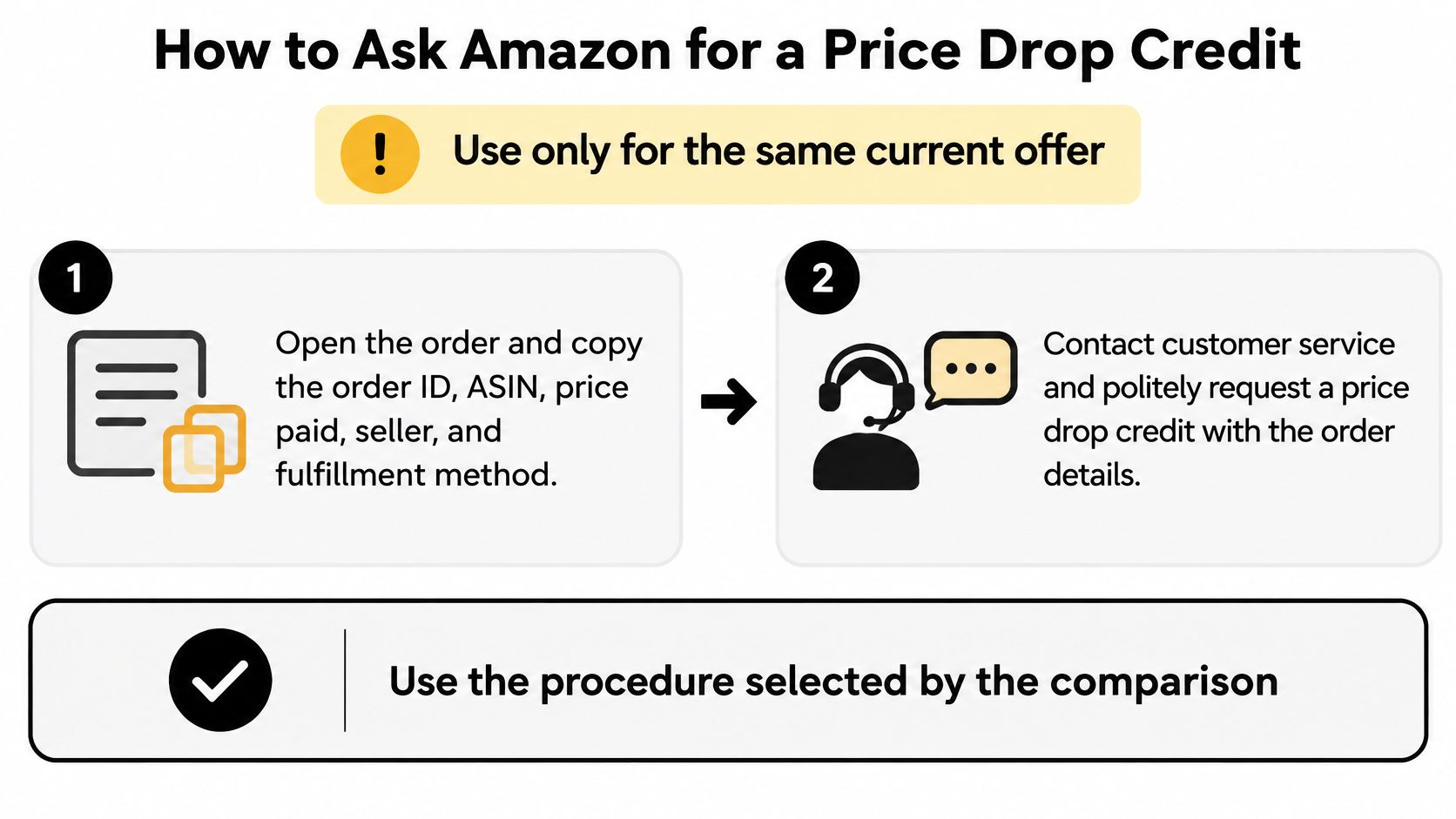
Request a discretionary courtesy credit
- Copy the order details. Record the order ID, ASIN, price paid, seller, fulfillment method, and shipping or delivery status.
- Capture the matching offer. Save a dated screenshot showing the current price, seller, condition, quantity, and fulfillment details.
- Contact customer service. Select the relevant order and explain that you're requesting a discretionary adjustment.
- Ask about the form of credit. Request a refund to the original payment method or ask whether a promotional balance is available.
- Save the response. Keep the case ID and any written confirmation of the amount, payment destination, or restrictions.
A concise message might read:
Hello, the identical offer for my recent order is now cheaper. I understand there isn't a general post-purchase price-match policy. Would you review the order for a courtesy adjustment so I can avoid an unnecessary return?
That's a request, not a claim of entitlement. If support declines, accept the answer and make your return decision while it remains available. Repeated chats add work without creating a stronger policy basis.
If support offers promotional credit, check its conditions before treating it like cash. Ask which purchases qualify and whether the balance has an expiration date.
Cancel an eligible unshipped order
- Confirm the order status. Check that the order hasn't shipped and that cancellation remains available.
- Submit the cancellation. Use Your Orders and retain the confirmation that cancellation succeeded.
- Review the replacement checkout. Check the exact offer, delivery estimate, tax, shipping, and promotions before paying.
Don't reorder solely because you clicked a cancellation button. If cancellation fails, you could end up managing both purchases.
Return and repurchase an eligible delivered item
- Start the original return. Use the correct order, choose an accurate reason, and save the displayed deadline and label terms.
- Choose replacement timing. Reorder after return approval if appropriate, or wait for the refund if overlapping charges would strain your budget.
- Keep return evidence. Retain the drop-off receipt and tracking details associated with the original item.
- Reconcile the payments. Match the original refund against the replacement charge.
Return approval isn't the same as money received. Our guide on how to track a refund explains how to follow the payment rather than stop at a confirmation message.
For a courtesy request, leave out competitor advertisements, unrelated seller screenshots, and A-to-z language. Send the evidence needed for the request you're making.
How Monitoring Turns Price Drops into Decisions
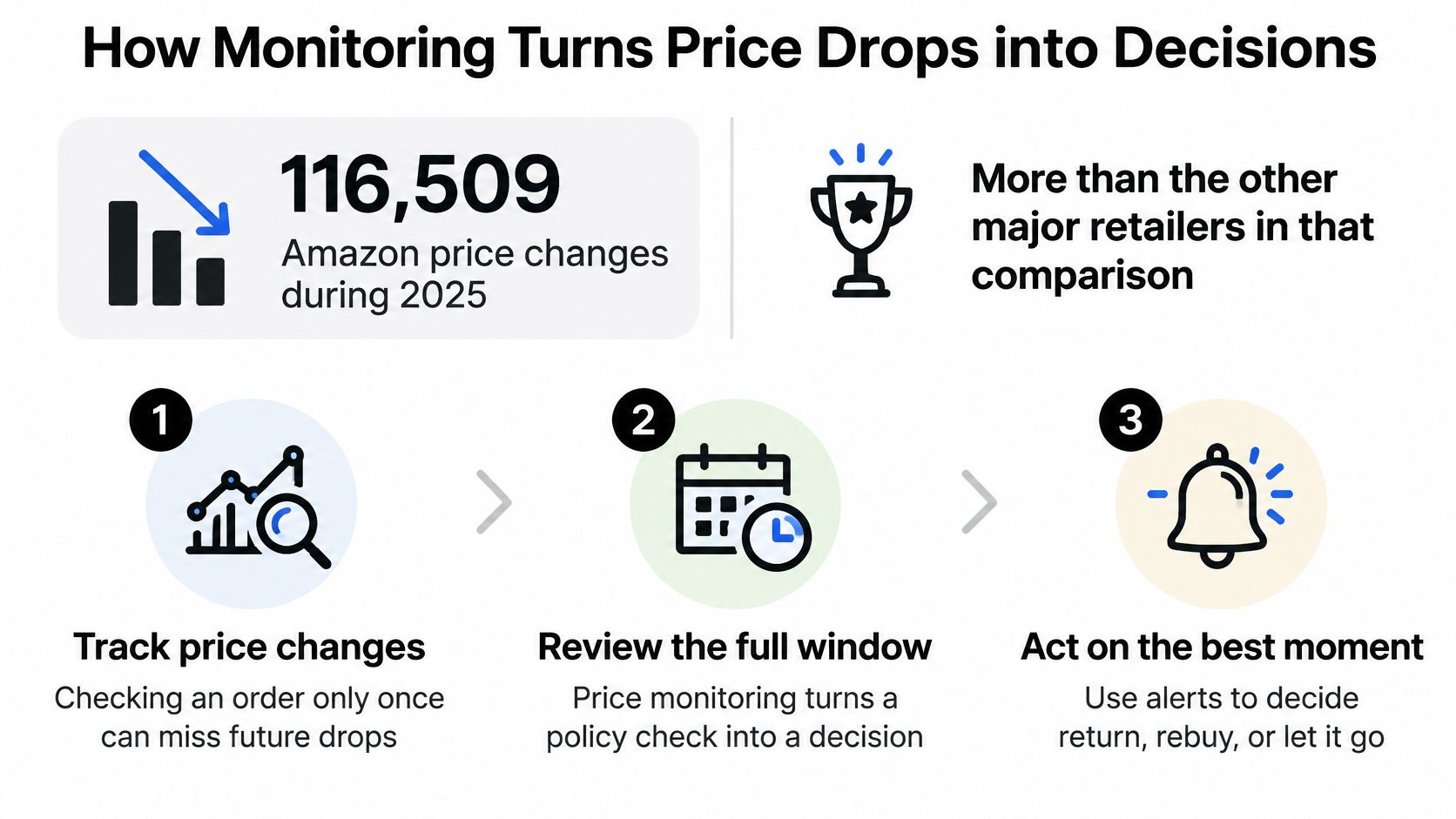
Price monitoring is useful only when it helps you decide what to do. ConsumerAffairs' price-change analysis coverage reports 116,509 Amazon price changes during 2025, more than the other major retailers included in that comparison.
That finding describes the analyzed prices, not the likelihood that your particular purchase will become cheaper. It supports checking intelligently, not assuming every order contains recoverable savings.
The useful monitoring process filters changes before asking you to spend time on them.
What an actionable alert should contain
- The original purchase: Order identity and the actual amount paid, including applicable discounts.
- The matching offer: Product, seller, condition, quantity, and fulfillment checks.
- The confirmed price change: Separation of listing price, coupon, Subscribe & Save terms, and temporary promotions.
- The usable deadline: The order's remaining return eligibility and any required ship-back date.
- The estimated benefit: Net savings after costs, with a recommended next action.
A mixer markdown with a matching offer, an open return window, and no return fee deserves review. A coupon attached to another seller's listing may be irrelevant to the original purchase. Neither should generate a notification saying that Amazon owes a refund.
For readers building their own tracker, CodeWords' guide to Amazon data collection without a developer provides implementation context. Collecting listing information is only part of the job; the decision still requires order details, eligibility, and costs.
Watch the opportunity, not every price movement
Set your attention threshold before enabling alerts. If you wouldn't repack an item for the expected benefit, suppress that notification rather than repeatedly reconsidering it.
At Compass+, we're pursuing a broader approach to finding money you're owed or wasting, spanning subscriptions, refunds, charges, renewals, and other opportunities. Our standalone experience is currently at the waitlist stage, and our access is read-only: we can't move money, make payments, open or close accounts, or cancel a subscription with a merchant.
Check the return deadline on an open order today, then compare its current identical offer with your original total. If there's no worthwhile action available, stop checking that purchase and save your attention for opportunities you can still use.
Compass+ surfaces potential savings opportunities with an estimated amount and a concrete next step, including post-purchase price drops that need review rather than an assumed refund. Visit Compass+ to join the waitlist for the standalone experience and explore a broader way to monitor shopping costs, refunds, and recurring expenses.