Lower My Bill Proven Tactics to Cut Monthly Costs Fast
Want to lower my bill fast? Get scripts, timing tips and tools to cut phone, cable and subscription costs and catch hidden increases.
14 min read
You open your bank app expecting a routine month. Instead, the total is higher again. Your internet plan costs more, a streaming service renewed, a duplicate charge sits beside the original, and a “small” add-on you barely remember approving has become part of the household budget.
That's why “lower my bill” shouldn't mean making one desperate phone call. You need a repeatable system that finds every recurring charge, gives you the right negotiation script, and keeps watching after you've made the first round of cuts.
Table of Contents
- Why Your Bills Keep Creeping Up Even When You Do Nothing
- Find Every Recurring Charge Before You Negotiate
- How to Negotiate Phone Cable Internet and Utility Bills
- Stop Paying for Subscriptions and Charges You Do Not Use
- Automate Detection So Savings Happen Without Manual Checks
- Your Lower Bill Action Plan and Next Steps
Why Your Bills Keep Creeping Up Even When You Do Nothing
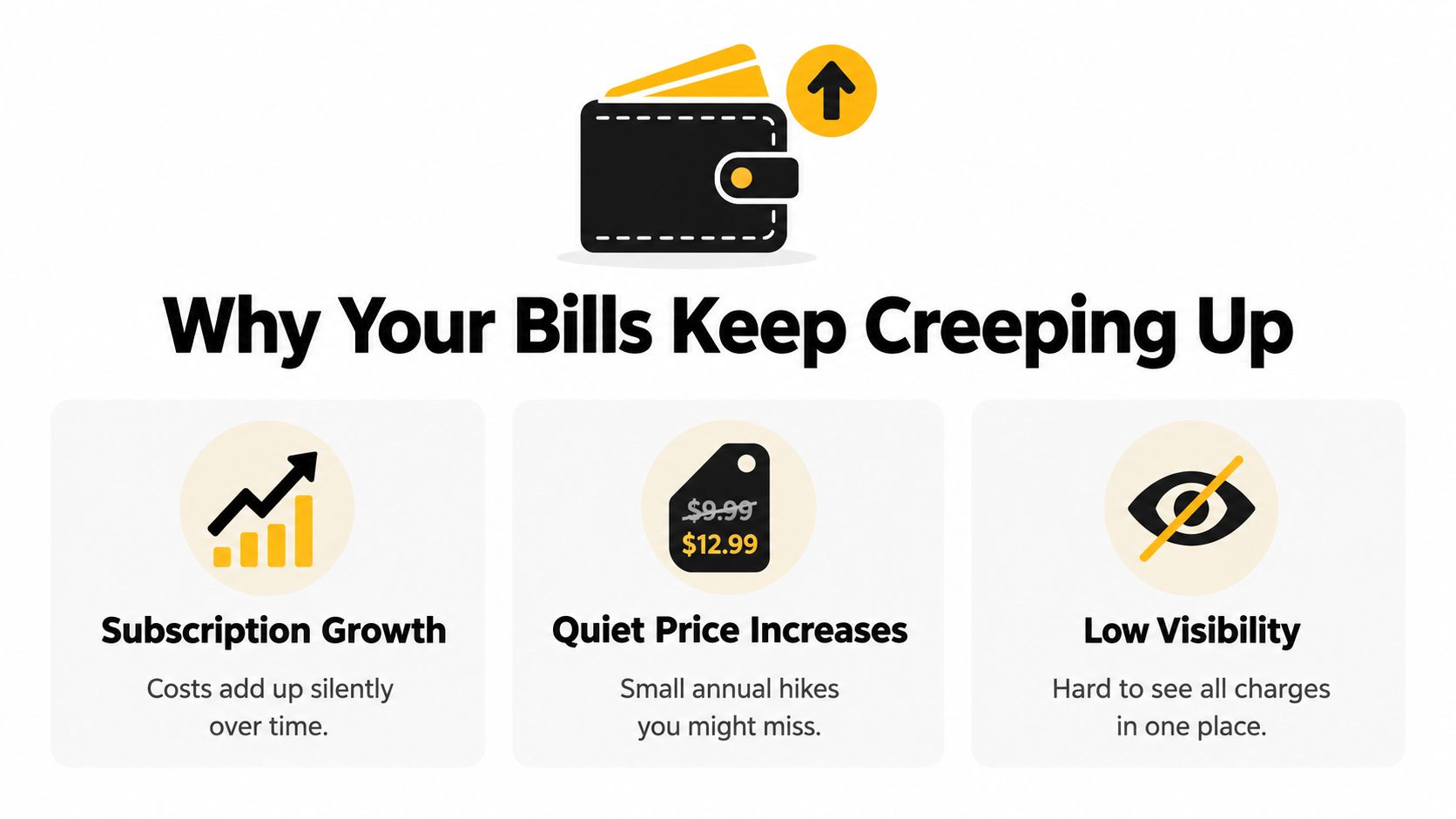
Bills rise without requiring a decision from you. A provider changes a promotional rate, a subscription adds a feature you never requested, or a free trial rolls into a paid plan while you're busy with work and family. Each change can look harmless on its own. Together, they turn a stable budget into a moving target.
The pressure is growing because recurring spending is growing. The Bank of America Institute analysis of consumer subscription spending found that U.S. subscription spending rose 7.7% year over year in July 2026, outpacing overall card spending growth by more than 1.5 percentage points for two consecutive years. Entertainment and retail subscriptions represented about 43% of subscription spending, compared with 41% in the prior two years.
The visibility problem costs more than the price increase
People don't underestimate a bill because they're careless. They underestimate it because recurring charges are scattered across bank accounts, credit cards, email receipts, app stores, and household members' accounts.
A C+R Research survey on subscription costs illustrates the problem. In the survey cited from 2022, consumers estimated that they spent $86 per month on subscriptions, while an itemized review produced an average of $219 per month, a $133 monthly gap. If that gap continued for a year, it would equal $1,596. A later CNET survey in 2026 found that U.S. adults who had subscribed within the prior year spent an average of $111 per month, including about $21 per month on subscriptions they didn't use.
The exact total matters less than the pattern. People can't cancel charges they can't see, and they can't negotiate confidently when they don't know which expenses are essential, duplicated, outdated, or increasing.
Practical rule: Don't start by asking which bill feels expensive. Start by asking which charges renew without a fresh decision.
Lowering bills requires follow-through
A lower rate only helps if the provider applies it correctly. A canceled subscription only saves money if another renewal doesn't slip through. A promised credit only counts after it appears on the next statement.
The routine in this guide is straightforward:
- Audit first. Build one complete inventory of recurring charges.
- Rank the opportunities. Separate large negotiable bills from low-use subscriptions and billing errors.
- Negotiate with a specific ask. Use retention language, competing offers, and timing to your advantage.
- Confirm the result. Check the next bill for the new rate, credit, or cancellation.
- Automate detection. Let monitoring surface price increases, duplicates, renewals, refunds, and post-purchase opportunities.
Manual reviews fail because they depend on memory. A system works because it checks the places where bill creep appears.
Find Every Recurring Charge Before You Negotiate
You can't lower a bill you haven't identified. Begin with evidence, not guesses.
Build the inventory from three places
Pull recent bank and credit card statements first. Look for charges that repeat under the same merchant, charges that appear at similar intervals, and payments whose names differ from the brand you recognize. A payment processor or parent company may hide the service behind an unfamiliar descriptor.
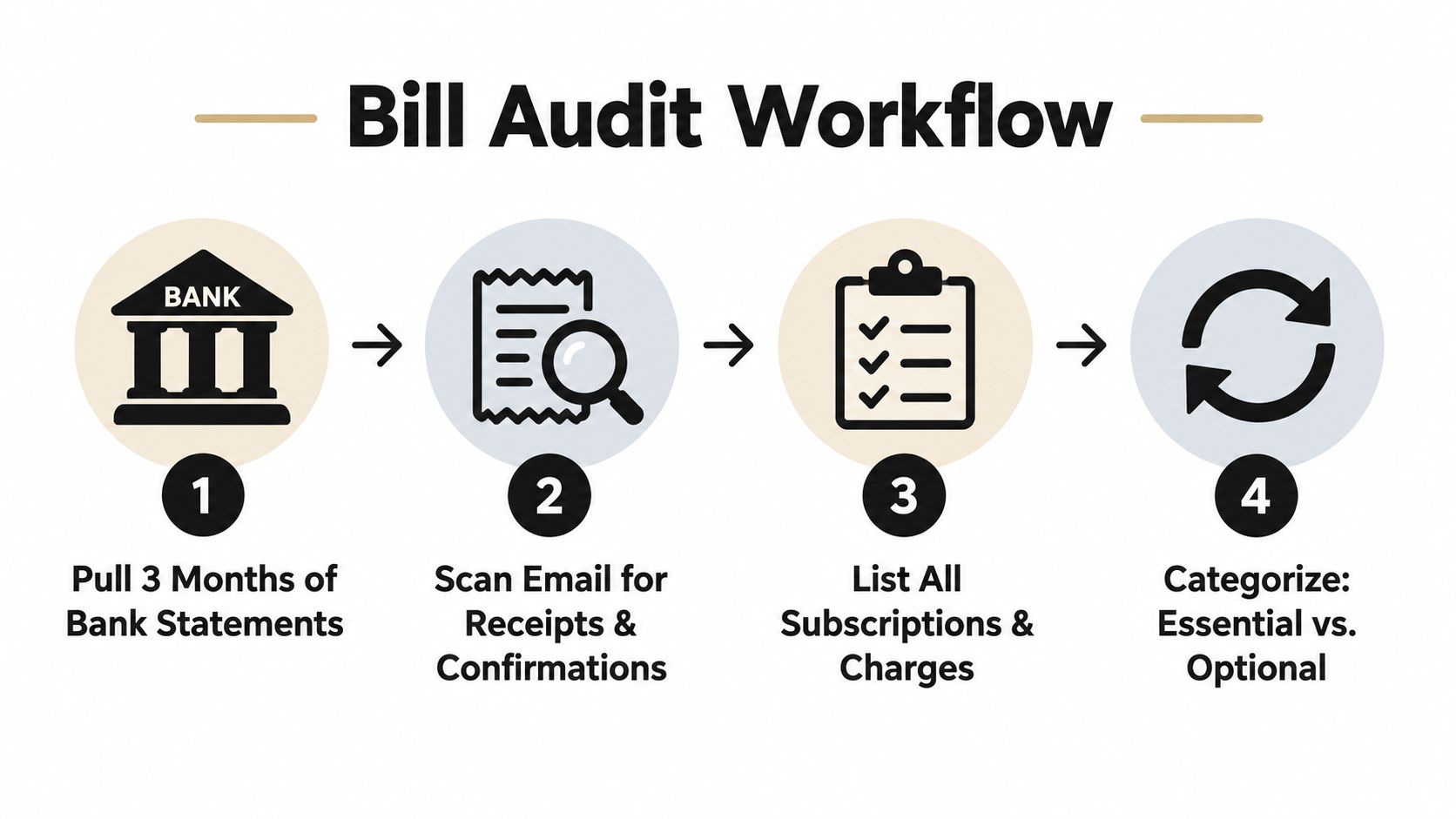
Next, search your email for receipts, renewal notices, “your payment was successful,” “trial ending,” “membership,” and “subscription.” Email often reveals the renewal date and plan tier that a bank statement doesn't show. Check app stores and household members' accounts too, especially if several people share entertainment, software, delivery, or retailer memberships.
Use this subscription-finding guide as a reference while you assemble the list.
Create one simple table with these columns:
| Merchant | Amount | Frequency | Next renewal | Payment source | User | Action |
|---|---|---|---|---|---|---|
| Service name | Current charge | Monthly, annual, or irregular | Known date or unknown | Card or account | Household member | Keep, negotiate, downgrade, cancel, investigate |
Don't worry about perfect categorization on the first pass. Capture the charge, then verify what it represents.
Flag the charges most likely to produce savings
Mark any charge that has increased since the previous statement. Then flag duplicate-looking transactions, overlapping services, unused memberships, free trials, annual plans you forgot existed, and bills with add-ons that no one uses.
Prioritize in this order:
- Large recurring bills: Phone, internet, cable, insurance, and utilities can justify a negotiation call.
- Low-use subscriptions: These usually offer the fastest cancel-or-keep decision.
- Duplicate charges: Investigate before canceling, because one transaction may be a legitimate renewal and the other may be an error.
- Upcoming renewals: Act before the payment posts, not after the money leaves.
- Quiet increases: Ask the provider to explain the change and restore a lower plan where possible.
Start with charges that are both recurring and actionable. A large bill with no available alternative may take research, while an unused service can often be stopped immediately.
For each item, write the next action in plain language. “Call provider and ask for current retention offer” is useful. “Review later” is how the charge survives another cycle.
How to Negotiate Phone Cable Internet and Utility Bills
Negotiation works best when you call with a target, a reason, and a willingness to change the service. Don't complain vaguely about the price. Tell the representative what you want them to do.

Call near the end of a promotional period, shortly before a contract expires, or after a price increase appears. Those moments give the representative a concrete reason to review your plan. Have your account number, current bill, competing offers, and acceptable fallback ready before dialing.
Use scripts that force a useful answer
For phone service:
“I'm reviewing my monthly expenses because this plan is no longer working at its current price. Please check whether you have a loyalty discount, a lower-cost plan with similar coverage, or a current retention offer.”
If the representative says there's nothing available:
“Please transfer me to the cancellations or retention team. I'm comparing the total monthly cost, not just the advertised rate, and I need to know what options are available before I decide.”
For cable or internet:
“My promotional price has ended, and the current rate is too high for the service I use. What is the lowest plan that meets my actual usage, and are there any discounts available if I keep the service?”
Ask them to remove equipment rental, premium channels, unused speed tiers, and optional protection packages separately. Providers often discuss the plan price while leaving add-ons untouched.
For utilities, distinguish between charges you can control and charges set by the rate structure. Ask the utility to explain unusual usage, estimated readings, rate schedules, and available lower-cost plans. If the bill is higher than expected, say:
“Please compare this period with the previous billing period and check whether the meter reading, billing dates, rate, and any adjustment charges are correct.”
If the first answer is no
Don't argue with the first representative. Ask for the retention department, request the plan's full terms, and compare the cost of downgrading against switching. A competing quote is useful only when it matches the same service level, equipment, taxes, and promotional expiration.
Use this decision matrix:
| Situation | Best move | What to ask |
|---|---|---|
| You need the service and another provider is cheaper | Negotiate first | “Can you match the comparable total cost?” |
| You use only basic features | Downgrade | “Which lower tier covers my actual usage?” |
| Add-ons drive the increase | Remove extras | “Which features can I remove today?” |
| The provider won't offer a workable price | Switch | “What are the cancellation terms and final bill details?” |
| The bill contains a suspicious charge | Investigate | “What service or event created this line item?” |
After the call, record the representative's name, confirmation number, effective date, new monthly amount, and any expiration date. Don't consider the negotiation finished until the next statement confirms the change.
Watch this short walkthrough before your next call for a practical negotiation framework.
Stop Paying for Subscriptions and Charges You Do Not Use
Subscription sprawl is rarely caused by one outrageous service. It comes from services that seemed useful when purchased, then became invisible after the first few renewals.
Start with usage, not guilt. Ask when you last used the service, whether another household member uses it, whether a cheaper tier covers the same need, and whether you can restart later without losing important data or benefits.
The subscription cancellation guide can help you prepare the steps before you open the provider's account page.
Make the keep decision deliberately
| Signal | Keep | Downgrade | Cancel |
|---|---|---|---|
| Usage | You use it consistently | You use only a few features | You can't remember the last use |
| Replacement | It fills a clear need | A cheaper tier would work | Another service already covers it |
| Timing | You need it before the next renewal | You need it occasionally | You can restart if needed |
| Cost clarity | The price is understood | Add-ons or tier are excessive | The charge is unexpected or unwanted |
| Household value | Several people rely on it | One person uses it | Nobody uses it |
Check for duplicate transactions before canceling. A repeated merchant name may represent two accounts, a renewal plus an add-on, or an actual billing error. Save receipts and screenshots when you cancel, then check the next statement for a final charge or credit.
Treat free trials as deadlines
A free trial is a future billing decision, not a free service you can forget. Put the renewal date on your calendar when you start the trial, and cancel early if you already know you won't continue. Email receipts and renewal notices can reveal trials that bank data shows only after conversion.
Cancellation friction also changes the economics. Research based on a cancellation survey of 1,091 respondents found that the median cancellation flow contained about 6.2 dark patterns and required roughly 6.7 clicks or taps from the homepage to cancellation, as described in the subscription cancellation customer experience study. The practical response is to act before renewal and keep the cancellation workflow short, documented, and decisive.
If the company makes cancellation difficult, avoid endless searching through account menus. Look for the official cancellation path, contact support, and request written confirmation. A subscription that requires repeated effort to stop deserves a higher bar before you ever restart it.
Automate Detection So Savings Happen Without Manual Checks
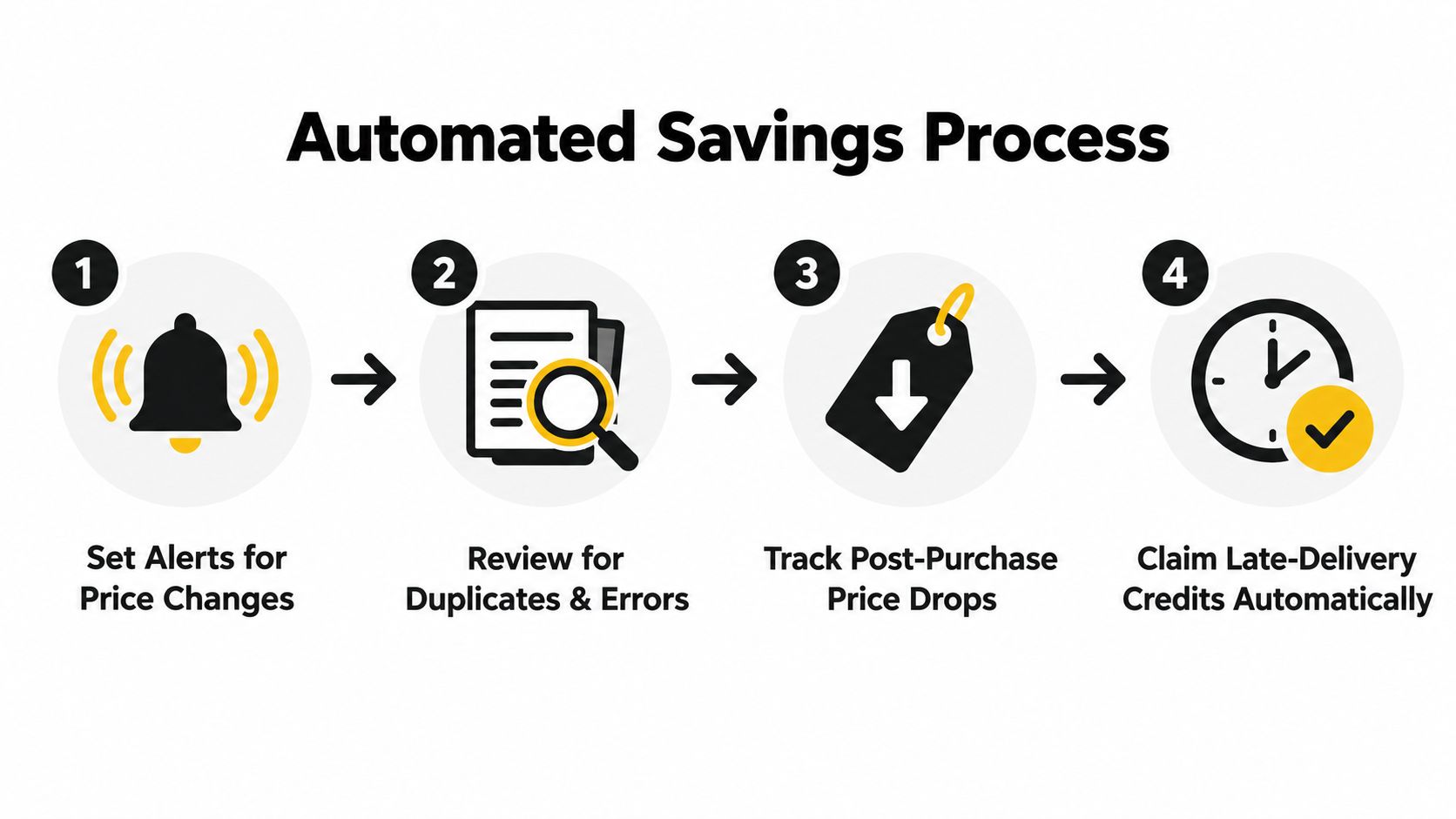
A monthly review is better than no review, but it still leaves gaps between checks. The strongest approach combines read-only transaction monitoring, receipt and renewal detection, calendar reminders, and shopping-order tracking.
Connect bank accounts through a read-only connection that can inspect balances and transactions without moving money. Use transaction analysis to identify recurring charges, duplicate transactions, and bills that increased. Keep access narrow and revoke individual connections when you no longer need them.
Email monitoring should focus on money-related messages, not your entire inbox. Receipts, renewal notices, refund confirmations, and delivery updates provide context that a transaction alone can't provide. Calendar checks add a deadline layer, especially for trials, annual renewals, return windows, and promised credits.
Turn alerts into decisions
A useful alert answers four questions:
- What changed: Identify the merchant, charge, renewal, order, or delivery issue.
- Why it matters: Explain whether the issue is a price increase, duplicate charge, unused subscription, refund, price drop, or missed guarantee.
- What to do next: Provide a concrete action, such as cancel, contact support, request an adjustment, or verify the charge.
- When to act: Show the renewal date, return deadline, or billing window.
Compass+ is one option that monitors linked financial, email, calendar, and shopping accounts to surface low-use subscriptions, increased or duplicate charges, promised refunds, post-purchase price drops, and delivery-credit opportunities. Its bank connection is read-only, and its notifications pair findings with recommended next steps.
The important design choice is context. “Your bill increased” creates work. “Your internet charge rose, the promotional period ended, and the next bill is scheduled soon. Ask for the current retention offer” gives you a decision.
For a broader workflow, use a money leak finder to organize recurring charges, duplicate transactions, rising bills, refunds, and renewals in one place.
Automation doesn't replace judgment. It removes the repetitive search so you can spend your attention on the calls and requests that recover money.
Your Lower Bill Action Plan and Next Steps
Lowering bills is a maintenance system, not a one-time victory. Make the first audit thorough, then let a short routine protect the savings.
Your first 30 days
This week:
- Pull bank and card statements and create one recurring-charge inventory.
- Scan email for receipts, renewals, trials, refunds, and delivery confirmations.
- Cancel obvious low-use services and document each cancellation.
- Call the largest negotiable bills with a specific retention or downgrade request.
- Mark every promised credit, new rate, and renewal date on your calendar.
During the next billing cycle:
- Check that canceled services stop charging.
- Confirm negotiated rates appear correctly.
- Follow up on credits and refunds that were promised.
- Investigate duplicate or unfamiliar transactions before accepting them as normal.
- Record confirmed savings separately from possible savings.
Keep the routine small
Review new recurring charges as they appear, not only at the end of the month. Revisit annual renewals before their deadlines, and use monitoring to flag bill creep, duplicates, price drops, refunds, and delivery issues between manual checks.
The best question isn't “How can I spend less?” It's “Which charge can I change, stop, dispute, or recover this week?” That question produces an action. Repeated consistently, it keeps your bills from returning to their old level.
Compass+ helps you find low-use subscriptions, rising or duplicate charges, missed refunds, post-purchase price drops, and delivery credits across connected accounts. Set up a savings workflow that tells you what changed and what to do next, then visit Compass+ to join the waitlist or explore its money-saving assistant.