How Can I Lower My Comcast Cable Bill
Learn how can I lower my Comcast cable bill with proven negotiation scripts, fee audits, and automated tools to cut costs and stop overpaying today.
12 min read
Most advice on lowering a Comcast cable bill starts with “call and ask for a discount.” That's incomplete. The biggest savings usually come from auditing the bill first, removing services and equipment you don't use, then calling the department that can change your pricing. If you negotiate without knowing which fees are inflating your total, an agent can offer a small promotional adjustment while leaving the expensive waste untouched.
The practical answer to how can I lower my Comcast cable bill is systematic: inspect every line, compare the cost of keeping cable with broadband-only service, negotiate from a credible cancellation position, and monitor the account after the call. A discount that expires is not a lasting solution.
Table of Contents
- Why Your Cable Bill Keeps Creeping Up
- Auditing Hidden Fees and Equipment Rentals
- Navigating the Retention Department
- Evaluating Broadband-Only and Streaming Alternatives
- Automating Bill Monitoring and Price Drop Alerts
- Securing Your Savings and Setting Renewal Reminders
Why Your Cable Bill Keeps Creeping Up
Loyalty doesn't guarantee a stable Comcast bill. In practice, staying with the same package while ignoring statements makes you vulnerable to annual rate increases, expired promotions, and surcharges that change independently of the advertised plan. Your service can remain exactly the same while the amount withdrawn from your bank account rises.
The broader cable market gives Comcast customers a reason to challenge increases rather than accept them. A Senate affordability snapshot found that basic cable bills more than doubled over the last ten years, and some providers imposed two price hikes in the same year. You don't need to prove that Comcast made an error. You need to recognize that the market normalizes recurring increases and that passive customers absorb them.
The FCC found the same pattern in its cable pricing report. For the year ending January 1, 2024, the average monthly price of basic cable rose 7.7% to $47.06, while expanded basic reached $108.41 and the next most popular service reached $124.54, according to the FCC annual cable price report. Those increases were $3.29, $6.04, and $6.08 respectively, and the FCC described the increases for each tier as statistically significant.
Treat the statement as a changing contract
Your Comcast bill isn't a fixed household expense. It's a changing contract with several moving parts:
- Promotional pricing: A new-customer or retention offer can expire while the package stays active.
- Programming fees: Broadcast and regional sports charges can rise without you changing channels.
- Equipment charges: Gateways, cable boxes, DVR service, and other hardware can remain on the account after your household stops using them.
- Package creep: A premium channel, faster speed tier, or additional box may no longer match your actual needs.
A customer paying near the national basic-service average could face nearly $40 more per year from a 7.7% increase alone, before equipment or broadcast-related fees, based on the FCC figures above. The lesson is simple: doing nothing is an active decision to accept every increase.
Auditing Hidden Fees and Equipment Rentals
A lower package price proves little if the bill still carries fees for hardware, sports programming, or broadcast access. Start with the statement, not the advertised offer. Download or photograph the latest Comcast bill, then mark each charge as base internet, television programming, equipment, taxes, or other fees. This breakdown shows which costs you can remove and which ones are fixed.
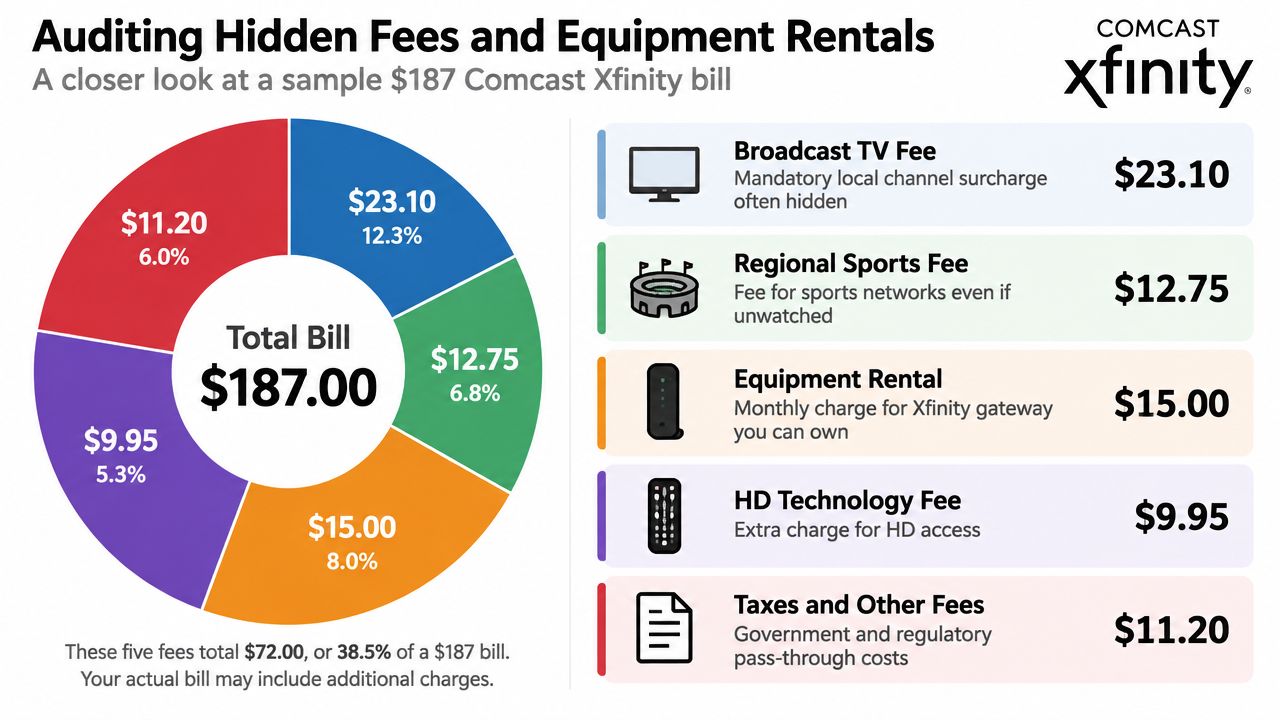
Broadcast and regional sports charges deserve immediate scrutiny. Comcast's Broadcast TV Fee and Regional Sports Fee rose from $2.50 per month in 2015 to $18.25 per month in 2019, a more than 600% increase, according to FCC documentation summarizing the fee history. Ask which television tier creates each fee, whether a lower tier removes it, and whether your viewing habits justify keeping that tier.
Use this bill audit before calling:
- Broadcast and sports fees: If you never watch regional sports, stop paying for a package that triggers the charge. Ask whether removing it also changes your channels or contract terms.
- Cable boxes: Count every box, including units in guest rooms and beside unused televisions. Return equipment that no longer serves a purpose.
- Gateway or modem rental: Ask whether compatible customer-owned equipment can replace Comcast's rental. Confirm compatibility and understand how that choice affects technical support before buying anything.
- DVR and premium features: Remove recording capacity, premium channels, and technology add-ons no one uses. Check for charges tied to old promotions or equipment upgrades.
- Taxes and regulatory charges: Separate these from negotiable fees. An agent should not describe every line as mandatory because it appears on the bill.
A downgrade can save more than a discount because it removes the fee-triggering service itself. Keep a record of the equipment you return and request confirmation that each rental charge has been removed.
Practical rule: Do not accept a lower package price until Comcast gives you the new total, including equipment, programming fees, taxes, and the promotional period.
If the audit reveals subscriptions or duplicate expenses beyond Comcast, use this guide to finding money you're owed or wasting to review them.
Navigating the Retention Department
The standard customer-service queue is designed to solve service problems. The retention or loyalty department is the place to discuss cancellation risk and promotional pricing. Route the call clearly, stay calm, and don't bluff about a competitor you haven't checked.
Start with a real alternative. Look up broadband providers, streaming options, and current offers available at your address. You don't need to invent a competing quote. You need a credible reason to leave and a clear monthly budget.
Use a direct call sequence
- Call Comcast and choose the cancellation path. When the automated system asks what you need, say “cancel service” or “disconnect service.” The purpose is to reach the team that handles customers considering departure.
- State the problem in one sentence. Say: “I need to lower my monthly bill, and I'm prepared to disconnect because the current total no longer fits my budget.”
- Ask for retention explicitly. If the representative isn't authorized to change the rate, say: “Please transfer me to the loyalty or retention department.”
- Present your comparison. Explain that you've reviewed broadband-only service, another provider, or a streaming setup and want Comcast's best offer before deciding.
- Make them price the whole account. Ask for the exact monthly total after all fees, equipment, taxes, and discounts. Don't negotiate only the advertised package rate.
A usable script sounds like this:
“I'm calling to disconnect because my Comcast bill is too high. I've compared alternatives and want to know whether retention can offer a lower total monthly price. Please review my package, remove anything I don't use, and tell me the promotion's exact duration and end date.”
If the agent offers more channels or faster internet instead of a lower total, decline politely: “I don't need additional services. What is the lowest total for the services I use?” If the offer requires a contract, ask about the commitment, cancellation consequences, and what happens when the promotion expires.
The approach has a strong consumer rationale. Consumer Reports-based summaries cited by AAA's cable-bill negotiation guidance report that 92% of people who haggled received money back or some perk, while 46% received a lower rate of up to $50 per month. Those outcomes can include a rate reduction, an extended promotional price, additional channels, or equipment savings, so judge the offer by its total value and duration.
Before ending the call, record the agent's name, the confirmation number, the new monthly total, the effective date, every removed service, and the date the promotion ends. Ask for the agreement in writing or through the account message system, then compare the next statement against your notes.
Watch this walkthrough before calling if you want a visual reminder of the retention sequence:
Evaluating Broadband-Only and Streaming Alternatives
A discount cannot fix a plan built around channels your household never watches. If your viewing is mostly on demand, dropping Comcast television and keeping broadband only is often the cleaner way to lower the bill. You remove the cable package, programming charges, and some equipment requirements, then select streaming services separately.
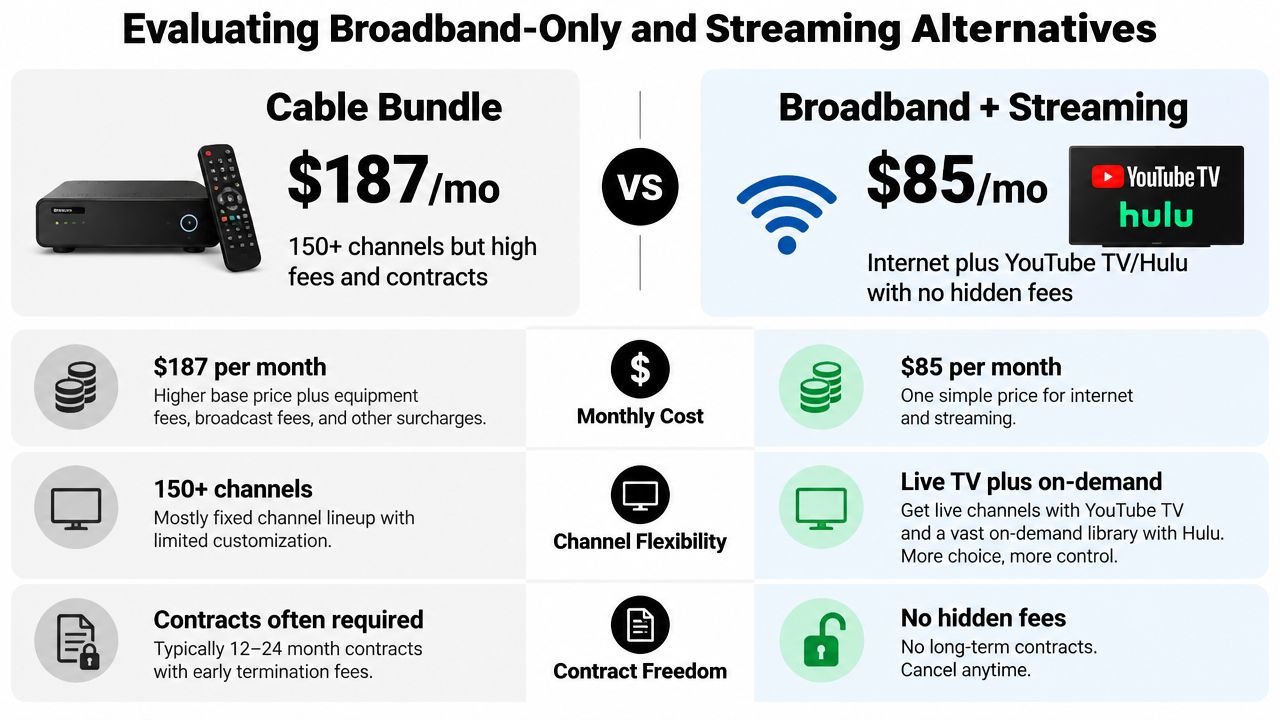
Judge the choice by household behavior, not channel count. Keep a bundle if your household regularly watches live sports, local news, or channels unavailable through a smaller service. Drop it when you pay for hundreds of channels to watch a few, or when a promotion ends and leaves the full package active.
Start with a short viewing audit. Record the specific content your household uses, then match each item to the least expensive practical option:
- Live sports: Identify the leagues or channels you watch. A targeted service may cost less than a broad sports tier.
- Local channels: Confirm how you will receive local news and broadcast programming. An antenna may work in some homes, while others need a live-TV streaming service.
- On-demand shows: List the services used each week. Remove duplicates and subscriptions that sit unused.
- Internet capacity: Select a speed tier based on household use, not an agent's upsell. More streaming does not automatically require the highest tier.
- Promotional terms: Compare the post-promotion price with the ongoing cost of streaming services and broadband.
Independent guidance on lowering a Comcast bill recommends checking whether internet-only plus one streaming service instead of a bundle fits your household, and whether you qualify for income-based programs such as Internet Essentials. Confirm eligibility directly with Comcast, then compare the total ongoing cost with your current service.
Track the recurring charges after switching. Broadband-only becomes expensive when every network adds its own subscription and nobody cancels it. Keep a list of active services, renewal dates, and the household member who uses each one. For unwanted recurring services, use this subscription cancellation guide. Recheck the list whenever a promotion ends or a new service is added.
Automating Bill Monitoring and Price Drop Alerts
A negotiated discount can vanish on the next statement. Treat Comcast billing as an ongoing audit, not a one-time phone call. Automated checks catch broadcast-fee increases, equipment-rental charges, duplicate payments, forgotten subscriptions, and expiring promotions before they become routine expenses.
Use three monitoring channels together. Bank alerts identify a higher Comcast withdrawal. Email review preserves confirmation messages, promised credits, and promotion terms. Calendar reminders give you a deadline to act before a temporary rate ends.

Make alerts lead to decisions
A useful monitoring system should flag a changed Comcast total, then identify the likely cause. Check whether a broadcast fee rose, hardware rental returned to the account, a credit disappeared, or a promotional price reached its end. Each finding needs a response, such as calling Comcast, returning equipment, changing the plan, or cancelling an unused service.
Compass+ monitors linked financial, email, calendar, and shopping accounts for recurring-charge increases, duplicate transactions, low-use subscriptions, refund opportunities, and renewal deadlines. Its financial connection is read-only, and notifications pair each finding with a suggested next step.
Set an alert for any change in the Comcast total. Then inspect the statement itself. Confirm that the equipment, channels, and fees still match what you agreed to, and record the date a discount expires. Automation should expose the change and prompt action, not create another notification you ignore.
Keep the audit focused on creeping charges. A small fee increase can remain invisible when the account is checked only after a large bill arrives. Regular background monitoring gives you time to challenge the charge while the billing record and negotiation details are still easy to verify.
A lower bill is a process, not a successful phone call.
Securing Your Savings and Setting Renewal Reminders
Treat every Comcast discount as temporary until the account documents otherwise. Independent bill-negotiation data suggests successful Comcast and Xfinity customers typically save in the low tens of dollars per month, with most savings lasting 12 months. The expiration date matters as much as the monthly reduction.
Set a calendar reminder for 11 months after the change so you have time to review the statement, compare alternatives, and contact retention before the promotional term ends. Store the confirmation number, agent name, promised total, effective date, and expiration date in the same note.
Use this quick checklist:
- Review the latest statement: Confirm that removed equipment, channels, and fees are gone.
- Verify the total: Compare the amount charged with the amount the agent quoted.
- Check the promotion: Record exactly when the reduced rate ends.
- Audit usage: Remove services your household isn't using.
- Compare alternatives: Recheck broadband-only and streaming options before renewal.
- Call before expiration: Ask retention for the next available offer, or schedule cancellation if the numbers no longer work.
Don't wait for a surprise increase to force the decision. Review the account now, remove obvious waste, and make Comcast compete for the business you're still willing to give it.
Compass+ monitors linked bank, email, calendar, and shopping accounts to identify recurring-charge increases, duplicate charges, unused subscriptions, refund opportunities, and renewal deadlines. Visit Compass+ to see how its money-saving assistant can help you catch Comcast bill creep and act before a temporary discount expires.