Free Trial Conversion Rate: Benchmarks and Growth Tactics
Discover what a good free trial conversion rate looks like in 2026. Explore SaaS benchmarks, optimize trial length, and learn tactics
14 min read
The most popular advice about a free trial conversion rate is also the least reliable: increase the percentage and assume the product is getting stronger. That conclusion ignores who entered the denominator, why they converted, and whether they stayed after the first charge.
A high rate can reflect genuine product value. It can also reflect a credit-card gate, an auto-renewal design, or users who forgot to cancel. The useful question isn't, "How many trials became paid?" It's, "How many users understood the value, chose to continue, and remained satisfied after billing began?"
Table of Contents
- Understanding Free Trial Conversion Rate and Its Formula
- Industry Benchmarks and What They Really Mean
- Key Factors That Influence Trial Conversions
- The Dark Side of High Conversion Rates
- Actionable Strategies to Improve Genuine Conversions
- Preventing Unwanted Conversions and Managing Subscription Sprawl
- Building a Sustainable Trial Strategy
Understanding Free Trial Conversion Rate and Its Formula
The basic calculation is straightforward:
Free trial conversion rate = (trial users who became paying customers ÷ total trial users in the cohort) × 100
The difficult part is defining both sides consistently. Use a cohort based on the date users started the trial, then specify the conversion window. A user who converts after the formal trial ends may still belong to the original trial cohort, but teams must apply the same rule across every period.
A clean measurement process has three steps:
- Define the starting cohort. Count users who began the trial, not every visitor or incomplete registration.
- Define conversion. Decide whether conversion means a successful first payment, an active paid account, or a payment that survives an initial cancellation or refund period.
- Match the denominator to the signup model. Keep opt-in and opt-out users separate.
An opt-in trial lets users start without payment details and requires an active decision to subscribe. An opt-out trial, often called a credit-card-required trial, begins with payment details and automatically becomes paid unless the user cancels. Both models can be legitimate, but they measure different kinds of purchase intent.
A card-free model usually creates a broader acquisition pool. Users can investigate the product with less commitment, so the denominator includes more curious or low-intent visitors. A card-required model filters that pool before the trial begins. Its conversion rate may be higher because payment intent has already influenced who enters.
Practical rule: Never compare a card-free conversion rate with a card-required conversion rate without labeling the signup model, acquisition source, trial length, and conversion window.
The metric also needs companion measures. Track activation, feature adoption, cancellations soon after conversion, refunds, support complaints, and retention by trial cohort. Otherwise, the headline percentage can reward a funnel that generates paid starts but fails to create durable customers.
Industry Benchmarks and What They Really Mean
A high free trial conversion rate can reflect signup friction rather than product-market fit. The 2026 SaaS benchmark linked by Eightx found a highly uneven distribution: one in five products converted below 2.5%, while about one-third landed between 2.5% and 7.5%. The median across products was 8%, useful as a reference point but weak as a universal target.
Signup design changes the meaning of that percentage. Credit-card-required trials converted at 30% on average, more than five times higher than card-free trials in the dataset. That gap does not establish stronger product-market fit. It indicates that the form filtered out lower-intent users before the conversion denominator was created.
A benchmark table with the denominator exposed
| Trial model | Median conversion rate | Typical use case |
|---|---|---|
| Card-free trial | Around 5-6% in the Userpilot's 2026 SaaS benchmark summary | Broad acquisition, self-serve evaluation, lower signup friction |
| Credit-card-required trial | 30% average in the Eightx 2026 benchmark (see link above) | Pre-qualified demand, opt-out billing, established purchase intent |
| All products in the benchmark set | 8% median in the Eightx 2026 benchmark (see link above) | Cross-model reference, not a like-for-like target |
The table exposes why benchmark comparisons often flatter a funnel. Removing the card requirement can lower the reported conversion percentage while increasing trial starts. That shift may represent broader reach, not weaker performance. The additional users may require stronger qualification later, but they also create a larger pool for activation and retention analysis.
Why the median can mislead
A benchmark may combine different products, price points, traffic sources, and buying processes. A complex workflow tool can require setup, team participation, and data import before users assess the outcome. A simple utility may demonstrate its value almost immediately. One target applied to both creates pressure to optimize the wrong stage.
The timing of payment also matters. Automatic renewal can raise paid-start conversion even when users have not formed durable usage habits. Some customers may overlook the charge, then cancel soon afterward. A headline rate above the median can therefore conceal weak retention, refunds, or poor first-month value.
Use external benchmarks as diagnostic ranges, not verdicts. Compare internal cohorts by signup model, acquisition source, activation behavior, and post-conversion retention. A rate below the median can support a healthy business when customers stay and expand. A higher rate is fragile when payment events create short-lived accounts.
Key Factors That Influence Trial Conversions
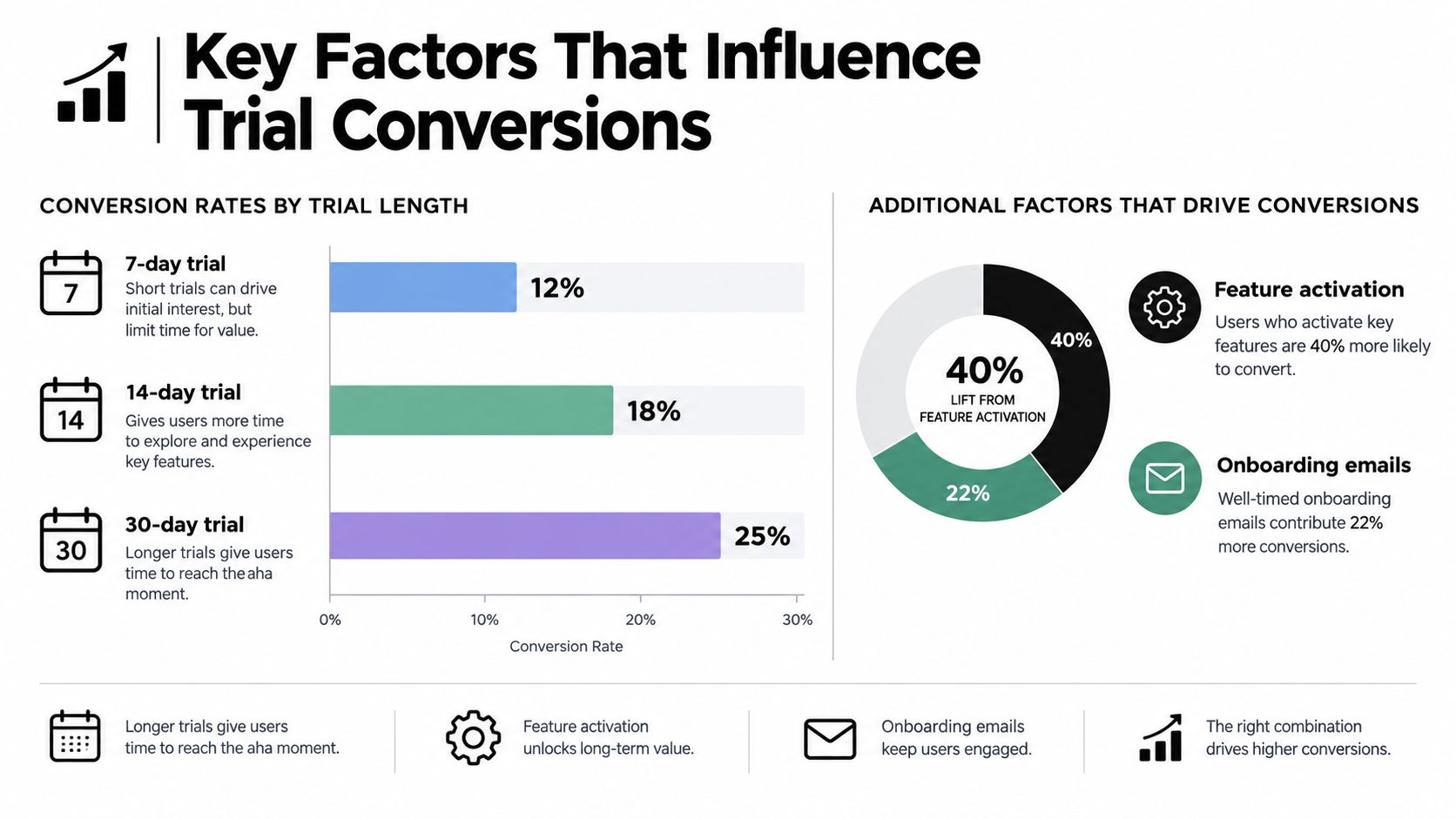
Trial conversion depends on whether users reach meaningful value before the decision point. Trial length, activation, onboarding friction, and behavioral prompts work together, so changing one in isolation can produce a misleading result.
Trial length changes the evaluation problem
RevenueCat's 2026 report, covering more than 17,000 apps, found that trials lasting 17 days or longer had a 42.5% median conversion rate, compared with 25.5% for trials lasting four days or less, as summarized by Userpilot's analysis of free trial length. The middle range doesn't erase the pattern. Trials of 5 to 9 days converted at 24.3%, only slightly above the 22.3% rate for trials of four days or less.
The implication isn't “make every trial longer.” A longer window helps only when users have valuable work to complete. If the product needs integrations, collaboration, accumulated data, or repeated use, a short deadline may expire before the user can evaluate the outcome. If the product delivers its core benefit in one session, extra time may delay commitment without adding evidence.
Activation matters more than elapsed time
A user reaches an activation milestone when the product performs the job they came to accomplish. For an analytics product, that might mean importing data and discovering a decision-relevant insight. For a collaboration tool, it might require inviting colleagues and completing a shared workflow.
Map the shortest credible route to that outcome:
- Remove setup that doesn't support the first outcome. Ask for information only when it changes the user's path.
- Show one primary next action. A crowded dashboard forces users to choose before they understand the product.
- Measure feature sequences. A feature used once may be less predictive than a sequence that shows recurring value.
- Segment by job to be done. Different roles may need different activation paths.
Use behavior to time the next prompt
Calendar-based email alone treats every trial user alike. A user who has activated a core feature needs a clear explanation of plan limits and continued access. A user who hasn't completed setup needs help removing the obstacle, not a generic upgrade reminder.
Onboarding emails should respond to behavior. Send guidance after a stalled setup step, a reminder when a user returns but hasn't completed the key workflow, and a renewal explanation before billing. The message should answer the user's next question, “What can I do with this now?” rather than repeat a sales slogan.
The Dark Side of High Conversion Rates
A high free trial conversion rate can hide a weak value proposition when the billing mechanism does more work than the product experience. Credit-card requirements, automatic renewal, unclear cancellation paths, and poorly timed disclosures can turn user inattention into reported revenue.
Recent reporting on subscription regulation and trial design found that EU pre-billing notice rules reduced opt-out trial conversion from 58% to 41.3% while also cutting refund requests by 29%, according to Amra and Elma's reporting on free trial conversion statistics. The combination matters. A lower conversion rate paired with fewer refunds suggests that some earlier conversions were sensitive to disclosure timing rather than strong product commitment.

Separate payment completion from value realization
A paid conversion is an event. Product-market fit is a continuing relationship. If users convert because they missed a cancellation deadline, the payment may improve the short-term dashboard while increasing refunds, complaints, involuntary churn, and reputational risk.
Review the cohort after billing begins:
- Early cancellation: Do new subscribers cancel immediately after the first charge?
- Refund behavior: Do users request money back because they didn't understand the renewal?
- Support language: Do tickets mention surprise billing or failed cancellation?
- Usage after conversion: Do paid users continue the behavior associated with activation?
- Retention quality: Does the account remain active beyond the first billing cycle?
These checks don't make a high rate unimportant. They tell you whether the rate represents earned demand or billing inertia.
A useful countermeasure is to compare two events separately: the moment a user becomes billable and the moment the user demonstrates continued value. A product can report both, but it shouldn't treat them as interchangeable.
For consumers trying to identify subscriptions that renew without notice, an automated review can complement statements and inbox searches. The Compass+ guide to finding money you're owed or wasting offers a relevant example of why renewal detection and recovery workflows matter outside the vendor's dashboard.
Actionable Strategies to Improve Genuine Conversions
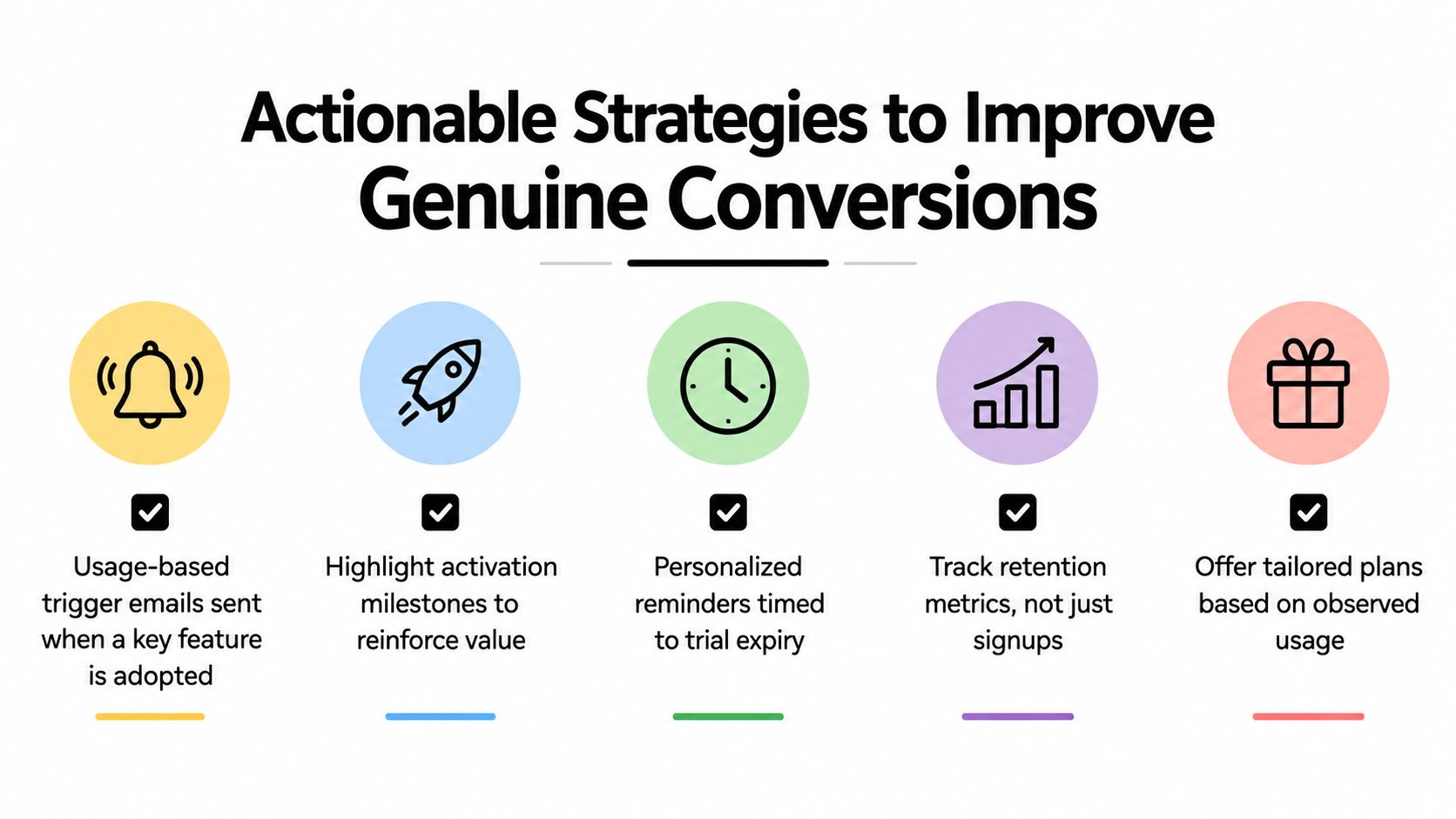
The safest conversion program increases the number of users who understand and repeatedly use the product. It doesn't rely on surprise billing or a harder cancellation process.
Start with the activation event
Define the smallest completed workflow that proves the product's usefulness. Then redesign onboarding around that event. If users need to connect a data source, import sample information so they can see the interface before doing heavy setup. If collaboration drives value, make the invitation step contextual instead of presenting it as an unrelated checklist item.
Track whether users reach activation, how long it takes, and what happens afterward. Don't assume that account creation, a login, or a page view represents value.
Build behavior-based messaging
Use the trial as a sequence of decisions, not a countdown timer.
- After activation: Explain what continued access includes and which plan limits matter.
- After inactivity: Offer one concrete path back into the workflow.
- After repeated feature use: Show the paid capability that removes the user's current constraint.
- Before expiry: State the date, price, renewal behavior, and cancellation method plainly.
- After non-conversion: Ask what blocked the decision instead of sending an untargeted discount.
Context makes the message useful. A user who has never reached the core feature shouldn't receive the same upgrade prompt as a team that has already built a working process.
Test the offer without weakening trust
Experiment with trial length, onboarding order, upgrade placement, and plan presentation. Judge each test against more than the immediate conversion percentage. Include post-conversion cancellation, refund requests, support contacts, and continued usage in the evaluation.
A practical guide to trial-to-paid conversion strategies can help teams organize these experiments around activation and payment design rather than a single vanity metric.
Use transparent prompts as a control condition. Tell users when the trial ends, what happens next, and how to stop renewal. If a transparent variant converts less but produces healthier retention, the result may represent a better business decision.
Watch the video for a product-led perspective
The following video can supplement the written framework with a practical discussion of moving users from evaluation toward paid adoption.
The strongest test is not “which version produces the most paid starts?” It is “which version creates the most retained customers per qualified trial?” That framing exposes tactics that lift billing events while damaging trust.
Preventing Unwanted Conversions and Managing Subscription Sprawl
From the user's side, a free trial is a deadline competing with work, family, travel, and dozens of other reminders. A person may sign up to evaluate a tool, receive little value, and still become a paying subscriber because the cancellation date disappeared inside an inbox.
That experience creates a direct conflict with the vendor's dashboard. The vendor may record a conversion. The customer may record an unwanted charge. Teams that ignore this distinction risk building revenue on inattention, which is unstable when consumers begin monitoring recurring expenses more closely.
What consumers need to track
A reliable trial review connects the original signup to the future billing event. Checking a bank statement alone may reveal the charge after it happens, while an email search may miss the renewal date or the payment method.
Consumers can look for:
- Renewal notices: Find emails that state when a trial becomes paid.
- Calendar deadlines: Add cancellation dates before the trial starts.
- Low-use subscriptions: Compare recurring charges with actual product use.
- Price changes: Check whether the amount differs from the original offer.
- Cancellation evidence: Keep confirmation messages and reference details.
Tools that support managing subscriptions with AccountShare can be useful for organizing cancellation tasks and reducing the effort of reviewing recurring services. For a broader audit, this guide to finding all your subscriptions describes a process that brings account activity and renewal information into one review.
Why proactive monitoring changes the relationship
The most useful alert arrives before the charge, with enough context to make a decision. It should identify the service, the renewal timing, the expected action, and whether recent usage justifies continued access.
That standard also gives SaaS companies a clearer product requirement. Transparent reminders aren't merely compliance work. They force the business to earn the renewal through value, which improves the quality of the paid cohort and makes conversion data more meaningful.
Building a Sustainable Trial Strategy
A sustainable trial strategy treats the free trial conversion rate as a diagnostic signal, not a score to maximize blindly. Start by choosing the model that matches the product and buyer. A card-free trial may widen reach, while a card-required trial may qualify intent earlier. Neither is naturally superior.
Next, align trial length with the time users need to reach a meaningful outcome. Measure activation before payment, then measure retention and refund behavior after payment. If the conversion rate rises while post-charge cancellations also rise, the funnel may be improving its billing mechanics rather than its product experience.
Finally, publish and monitor a transparent scorecard:
- trial starts by acquisition source,
- activation by user segment,
- paid conversion by signup model,
- early cancellation and refund behavior,
- retained paid usage,
- support complaints related to billing.
For consumers, tools such as the Compass+ money leak finder reflect the same shift from passive subscription management to proactive detection. The broader lesson is simple: vendors need to earn renewals, and customers need timely visibility before charges occur.
A strong trial strategy therefore balances volume, qualification, time-to-value, and trust. The best conversion is not the one that happens fastest. It's the one that follows a clear product outcome and survives informed customer choice.
Compass+ monitors linked financial, email, calendar, and shopping accounts to surface upcoming trial conversions, low-use subscriptions, duplicate charges, refunds, and other concrete savings opportunities. Visit Compass+ to join the waitlist or learn how its money-saving agent can help you act before recurring costs become unwanted charges.