How to Save 50k in a Year with a Realistic Plan
Learn how to save 50k in a year with a monthly target, budgeting, expense cuts, income boosts and automated tracking to hit $50,000 in 12 months.
20 min read

Saving $50,000 in one year is not a vibe. It's a math problem. If you save it evenly, you need about $4,167 per month or roughly $137 per day, and even at 4% APY the monthly target only drops slightly to about $4,091 because interest helps a bit over time, not magically enough to save you [monthly savings math and APY example].
That's why most advice on how to save 50k in a year misses the point. People frame it as discipline. I think that's lazy advice. For a goal this large, you need a cash-flow system and a money-recovery system. You need planned transfers, yes. But you also need to catch money already leaking out through renewals, overcharges, unused subscriptions, missed refunds, duplicate charges, and bills that crept up while you were busy living your life.
The average savings behavior won't get households there. Independent consumer research says Americans save only about 3.5% to 4.6% of disposable or personal income on average, which helps explain why $50,000 in one year is unrealistic without either a high income, very low fixed costs, or both [average savings rate context and subscription data]. So stop pretending this goal comes from “skipping coffee.” It usually comes from aggressive reallocation, income growth, and recovering money you were about to lose.
Table of Contents
- Breaking Down What Saving 50k in 12 Months Really Means
- Mapping Your Personal Path to 50k
- Cutting Recurring Costs Without Cutting Your Life Apart
- Boosting Income to Close the Gap Faster
- Making Your Money Work While You Save
- Staying on Track and Automating Your Progress
Breaking Down What Saving 50k in 12 Months Really Means
Saving $50,000 in 12 months requires about $4,167 per month or roughly $137 per day if you spread the goal evenly across the year.
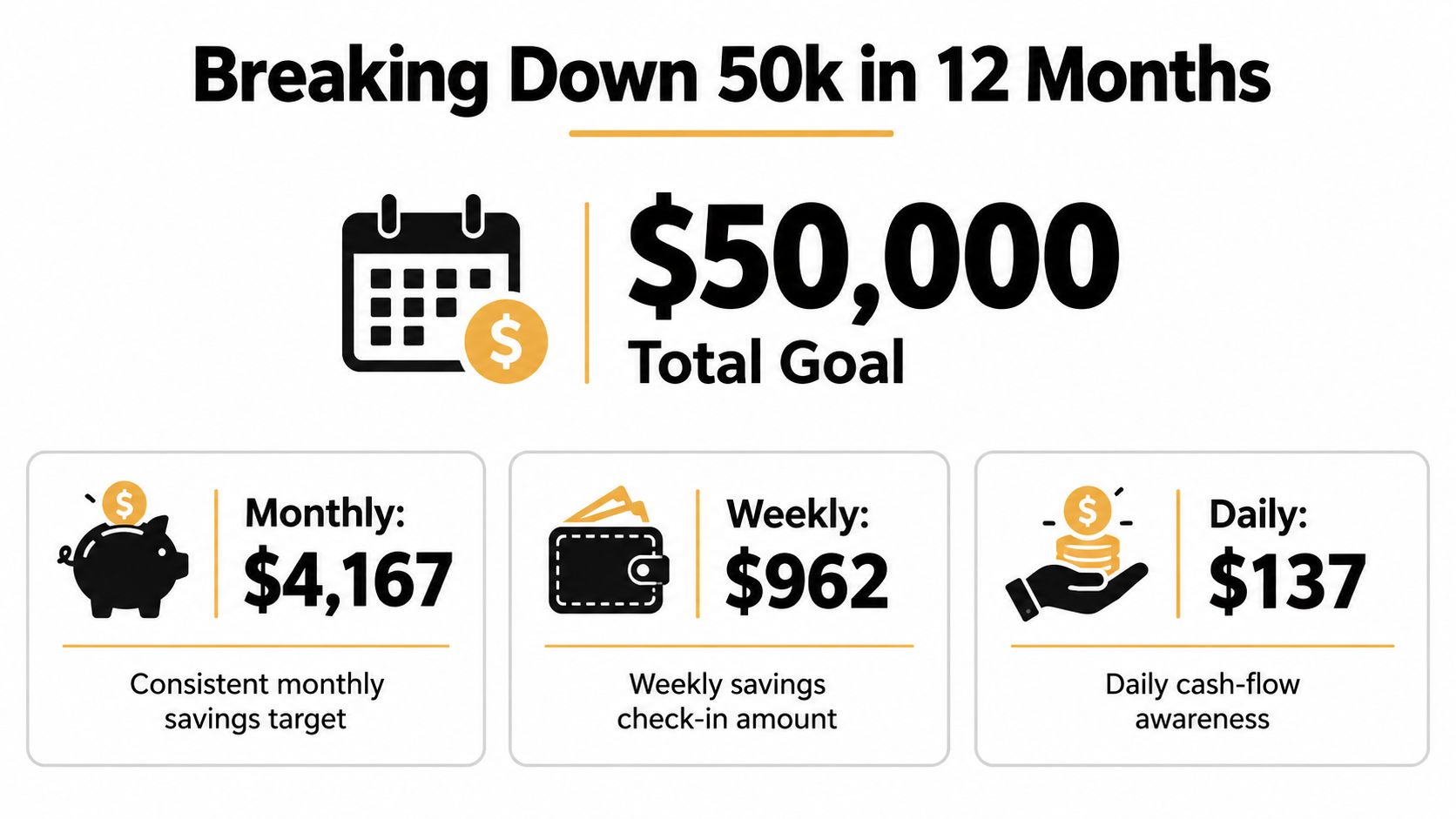
That number matters more than the headline goal. Annual targets feel dramatic. Monthly cash flow decides whether you win.
Interest will help a little over time, but not enough to rescue a weak plan, as noted earlier. A one-year push to $50,000 still comes down to how much cash you can redirect each month and how much lost money you can recover before it disappears for good.
Why standard savings advice breaks here
Generic budgeting advice usually focuses on trimming discretionary spending. That approach is too small for a goal this aggressive. If your fixed bills already absorb most of your take-home pay, the gap will not close because you brought lunch from home three extra times.
You need a system with two jobs. First, create monthly surplus. Second, recover money that should have stayed in your account in the first place.
That recovery piece is where people miss easy gains. Price-drop credits, returned purchases, HSA or FSA reimbursements, insurance premium adjustments, bank fee reversals, duplicate charges, annual-subscription cancellations before renewal, unused travel credits, and payroll corrections all count. None of that replaces saving from income. It does speed up the timeline and reduce how much fresh money you have to squeeze from each paycheck.
Practical rule: If your monthly target is far above what your current surplus can support, fix the structure first. Then chase optimization.
For this kind of goal, the structure usually comes down to three levers:
- Lower recurring obligations: Housing, car costs, insurance, telecom, and other fixed bills create bigger savings than random spending cuts.
- Raise earned income: Overtime, a higher-paying role, contract work, or selling a marketable skill can add thousands faster than frugality alone.
- Build a recovery routine: Check statements, claim refunds, contest errors, use credits before deadlines, and sweep every reclaimed dollar straight into savings.
The benchmark to watch
Watch one operating number every month: net progress toward $4,167.
Net progress is better than “amount transferred to savings” because it captures the full system. If you moved $3,200 into savings and recovered $600 from a medical reimbursement, $150 from a duplicate charge, and $100 from a canceled renewal, you did not save only $3,200. You produced $4,050 of progress. That framing is more accurate, and it shows why recovery work matters.
Use this scorecard:
| Milestone | What it means |
|---|---|
| Monthly target | The amount you need to produce this month to stay on pace |
| Base surplus | What your paycheck can fund after required bills |
| Recovery total | Money reclaimed through refunds, credits, reversals, or billing errors |
| Gap remaining | What still needs to come from cuts, extra income, or both |
Treat the $50,000 target like an operating plan. Monthly surplus funds it. Recovery boosts it. Deadlines matter. Missed credits and unclaimed refunds are not small mistakes here. They are part of the gap.
Mapping Your Personal Path to 50k
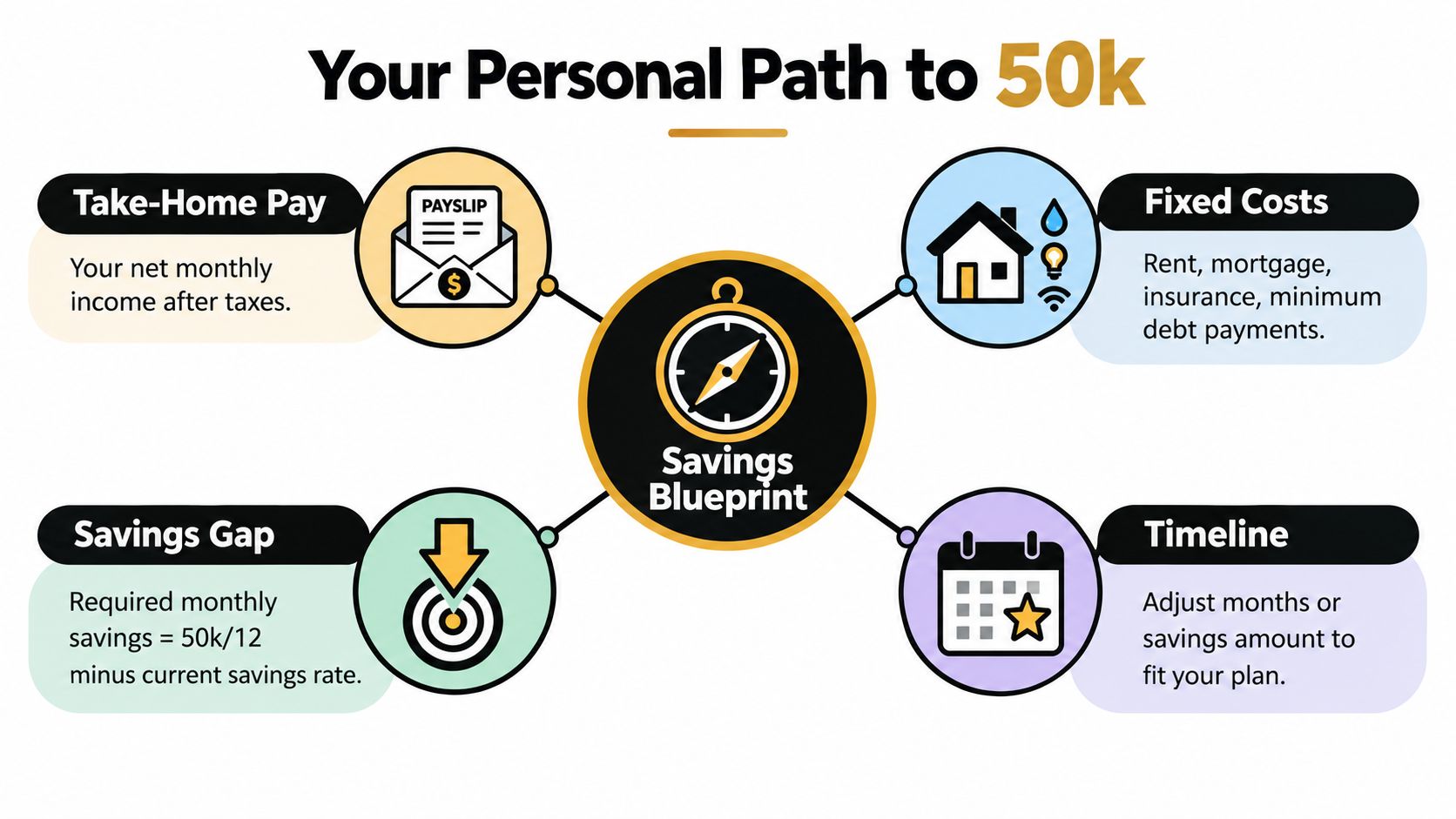
Jumping straight to “what should I cut?” is the wrong starting point. First, you need a one-page map of your actual finances.
Build the one-page plan
Start with four lines on a sheet or spreadsheet:
- Take-home pay
- Fixed costs
- Current monthly saving
- Required monthly target
That gives you the gap. Not a motivational gap. A numerical one.
If you need help pressure-testing what your current spending can support, use a spending framework like this guide on how much you can safely spend. The point isn't to admire your budget. The point is to find out whether your current setup can realistically produce a $50k result.
Separate fixed costs from flexible spending
A lot of people sabotage this step by treating every expense the same. Don't.
Fixed costs are the big commitments that don't change easily month to month. Housing, minimum debt payments, insurance, utilities, childcare, required transportation. These determine whether your plan has oxygen.
Flexible spending is where you can tighten quickly. Food out, shopping, entertainment, travel, convenience services, optional apps, add-ons, and random online purchases. This category matters, but it usually doesn't solve the whole problem by itself.
A realistic plan doesn't ask, “Can I be stricter?” It asks, “Can my current income and cost structure produce this result within 12 months?”
If the answer is no, good. Now you're being honest.
Choose how you'll close the gap
There are only three real ways to close it:
| Lever | Best use | Limitation |
|---|---|---|
| Cut expenses | Fastest first move | Can hit a ceiling quickly |
| Increase income | Best for large gaps | Takes time and energy |
| Use windfalls intentionally | Great accelerator | Irregular and unpredictable |
Here's my recommendation. Pick a primary lever and a backup lever.
If your income is already strong but your spending is sloppy, lead with cuts and recovery. If your budget is already lean, stop pretending more trimming will solve it. You need more income. If your pay fluctuates, build the plan around a conservative base and treat every irregular inflow as direct savings fuel.
Add a buffer for real life
A fake plan assumes nothing goes wrong. Real life always does. Your car needs something. A bill lands early. A family expense pops up. That doesn't mean the plan failed. It means you needed a buffer and didn't create one.
Use your monthly target as the base, then leave room in your checking account so you're not forced to raid savings every time life gets inconvenient. A plan that works only in a perfect month is a plan that won't survive a full year.
My coaching view is simple:
- Track monthly, not vaguely
- Know your fixed-cost ceiling
- Decide in advance whether cutting, earning, or both will carry the load
- Give every windfall a job before it arrives
That's how you stop guessing and start executing.
Cutting Recurring Costs Without Cutting Your Life Apart
Recurring expenses are where aggressive savings plans either get traction or stall out. A $12 charge does not look important once. It does look important when it hits 12 times, renews automatically, and sits next to three other charges you stopped noticing months ago.

The goal here is bigger than “cut spending.” Build a cash-flow recovery system. The households that save faster do not just cancel a few apps. They catch duplicate charges, request credits after service issues, pause renewals before they bill, and claim refunds and price adjustments before the deadline passes. That closes the gap faster than generic budgeting alone.
Audit recurring costs like they owe you money
Start with the last 90 days of bank and card statements. Review every repeating charge and every bill that increased without a clear reason. You are looking for money leaks you can stop and money you can recover.
Focus on these categories:
- Subscriptions and memberships: Streaming, apps, software, cloud storage, delivery programs, fitness memberships
- Phone and internet: Old plans, equipment rental fees, speed tiers you do not need, bundled extras
- Insurance: Auto, renters, homeowners, pet, umbrella, roadside coverage
- Utilities and household services: Pest control, lawn care, cleaning, security monitoring, water delivery
- Recovery opportunities: Duplicate transactions, billing errors, late fees worth reversing, credits for outages, annual renewals you can cancel before the next cycle
If you want a cleaner process, use this step-by-step guide to finding all your subscriptions. Do not trust memory. Statement data wins.
Cut, downgrade, pause, or recover
Every recurring charge should pass a hard test.
Ask:
- Did this improve my life enough last month to earn another payment?
- Would I choose this again today at the current price?
- Can I get the same result cheaper?
- Did this company make a billing mistake, miss a service standard, or raise the price without giving me better value?
Question four is where people leave money on the table.
Canceling unused services matters. Recovering money matters too. If your internet went down for a day, ask for a credit. If a hotel rate drops after booking, request the adjustment. If a retailer offers price protection, claim it before the window closes. If a merchant charged twice, dispute it now, not six months from now when the trail is cold.
The fastest savers do both. They cut future charges and pull past money back into circulation.
Here's a useful walkthrough if you want a visual reminder of how to tighten this category without overcomplicating it:
Renegotiate the big monthly bills
The actual dollar amounts usually sit here.
A canceled streaming service might save $15 a month. A cheaper insurance policy, lower phone plan, and better internet rate can free up a few hundred. That is the difference between “I'm trying to save more” and “I moved serious cash this quarter.”
Call providers and ask direct questions:
- What is the lowest plan that fits my current usage?
- Are there retention offers or unadvertised discounts?
- Can you remove equipment or add-on fees?
- Can you re-shop this policy and reprice my coverage?
- Is there a pay-in-full discount, autopay discount, or multi-policy discount I am not getting?
Consumer guidance from the CFPB on reviewing monthly bills and subscriptions supports the same habit: review recurring expenses, cut what no longer fits, and redirect the freed cash on purpose.
Put recurring-cost control on a schedule
Do not treat this as a one-time cleanup. Run it like maintenance.
- Monthly: Review subscriptions, duplicates, surprise fees, and service credits you can request
- Quarterly: Reprice insurance, phone, internet, and household service plans
- Before every renewal: Decide in advance whether to keep, pause, downgrade, or cancel
- After any large purchase: Check refund status, return deadlines, and price-drop windows
That system is what keeps savings from leaking back out. Cutting costs helps once. Ongoing monitoring protects cash flow all year.
Boosting Income to Close the Gap Faster
Some budgets are too tight for cuts to carry the whole mission. When that's true, stop over-optimizing grocery spend and go earn more.
You don't need five side hustles. You need one primary income booster and maybe one secondary option that fits your time, skills, and stress tolerance. The right choice depends on speed, predictability, and whether it can scale.
Income Boost Options Compared by Effort and Payoff
| Income Strategy | Best For | Time to First Pay | Scalability |
|---|---|---|---|
| Overtime or extra shifts | People with hourly work or shift-based jobs | Fast if your employer allows it | Limited by schedule and stamina |
| Freelancing existing skills | Writers, designers, marketers, bookkeepers, developers, consultants | Moderate. You need clients first | Strong if demand exists |
| Part-time local work | People who want predictable side income | Often fairly quick | Moderate |
| Selling unused items | Households with clutter or dormant valuables | Fast once listed and sold | Limited and one-time |
| Renting out assets | People with storage, equipment, parking, or spare space | Moderate | Moderate, depends on asset demand |
| Job change or raise push | Underpaid professionals with leverage | Slower than a quick side gig | High if successful |
Pick based on return per hour
Don't choose by trend. Choose by return on effort.
If you can earn more by working extra hours in your current field, that often beats learning an entirely new side hustle from scratch. If your primary job doesn't offer overtime or advancement, freelancing a skill you already have usually beats random gig chasing. If cash is urgent, sell unused items and cut the clutter. That won't fund the whole year, but it can create momentum and reduce friction at home.
Your extra income only counts if it bypasses lifestyle inflation and lands in savings.
That last part matters. Plenty of people increase income and still don't build savings because the money gets absorbed into nicer weekends, convenience spending, and “I earned this” purchases.
My recommendation for aggressive savers
Use this decision filter:
- Fastest cash now: Overtime, extra shifts, local part-time work, selling items.
- Best medium-term upside: Freelancing your current skill set or switching to better-paid work.
- Lowest operational complexity: Extra work through your existing employer.
- Best if your schedule is fragmented: Contract work you can do in blocks, not jobs requiring fixed shifts.
Then set one rule. Every dollar from the chosen income stream gets routed automatically to the savings goal. Don't mix it into your regular checking account and hope discipline saves you later. It usually won't.
When people ask me how to save 50k in a year, I tell them the uncomfortable truth. If the gap is large, income is not optional. It's the lever that turns an aggressive target from fantasy into a live plan.
Making Your Money Work While You Save
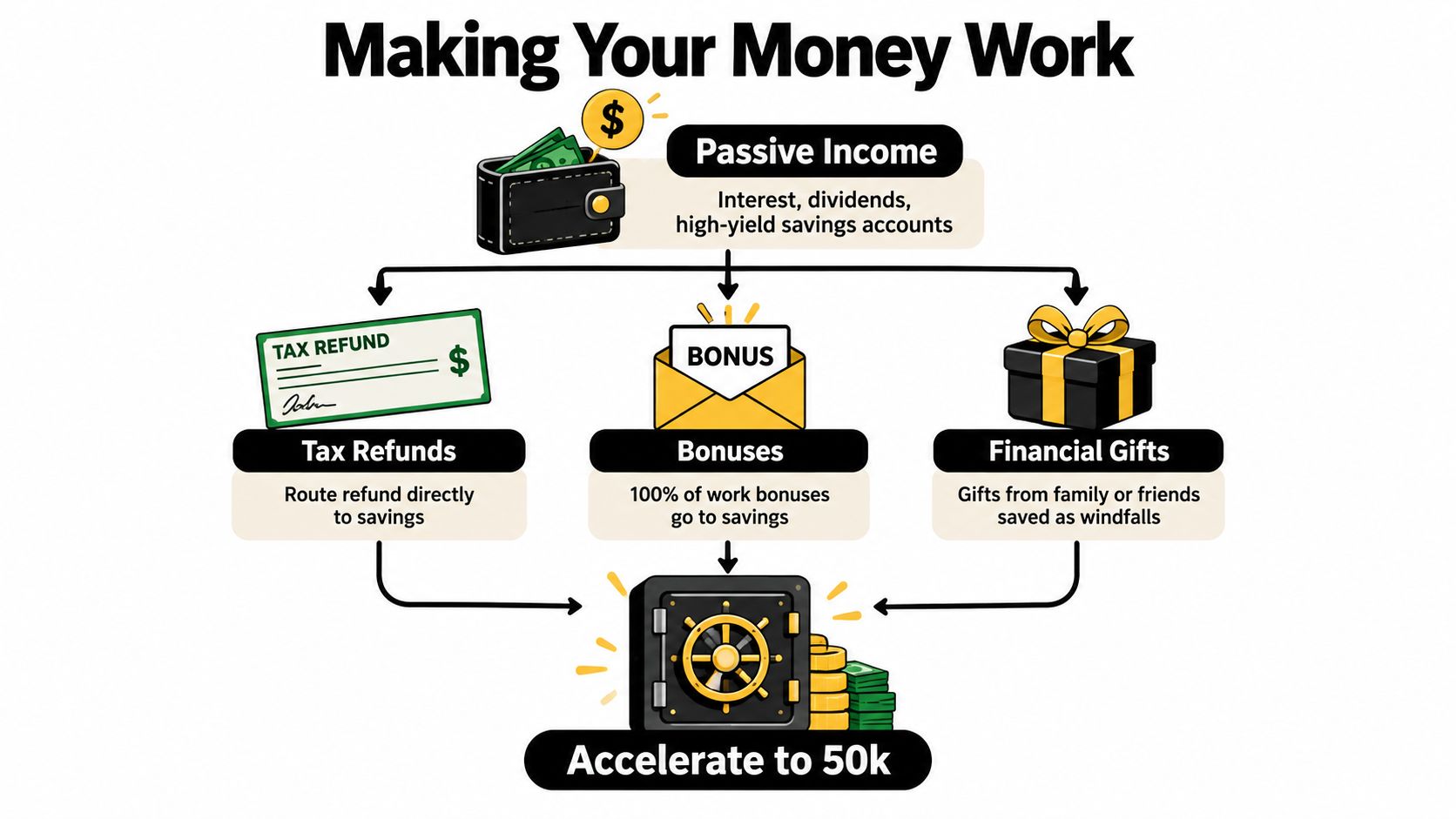
A $50,000 goal rarely gets finished through paycheck transfers alone. The people who hit aggressive targets faster usually do two things well. They park cash intelligently, and they recover money that would otherwise slip away through refunds, price drops, duplicate charges, bill credits, and missed deadlines.
Treat windfalls and recoveries like scheduled deposits
Tax refunds, bonuses, rebates, returned purchases, insurance reimbursements, and account credits should have a job before they arrive. If they hit checking first, they usually disappear into routine spending.
Set one rule. Any irregular inflow goes straight to the savings system the same day it lands.
That rule should include money you recover, not just money you earn. If a retailer drops the price after you buy, request the adjustment. If a biller posts a duplicate charge, reverse it. If a subscription renewed after you meant to cancel, ask for the credit while the window is still open. That is not small change behavior. It is cash-flow management, and it closes the gap faster than generic budgeting because you are reclaiming dollars that were already yours.
If you want a place to sort those buckets and decisions, the Compass+ savings resources give you a practical way to organize short-term cash, reserve money, and goal-based savings.
Split the money by job
Do not dump the full 50k into one account out of habit. Account placement matters because some of this cash needs instant access, and some can sit still for a few months and earn more.
Raisin notes that short-term savers often use a mix of high-yield savings, CDs, and Treasury bills instead of leaving everything in a standard savings account (Raisin account placement guide). Fidelity's cash management guidance makes the same basic point. Keep near-term money liquid, and use slightly less liquid options for cash you will not need immediately (Fidelity cash options overview).
Use a simple structure:
| Money bucket | Best use |
|---|---|
| Immediate-access cash | Refunds in process, upcoming transfers, or money you may need within weeks |
| Near-term reserve | Savings you want stable and available without market risk |
| Later-year tranches | Cash you do not expect to touch for a few months, parked in CDs or short-term Treasuries |
This is a recovery system as much as a savings plan. Recovered dollars need a landing spot fast. If they sit in checking, they get spent. If they move straight into the right bucket, they start working the same day.
Keep the goal safe while it earns something
A one-year savings target is not the place for stock market risk. Money with a near-term job belongs in stable vehicles. Yield matters, but access matters more.
Use tax-aware moves where they clearly improve cash flow. Adjust withholding if your refund is consistently large and you need more monthly room. Use workplace accounts or pre-tax options if they fit your broader plan and do not trap money you need for this goal. The standard is simple. Choose moves that increase usable cash, protect the timeline, and avoid turning a one-year savings target into an investment bet.
Staying on Track and Automating Your Progress
A hard savings target falls apart when tracking depends on memory. You need automation, check-ins, and a process for when you slip.
Run a monthly checkpoint
Once a month, review four things:
- Did you hit the monthly savings target?
- Which recurring costs changed?
- What recoverable money showed up?
- What deadlines are coming next?
That review should take minutes, not half a day. If you're behind, don't panic and don't wait. Decide immediately whether the catch-up will come from a temporary spending clampdown, extra income, or a windfall that hasn't been allocated yet.
Watch for deadline-based money
This is the most ignored piece of the whole puzzle. Savings opportunities often expire.
Refund windows close. Return periods end. Free trials convert. Merchants issue credits only if you ask in time. Delivery guarantees pass. Bills renew before you remember to question them.
People don't only lose money by overspending. They lose it by missing the moment to claim what they were already owed.
That's why I prefer a monitoring mindset over a pure budgeting mindset. Budgeting tells you what should happen. Monitoring shows you what happened and whether you need to act.
Automate the leak detection
A proactive system can watch for:
- Duplicate charges
- Bill increases
- Low-use subscriptions
- Refunds that were promised but never landed
- Post-purchase price drops
- Late-delivery credits
- Renewal and return deadlines
That's where a tool can do work your willpower won't. For example, Compass+ monitors linked financial, email, calendar, and shopping accounts to surface specific savings or recovery opportunities such as refunds owed, duplicate or increased charges, low-use subscriptions, post-purchase price drops, and deadline-sensitive credits, then shows a concrete next step and estimated amount. That's useful because it replaces manual inbox digging and statement reviews with ongoing detection.
Keep the plan alive when you miss a month
You probably won't execute a perfect year. Almost nobody does. The people who still win are the ones who correct fast.
Use this recovery sequence:
| If this happens | Do this next |
|---|---|
| You miss the monthly target | Increase the next month's transfer and add one income action immediately |
| A bill jumps | Review the plan, negotiate, or switch providers before the next cycle |
| A renewal sneaks through | Cancel same day and check whether a refund or prorated credit exists |
| Savings gets raided for an emergency | Rebuild with the next windfall or temporary spending freeze |
The biggest mistake is turning one miss into a story about failure. It's not failure. It's a signal. Adjust quickly and keep moving.
If you want to know how to save 50k in a year, this is the answer I'd give any client. Build the monthly target. Cut recurring waste. Increase income where the gap demands it. Route windfalls with intent. Then automate detection for the money leaks and credits most never notice.
Compass+ helps you do the part most savings plans ignore. It monitors connected accounts for refunds owed, duplicate or increased charges, low-use subscriptions, price drops, and deadline-based credits so you can recover money that would otherwise slip by. If you want a savings plan that acts more like a system than a spreadsheet, visit Compass+.